
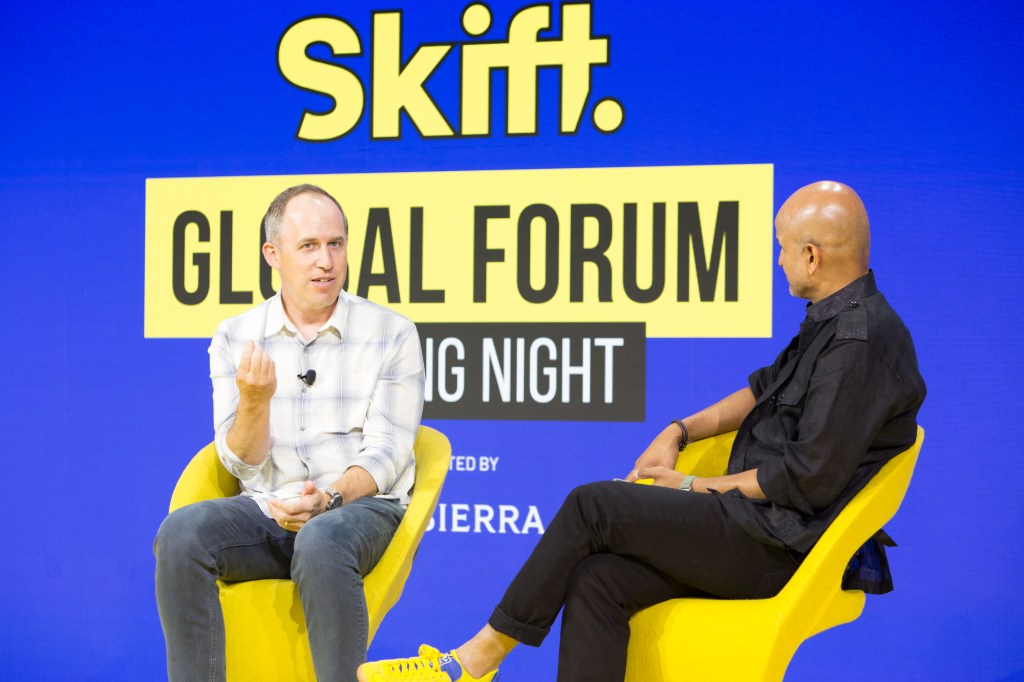
This sponsored content was created in collaboration with a Skift partner. For years, travel companies have invested heavily in digitizing individual parts of the customer journey. Travelers can search for flights online, check into hotels through an app, message customer service, manage loyalty accounts, and make changes without picking up the phone. Bret Taylor, co-founder and CEO of Sierra and chairman of OpenAI, thinks the next shift will be less about improving those individual touchpoints and more about connecting them. At Skift Global Forum in New York, Taylor first joined Skift founder and CEO Rafat Ali and Uber CEO Dara Khosrowshahi onstage to discuss how Uber is using Sierra’s AI agents across parts of its marketplace. He then stayed for a one-on-one conversation with Ali about Sierra’s broader view of where AI agents are headed in travel and customer experience. Sierra helps businesses create better customer experiences and stronger business outcomes with AI, from booking and onboarding to service, upgrades, and loyalty. Taylor describes the company’s central idea simply: “Your new digital front door is an agent.” For travel companies, that could mean rethinking customer experience from the ground up. Travel's Agentic Horizon: Who Talks to the Traveler Now? Connecting the Entire Customer Journey Taylor argues that the opportunity for AI agents extends well beyond customer service. Booking, onboarding, sales, and service may reside in different internal departments, but customers experience them as parts of the same relationship. A hotel guest, for example, moves through booking, pre-arrival, the stay itself, and post-stay engagement. Each stage can include questions, service needs, upgrades, recommendations, or other interactions. Taylor calls these “long horizon engagements.” “The difference between marketing and service is just who initiates the conversation,” he said. Over time, he expects a company’s agent to maintain a continuous relationship even as the traveler moves between different stages of the journey. That matters in travel because the industry has historically divided the traveler journey across systems and business functions. The team responsible for booking may have little connection to the team handling a service issue after departure. Travelers rarely care who owns which system. Taylor frequently encounters that divide within airlines, hotels, and marketplace companies. His argument is that an AI agent can create a unified layer across those systems so the traveler does not have to understand how the company is organized. Getting passed from one department to another, he said, “should never happen in the world of AI.” “You always have to start with the customer journey first,” Taylor said. Moving Beyond the Chat Window The interface itself is also changing. Taylor is a strong believer in multimodal experiences that combine voice, text, images, and other forms of interaction. Travel is particularly well-suited to that approach because so many decisions require both conversation and visual information. Booking a flight may require looking at a seat map. Choosing a resort room may depend on seeing the room itself. A traveler might prefer to explain what they want verbally while viewing options on a screen. Taylor said voice has become dramatically more useful as large language models have improved, but he does not see voice replacing other interfaces. Instead, the experience can move fluidly between them. “You should be able to speak to it and get visuals out. You should be able to type into it and get audio out,” he said. Sierra is working with a major U.S. airline on an experience Taylor said will apply that approach directly to booking. The broader point is that the agent does not have to behave like a traditional chatbot sitting in the corner of a website. It can become part of the booking and shopping experience itself. Solving Problems Instead of Adding Friction Taylor also draws a sharp distinction between AI that removes friction and automation that merely puts another barrier between a customer and what they want. Consumers, he said, quickly recognize the difference. An AI agent can function almost like a concierge, but if it simply prevents someone from reaching an answer, it becomes another obstacle. That distinction is important given the history of automated customer service. Interactive voice response systems were often designed around routing calls and controlling costs. Taylor believes AI agents can instead be judged on whether they actually resolve the customer’s problem. Agents can operate around the clock, communicate in multiple languages, access information across systems, and reason through situations that might not fit neatly into a predetermined workflow. Khosrowshahi offered an example from Uber’s work with Sierra. Becoming a driver or courier involves multiple steps, including documentation and background checks, and prospective earners can drop out along the way. Uber is using agents to reconnect with some of those people, identify what prevented them from completing the process, and help them move forward. Khosrowshahi said the approach is more affordable and produces better outcomes. For Taylor, that illustrates a shift in how companies should approach automation. From Rules to Goals and Guardrails Traditional operations are built around procedures: If a customer does X, take action Y. Those systems create consistency, but they can struggle when circumstances fall outside the expected flow. Taylor believes increasingly capable AI models make another approach possible. Sierra describes it as moving from “rules or standard operating procedures to goals and guardrails.” Companies still define policies and boundaries. But inside those boundaries, the agent can reason about the situation and determine how best to accomplish the goal. “The opportunity of agents is being creative and problem-solving,” Taylor said. In travel, where disruptions and exceptions are routine, that flexibility could be particularly valuable. A rigid workflow might know what to do when a flight is canceled under a specific set of circumstances. An agent operating against broader goals could weigh factors such as a traveler’s status, itinerary, available alternatives, company policies, and other relevant context before determining what action to take. Khosrowshahi said Uber has reached a similar conclusion. The company initially tried to get AI agents to replicate the work performed by human agents. Over time, it found greater value in redesigning processes from first principles, based on what the technology could actually do. That shift may ultimately be one of the biggest implications of agentic AI for travel companies. Deploying AI does not necessarily mean automating an existing process step by step. It may mean reconsidering why that process exists in the first place. Building Around the Traveler Taylor is bullish on AI’s capabilities, but he is also cautious about assuming adoption will occur everywhere at the same pace. Intelligence, he argued, is only one constraint inside a much larger economic system. Companies still operate within physical infrastructure, regulations, legacy technology, organizational structures, and established ways of working. Making one part of a process radically more efficient does not automatically transform everything around it. “I think there will be much slower adoption of AI than we all think,” Taylor said. That may be especially relevant to travel, where digital interactions constantly collide with the physical world. Flights are delayed. Rooms become unavailable. Drivers get stuck in traffic. Travelers change their minds. Sierra’s bet is that AI agents can help connect those moments into a more continuous relationship. The technology may be sophisticated, but Taylor’s argument for how companies should deploy it is relatively straightforward: Start with the traveler, give the agent the context and flexibility to solve meaningful problems, and organize the experience around the customer journey rather than the systems and departments sitting behind it. If that vision takes hold, the next generation of travel interfaces may feel less like navigating a company’s organization and more like continuing a conversation. To learn how Sierra helps travel and hospitality companies increase bookings and loyalty with AI agents, click here. This sponsored content was created collaboratively by Sierra and Skift Studio.
Why AI Agents Could Become Travel’s New Digital Front Door: Watch Video
Full Article
Original Source
Read the full article at Skift →KhanList aggregates and links to publicly available news content. We do not host full articles from third-party sources. Always verify important information with original sources.