
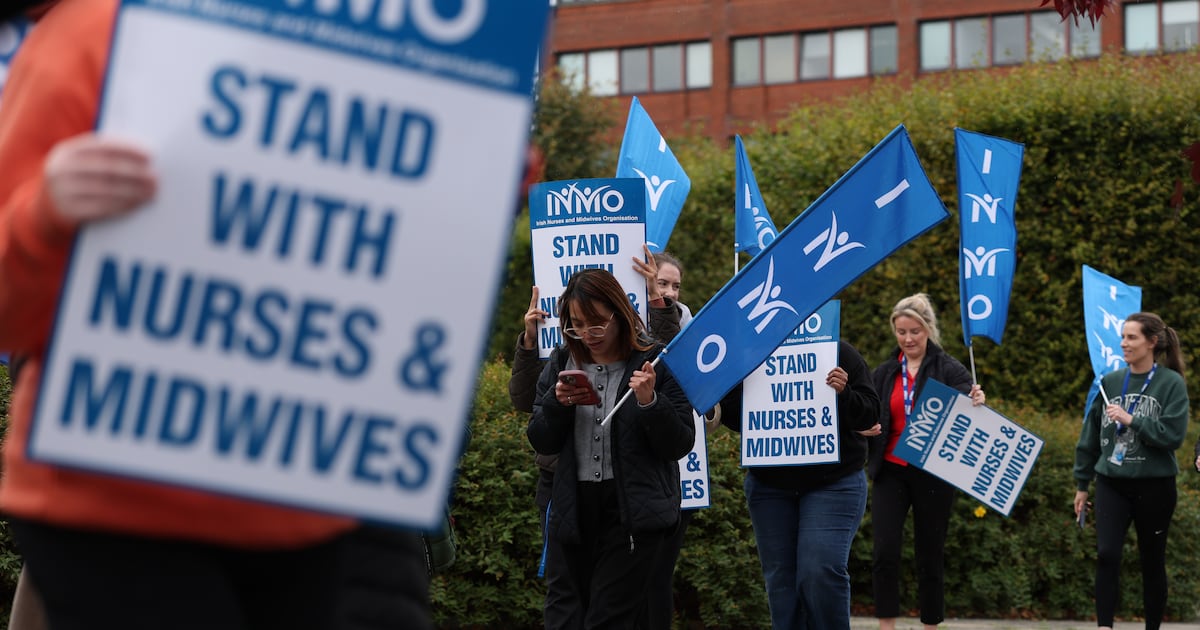
A remarkable era of industrial peace seems to be at an end. Within days, almost every school in the State may be shut as a result of industrial action, while thousands of patients could find their appointments cancelled and disrupted.Hundreds of thousands of public sector workers are still without a new pay deal and there appears little sign of a rapprochement between the unions and the Government. Even through the very worst years of austerity that followed the economic crash, major days of industrial action were largely avoided through dialogue. READ MOREThe Croke Park deal, for example, was struck in the summer of 2010 after two punishing budgets and just in advance of the international bailout. Unions agreed to efficiencies in return for the protection of jobs. Further deals followed. Each ensured that major strikes were avoided.Years on, the situation has changed. On Wednesday, public sector workers are due to strike. The industrial action began at the end of last month as more than 100,000 public sector workers began a work-to-rule in a dispute over pay. The escalation of the dispute and the closure of schools, due to the actions of striking teachers and support staff, will on Wednesday present many working parents with a difficult choice. [ Budget 2027 falls short of preventing public sector industrial action, say unionsOpens in new window ]Members of the Irish National Teachers’ Organisation and the Association of Secondary Teachers Ireland are expected to picket at their school gates.With schools doubling as childcare for many families during the day, the prospect of having to take time off work arises. One Family, a charity that supports single parents, says the planned work stoppages on October 14th and 21st will present a big challenge to many of the families they assist.“Unexpected school closures will affect all working parents, but even more so for people parenting alone who do not have backup and are already struggling with school drop-offs and trying to find after-school care,” says the charity’s chief executive Karen Kiernan. “We know of some parents who are having to use precious annual leave, or make themselves unavailable for shifts meaning their incomes will be lower at an expensive time of year.”Health workers are also due to join the industrial action on Wednesday. Thousands belonging to Siptu, Fórsa and the Irish Nurses and Midwives Organisation are taking part. So too is the Irish Medical Organisation.[ Public sector pay dispute ‘unwarranted given our willingness to talk’, Taoiseach saysOpens in new window ]Charities working with older people are concerned by the potential effect on health services, but are reluctant to comment on the standoff between the unions and the Government. They point out that the elderly should not be too concerned about the impact on the emergency services, but that there will be a significant amount of disruption to elective procedures, clinics and appointments.“Previously, ambulance and emergency services have largely been unaffected by strike action,” says one person in the sector. “The last thing the unions will not want is to have a situation where someone suffers a health catastrophe due to industrial action.”The strike action has moved into new areas. For the first time ever, dentists working in the Health Service Executive belonging to the Irish Dental Association will be taking part in such action.The standoff is framed around the rising cost of living. The unions maintain that their members’ wages have not kept pace with inflation and accuse the Government of putting preconditions in the way of constructive negotiations.Jack Chambers outside Leinster House after the announcement of Budget 2027. Photograph: Clodagh Kilcoyne/PA Wire Minister for Public Expenditure Jack Chambers has said a deal could have been struck by now that would have replaced the last public service agreement that expired in June. He said unions walked away from talks after two meetings. However, he has said there must be discussion about “reform of our public services and value for money”. On Tuesday, as part of the budget’s publication, he announced that there was €1.2 billion being set aside for a new deal. The figure has been dismissed by the unions as being far from enough.Paul Sweeney was the main number cruncher for the unions during the golden years of social partnership. As economic adviser and chief economist to the Irish Congress of Trade Unions, he would frequently present the unions’ case in public.They won’t be looking for an insane amount of money— Paul Sweeney“A deal is absolutely doable,” he says.“The worry when I was there was always about a wages-prices [inflation] spiral. In the old days the prices were leading the way and the wages were catching up – much like it is now.“Just because the country is awash with money doesn’t mean the unions aren’t cognisant that a huge pay deal would just boost inflation. They won’t be looking for an insane amount of money.”Sweeney believes there is a lack of overall direction from the current Coalition Government and the tabling of the €1.2 billion figure before negotiations had begun to have been “naive”.“It seems to me the whole country has broken down,” he says. “It’s awash with money and nobody is happy.“This is a government that has no direction whatsoever and that disappoints me. I have a lot of respect for Micheál Martin – he is a Fianna Fáiler and they know how to negotiate.“He brought in the smoking ban with the help of the unions – what’s wrong with them now? Where is the direction?”There is similar dismay from the other side of the old partnership. Turlough O’Sullivan was director general of the employers’ group Ibec, a powerful lobby group for businesses, during the 2000s.“It is awful that a partnership of some kind is not in effect,” he says. “It just strikes me that what is happening is putting the cart before the horse. “It was unheard of, when I was operating in the field, that unions would be talking about industrial action before exhausting negotiations. Something is basically wrong in the set-up.”You would hope sense would prevail— Turlough O'SullivanO’Sullivan says it appears the two sides are now on a “collision course”, but there are plenty of people around with the ability to find some sort of resolution.“There are still some very experienced people around in the unions and you’d be looking at them to do the right thing,” he says. “They have been around this mulberry bush before and I’m surprised at them. You would hope sense would prevail.”Standing between the unions and Government in the past was the likes of Kieran Mulvey, the former head of the Labour Relations Commission. He was regarded as the go-to industrial strife troubleshooter – and was centrally involved in striking the Croke Park deal of 2010 and the implementation of the Haddington Road agreement, the 2013 deal between the government and the unions that achieved pay and pensions savings to the public purse of €1 billion.“I’m surprised that we are at the level of a war-of-words on this,” says Mulvey, who believes the “arithmetic” on a deal shouldn’t be difficult.“I would have expected that very discreet tick-tacking would have gone on between the Ministers’ departments and Ictu [Irish Congress of Trade Unions]. They have a good history of resolving these issues over the years.“I’m a bit surprised that this tick-tacking, if it has taken place, hasn’t led to a more fruitful outcome at this stage.”[ Are the unions right? Did the Government’s budget abandon workers? If they lost, who won?Opens in new window ]Mulvey says he has detected that the Government has “moved away” from the social partnership model over recent years and this has manifested itself in the last two budgets.“I would be concerned that there would be any drift on this,” he says. “Stability is very important to the economic outlook of the country. We also have the European presidency. Strikes are not normal in this country and it is not necessarily the message we want to be giving to the world.” Members of the Irish Nurses and Midwives Organisation at St Vincent’s Hospital on October 8th, 2026. Photography: Clodagh Kilcoyne: The Irish Times He also worries that strike action could be seized upon by fuel protesters, who last April managed to exert the sort of impact trade unions had been unable to achieve “since the 1960s”.“At the time of fuel protests, the congress was very audible and forthright that it undermined those who took the representative route to negotiation,” says Mulvey. “Suddenly out of the blue comes this unrepresentative body that was not on the landscape and brings the country to a standstill.”Mulvey is still hopeful that some coming together is possible, but that urgent steps will need to be taken by the end of next week at the latest.“If the one-day strike goes ahead, it cannot be allowed to escalate. What we don’t want is other groups using the opportunity to add further fuel to the fire,” he says.“In some ways, unions may have needed to ventilate the anger of members. The work to rule has a nuisance value – it is the one-day strike that makes the difference. “Some intervention has to take place.”
Who is affected by next week’s strike and can it be averted in a last-minute deal?
Full Article
Original Source
Read the full article at Irishtimes →KhanList aggregates and links to publicly available news content. We do not host full articles from third-party sources. Always verify important information with original sources.