
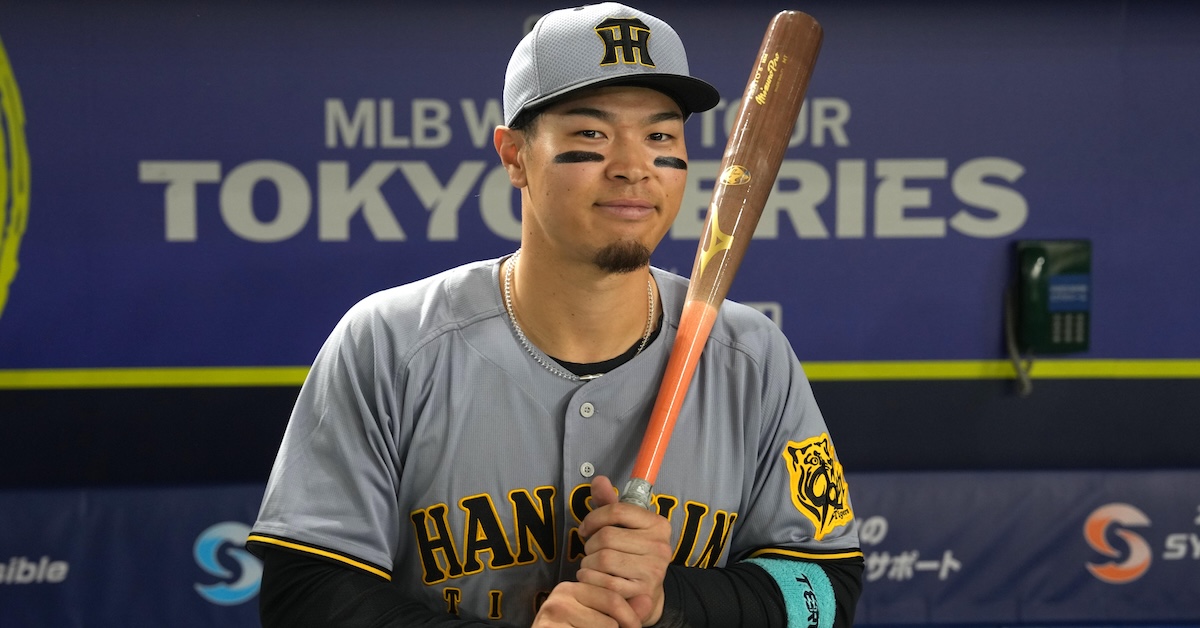
Darren Yamashita-Imagn Images The Cubs made sure to let everyone know they weren’t in on Tarik Skubal. I thought that was a strange move at the time (announcing that they weren’t pursuing him, not the decision itself). But as it turns out, they might not even have had time to be in on Skubal, because they were working the rest of the free agency market feverishly. Last night, they signed Trevor Rogers, my third-ranked free agent of the offseason. This morning, they made another splash: As ESPN’s Jeff Passan first reported, the Cubs have agreed to terms with NPB standout Teruaki Sato on a six-year, $120 million deal. Sato has been the best hitter in NPB for two straight years. A power breakout in 2025 – he hit 40 homers after four years of 20ish per season – catapulted him to the Central League MVP. He followed that up with an even better 2026, winning the Triple Crown with a .306/.383/.609 line, 106 RBI, 39 homers, and a second straight MVP. Triple Crowns aren’t quite as rare in NPB as they are on this side of the Pacific – Munetaka Murakami snagged one in 2022 – but the point here is that Sato has been head and shoulders above his competition for the last two seasons. The scouting report on Sato starts with colossal power. He punishes soft stuff especially well, lifting and pulling it for extra-base damage, with a swing geared to elevate low pitches. Combine that with a solid sense of the strike zone and a swing-first approach to pitches that he can drive, and you get a pitcher’s nightmare, albeit one who’s going to strike out his fair share of the time in pursuit of power. Sato’s contact rate is the biggest question mark in his profile. His high-effort, uppercut swing leaves him prone to swinging under pitches, particularly at the top of the zone. He struck out nearly 27% of the time in 2026, and his 17.3% swinging-strike rate would have been the second highest in the majors, ahead of only single-season strikeout record holder Colson Montgomery. If you’re looking for an NPB-import comp, Murakami had similar strikeout and whiff numbers in his NPB tenure. In other words, Sato is going to strike out a ton on the Cubs, even if he’s a very good hitter overall. It’s just the nature of his game. There’s clearly some level of contact below which hitters simply can’t function in the majors. But that level is higher than you’d think. Montgomery’s 35.6% strikeout rate held him to a 91 wRC+ – but Murakami struck out nearly as often, 35.4% of the time, and posted a 129 wRC+. Kyle Schwarber struck out 31.4% of the time in yet another excellent offensive campaign. James Wood and Elly De La Cruz both swung and missed often en route to getting MVP votes. Per Eric Longenhagen, Sato posted a 67% contact rate on fastballs in his last season in Hanshin. That would be within a rounding error of the worst mark in the majors. Only three players were worse – part-timers Zac Veen and Gabriel Arias, and Murakami, whom we seem to keep bumping into in these comparisons. NPB fastball velocity is rising quickly, but it’s still a less velo-focused league than the majors. Sato did a lot of his damage against secondaries, though he held his own against the higher-velocity fastballs he saw. That means that I’m expecting a steady diet of letter-high fastballs to greet him stateside. But one thing worth remembering in league-transplant situations like this is that hitters are more than the sum of their statistics, and that they can change approaches based on how they’re pitched. Just to give an example that’s on my mind after the free agency prediction process, Murakami had some very poor numbers against high-velocity fastballs in NPB, and then was one of the best hitters in the majors against 95+ last year. He’s still strikeout-prone, obviously – did you see the comps up above? – but he adapted to the way he was pitched and found a way to do damage anyway. In other words, I’m not sure how Sato will adjust to a new league, but I’m still bullish about his offensive prospects. I imagine he’ll swing under plenty of four-seamers – this is modern baseball, after all. But I also imagine he’ll bang plenty of sinkers and sliders over the Wrigley Field ivy. He has enough pop that even the below-average outcomes probably come with 20 homers and plenty of walks. ZiPS agrees with that assessment, and would have offered him almost the exact deal the Cubs did for six years (the model would have suggested $121 million): ZiPS Projection – Teruaki Soto Year BA OBP SLG AB R H 2B 3B HR RBI BB SO SB OPS+ WAR 2027 .250 .322 .466 541 84 135 30 6 25 96 56 198 6 117 2.6 2028 .245 .319 .453 534 83 131 29 5 24 93 56 190 5 113 2.3 2029 .245 .320 .451 519 80 127 28 5 23 88 55 183 5 113 2.2 2030 .241 .317 .438 498 75 120 27 4 21 82 53 175 4 109 1.8 2031 .235 .312 .417 468 68 110 25 3 18 73 51 165 4 102 1.3 2032 .231 .307 .405 412 59 95 21 3 15 61 44 147 3 98 0.8 Sato mostly played third base for Hanshin, but he dabbled in right field as well, and scouts didn’t love his defense at either spot. With Alex Bregman already ensconced at third for the Cubs and a severe lack of outfield options, that makes it an easy decision: Sato will play an outfield corner, likely right. We have him as below average there, though with less confidence than our view of his third base defense because he played the outfield less frequently than the infield. In any case, it’s surely nice to have Pete Crow-Armstrong beside you covering ground when you’re getting up to speed at a less-familiar position. This deal fills in the biggest hole left in Chicago’s lineup by departing free agents. If Sato ends up in right in the long-term, he’ll be a direct replacement for Seiya Suzuki, who just finished a successful five-year run as the Cubs right fielder. The Cubs had one of the best offenses in baseball in 2026; they still need to find a left fielder to replace Ian Happ, but they’re well on their way to putting together a run-scoring juggernaut again. A bevy of on-base threats mean that Sato’s power should frequently find runners on base to drive home. It’s hardly a done deal, but signing Sato suggests to me that the Cubs are going to fill the other outfield spot either internally or through trade. This year’s crop of free agents is light on high-impact hitters, but a number of competent corner outfield bats are still available. If the Cubs wanted to fill both outfield corners in free agency, I imagine they would have opted for a less lucrative signing here; Sato could plausibly end the winter with the largest contract guaranteed to a position player. The Cubs still have plenty of budget to play with. They finished 2026 with a $252 million payroll and a metric ton of departing free agents. Even after signing Rogers and Sato, their 2027 payroll checks in at $198 million. But most of that budget room is earmarked for the rotation. The Cubs spent most of the year looking for competent starters, which led to plenty of deadline trades. That also led to pretty much the entire rotation – Matthew Boyd, Shota Imanaga, Kevin Gausman, David Peterson, and Clay Holmes – leaving as free agents at the end of the season. So despite signing Rogers and expecting Justin Steele back from injury, there’s still work to be done on that end. Two more pitchers and a smattering of relievers and backups would bring the Cubs back up to last year’s budget number. Meanwhile, former top prospect Matt Shaw could be an unlikely option in left, or could headline a deal to bring someone else in there. That seems more likely to me than another meaningful outfield signing, but the Cubs could also play the bargain market by waiting to see which free agent outfielders find softer-than-expected markets after the lockout. A pillow deal with Happ is surely still on the table for both sides if he doesn’t find a deal he likes elsewhere. I think this plan makes a ton of sense for the Cubs. Sato fits well into what I perceive to be their competitive window. If I were them, I’d be building around the entire length of Pete Crow-Armstrong’s prime rather than focusing exclusively on the 2027 team. At only 28 and 29, respectively, Sato and Rogers should be key contributors for years to come. Sato doesn’t need to occupy a particular defensive spot, either, which gives the team valuable flexibility if it wants to supplement its core with a specific desirable trade piece (think Kyle Tucker in 2025). Of course, error bars are always wider when a player is changing leagues. It’s possible that Sato is meaningfully better or worse than our expectations. But overall, I like this deal quite a bit for the Cubs. It’s right on the market expectation, so it’s not as though it’s some massive bargain that they couldn’t turn down, but he fits their team very well in multiple ways. He’s the right age. He plays the right position – or at least, he doesn’t play a position where he’d be blocked by their many excellent incumbent infielders. He gives their lineup some balance, a minor consideration but not meaningless. The moves that follow this one could change my opinion, of course. If adding Sato prevents them from signing one or two more good starting pitchers, I like it meaningfully less. Acquiring a potential star hitter like Sato is good, but it’s less good if it takes away from a viable major league rotation. But I don’t get the sense that the Cubs are done, and if that’s the case, they’re in the running for the most impactful offseason of any team. Sato and Rogers both have the potential to be stars for the next half-decade, and Chicago got them both on reasonable deals in the backdrop of a weak winter for free agency and an impending lockout. Time will tell whether both, one, or neither of the two live up to their potential. But even if the Cubs go 1-for-2 here, that’s not bad. When it comes to big league salaries, $20 million isn’t what it used to be, and big-budget teams like the Cubs can absolutely afford to carry a bad deal or two on their books without too much discomfort. I like it when they utilize that risk tolerance to go after some players whose contracts will look like bargains if they deliver a good first year – young free agents with carrying tools, basically. I’m a sucker for star-level upside, particularly when you can speculate on getting it without playing in the Skubal tier of contracts; that describes Sato and Rogers well. I think this is a great deal for all parties, and I’m excited to see another NPB Triple Crown winner launching balls into the stands in the Windy City. If this deal turns out as well for the Cubs as Murakami’s has for the White Sox – or even better, if it turns out as well for them as the Suzuki signing – the persistent worries around low-contact NPB hitters will be well and truly buried.
While the Iron Is Hot: Cubs Double up on Free Agents With Teruaki Sato Signing
Full Article
Original Source
Read the full article at Blogs →KhanList aggregates and links to publicly available news content. We do not host full articles from third-party sources. Always verify important information with original sources.