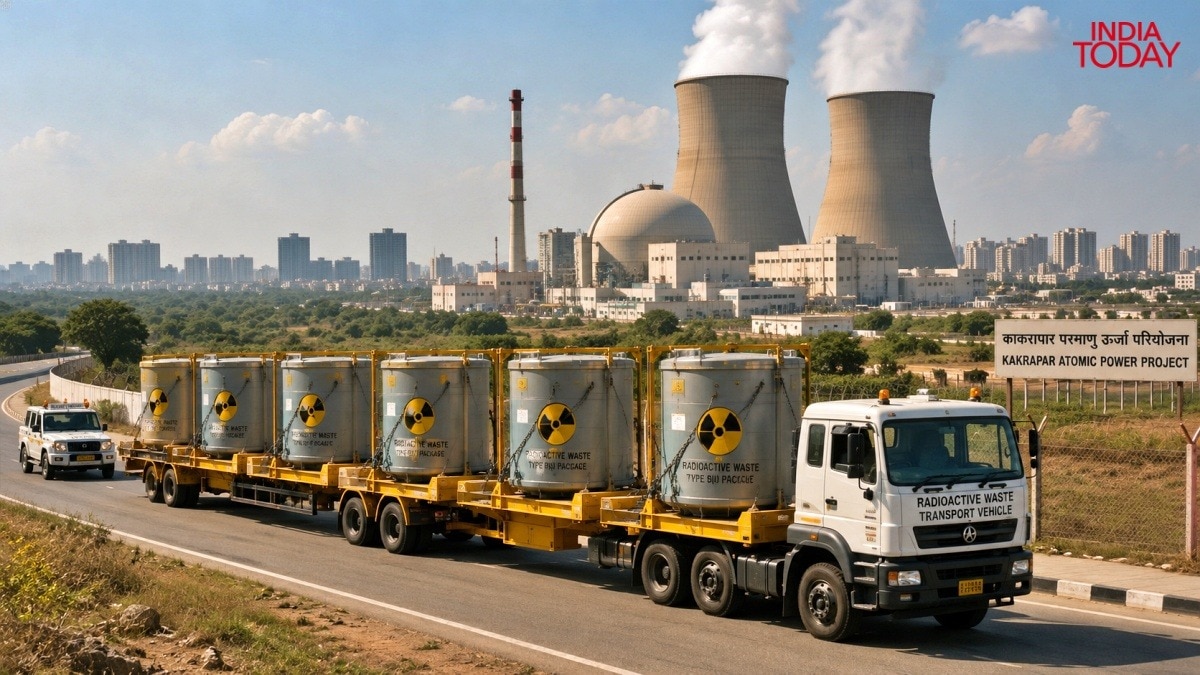
India is focused on its nuclear ambitions but a less visible challenge remains. A rare government disclosure sheds light on how the nation handles radioactive waste.Every facility generating radioactive waste must obtain authorisation. (Photo: Generative AI)Every time a nuclear power plant generates electricity, it leaves behind something that cannot simply be thrown away.Unlike the waste from coal-fired power plants, radioactive waste must be carefully treated, monitored and stored to ensure it does not pose a risk to people or the environment.Most of this process happens far from public view, making nuclear waste one of the least understood parts of the country’s clean energy journey.The government, however, has now offered a rare glimpse into how India manages that invisible by-product. Tarapur Power Station at Tarapur near Mumbai. (Photo: Getty) Responding to a question in Parliament, the Department of Atomic Energy (DAE) informed that India’s nuclear power plants typically generate about 0.15 cubic metres of radioactive solid waste per megawatt (MW) every year, including waste produced during a plant’s operational life and its eventual decommissioning.To put that into perspective, 0.15 cubic metres is about 150 litres, which is roughly the volume of one-and-a-half standard household bathtubs. The figure is reported for every megawatt of a nuclear plant’s electricity-generating capacity each year. The department also said records of the quantity and location of radioactive waste disposal are regularly filed with the Atomic Energy Regulatory Board (AERB), India’s nuclear safety regulator. Barrells containing nuclear waste are pictured. (Photo: Getty) As India plans to expand nuclear power to help meet rising electricity demand while reducing carbon emissions, the spotlight is expected to remain not only on power generation but also on what happens after the power generated for billions has reached our homes.DIFFERENT WASTE, DIFFERENT RADIOACTIVITYRadioactive waste is generated during the routine operation and maintenance of nuclear power plants.It can include used filters, protective clothing, tools, equipment and other materials that have come into contact with radioactive substances.The waste is also produced when a reactor reaches the end of its life and is dismantled, a process known as decommissioning.One common misconception is that all radioactive waste is equally radioactive. A worker shows coolant channels inside a nuclear power plant. (Photo: Getty) In reality, different types of waste contain different levels of radioactivity and therefore require different methods of handling, treatment and disposal. Materials with higher levels of radioactivity are subject to stricter controls and longer-term management than those with lower levels.According to the parliamentary reply, waste generated at nuclear power plants broadly falls into three forms; gaseous, liquid and solid. Naturally, each is managed differently before disposal.HOW DOES INDIA MANAGE RADIOACTIVE WASTE?The government said that radioactive waste is not disposed of immediately after it is generated.Instead, it undergoes treatment appropriate to its physical form and the level of radioactivity it contains before being considered for disposal. Fishermen on the shore near the Madras Atomic Power Station, a nuclear power facility, at Kalpakkam, Tamil Nadu. (Photo: PTI) Gaseous waste is treated at the source before being released in accordance with regulatory limits, while liquid waste is treated using established purification methods depending on its characteristics. Solid waste is segregated, and its volume reduced before disposal.The parliamentary reply also stated that, as a matter of policy, no radioactive waste in any physical form is released into the environment unless it has been cleared, exempted or excluded from regulatory control.Every facility generating radioactive waste must obtain authorisation from the AERB, which specifies how much radioactive material can be discharged and through approved routes.For solid radioactive waste, disposal takes place in specially engineered facilities such as stone-lined trenches, reinforced concrete trenches and tile holes located within access-controlled areas.These structures use what is known as a multi-barrier system, which has multiple natural layers designed to prevent radioactive material from escaping into the surrounding environment. A nearly 200 ton nuclear reactor safety vessel is erected at Indira Gandhi Centre for Atomic Research at Kalpakkam. (Photo: Reuters) Furthermore, disposal sites are kept under continuous surveillance, including through monitoring bore-wells around the facilities.HOW DOES INDIA’S APPROACH COMPARE WITH THE US AND FINLAND?India, however, is only beginning to face the problem others already have for a long time.Other countries manage radioactive waste differently depending on the size of their nuclear programmes, the type of fuel cycle they follow and their long-term waste management policies.India, the United States and Finland all rely on strict regulation and multiple safety barriers, but they differ in how they deal with spent nuclear fuel, which is the highly radioactive fuel removed from a reactor after it has been used.India follows a closed nuclear fuel cycle, under which spent nuclear fuel is not treated simply as waste. Instead, it is stored under regulatory oversight before being reprocessed to recover reusable materials such as uranium and plutonium.Only the remaining high-level radioactive waste from this process requires long-term management, making reprocessing a key part of India’s long-term nuclear energy strategy. Donald Trump holds an executive order regarding reinvigorating the nuclear industrial base. (Photo: AP) The United States, on the other hand, largely follows a once-through fuel cycle for its commercial reactors.Used nuclear fuel is generally stored at reactor sites, first in water-filled cooling pools and later in heavily shielded dry storage casks. US, for now, is relying on this method as it continues to search for a permanent disposal solution.Finland, however, resorted to more innovative solutions.The nation went a step further by developing what is expected to become the world’s first permanent repository for spent nuclear fuel. A geologist walks down a disposal tunnel inside the Posiva Onkalo nuclear waste repository in Finland. (Photo: AP) Known as Onkalo, the facility has been built about 430 metres below the island of Olkiluoto in stable bedrock.There, spent nuclear fuel will be sealed inside corrosion-resistant copper canisters, surrounded by bentonite clay that swells on contact with water to form an additional protective barrier, and finally placed deep underground.The multiple barriers are designed to isolate the waste from people and the environment for thousands of years.While the three countries have adopted different strategies, they share the same objective: ensuring radioactive waste remains safely contained. WHY IS HANDLING NUCLEAR WASTE BECOMING IMPORTANT?That objective, for India, is bound to demand more attention as the world's most populous nation is planning to expand nuclear power as part of its broader clean energy strategy.While nuclear reactors generate electricity without emitting carbon dioxide during operation, they also require robust systems to safely manage radioactive waste throughout the life of a plant and beyond.Luckily, India won't have to start from scratch.There already exists a legal framework under the Safe Disposal of Radioactive Wastes Rules, 1987, which requires facilities generating radioactive waste to get regulatory authorisation and follow procedures laid down by the AERB. A disposal tunnel riddled with radioactive waste is seen in Finland. (Photo: AP) For most people, radioactive waste remains out of sight and out of mind. But as India expands its nuclear power programme, the systems that safely collect, treat, store, monitor and, where appropriate, reprocess radioactive materials will remain just as important as the reactors producing the electricity.The long-term success of the country’s nuclear ambitions will depend not only on generating more clean power, but also on maintaining public confidence that its most enduring by-product is being managed safely.- EndsPublished On: Aug 1, 2026 10:57 IST
Where does India's radioactive waste go? Inside the nuclear waste strategy
Full Article
Original Source
Read the full article at Indiatoday →KhanList aggregates and links to publicly available news content. We do not host full articles from third-party sources. Always verify important information with original sources.