
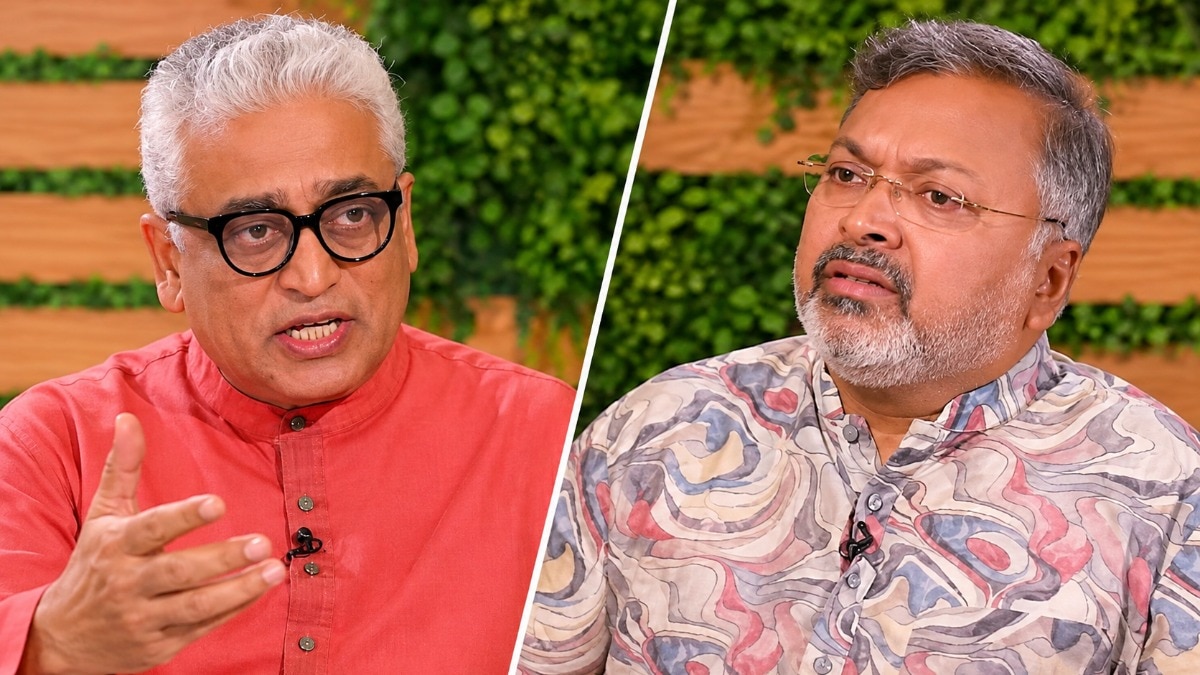
Are Hindu goddesses worshipped as much as we believe? Mythologist and writer Devdutt Pattanaik has questioned the place of women in Hindu religious imagery, arguing that female deities are increasingly missing from representations of popular gods. His remarks on Rajdeep Sardesai's show have triggered a debate over India's traditions of goddess worship.Author Devdutt Pattanaik's remarks in an interview to India Today TV's Rajdeep Sardesai triggered a debate. (Images: India Today)New Delhi,Nov 17, 2026 13:39 ISTMythologist and author Devdutt Pattanaik has stirred a debate over the place of women in Hinduism after arguing that the worship of goddesses does not necessarily translate into the "worship of women in India". In an interview with India Today Group's consulting editor Rajdeep Sardesai, Pattanaik questioned the widespread belief that Hinduism accords women a prominent position because of its pantheon of female deities.In the interview released on Saturday, Sardesai asked Pattanaik, "Is mythology reflecting society or is it presenting in a sense an aspiration that society has consistently failed to fulfill?... Why is there such a gap if it's reflecting society between the powerful position of women in Hindu mythology and the subordinate position of them in society?""We don't worship women in India. Who said we worship women in India?" Devdutt Pattanaik said, pointing to the apparent disconnect between the prominence of goddesses in Hindu mythology and the subordinate position of women in Indian society. He also argued that despite the worship of goddesses, contemporary Hindu religious imagery increasingly sidelines female deities. Pattanaik said most of the gods are featured without their consorts.Pattanaik's remarks have drawn criticism, with several people pointing to India's extensive traditions of goddess worship, including prominent Shakti shrines and temples where female deities are the presiding gods. The debate has also raised questions about whether the representation of goddesses alongside male deities can be separated from the broader question of women's position in religious and social life. WHERE ARE THE WOMEN? ASKS DEVDUTT PATTANAIKExplaining his argument, Devdutt Pattanaik pointed to what he sees as the growing absence of female deities from popular representations of Hindu gods."We built a Ram temple without Sita saying that he's a child but didn't show his mother. We are worshipping Krishna without Radha," he said. He also cited temples dedicated to Krishna in Pandharpur, Udupi and Tirupati, arguing that female consorts are not always represented in the same shrine as their male counterparts."Our gods today, look at the posters across India. Shiva is shown without Shakti. Durga is shown without her family. Krishna is shown with Arjun more than Radha. Strange, no? In a battlefield rather than Madhuban. And Ram seems to be always alone. Why? In every poster he's alone. So where are the women?" he asked.Pattanaik argued that the representation of goddesses had also undergone a transformation over time. Referring to older Tantric temple imagery, he said goddesses were depicted sitting on the laps of male deities and looking into their eyes."The goddess was erotic. So the erotic goddess becomes the romantic goddess. And finally, now gods are all about solitude," he said.He also attributed some of these changes to the influence of Buddhism and Jainism, arguing that religious traditions and their representations of male and female deities evolved with changing social and economic circumstances. Savitri Mumukshu, an entrepreneur and an independent history researcher, argues that goddess worship is deeply embedded in Hindu traditions, scriptures and temple practices, and accuses Devdutt Pattanaik of contradicting his own earlier remarks to provoke controversy and seek attention. CRITICS POINT TO INDIA'S GODDESS TRADITIONSHowever, his assertion that women are not worshipped in India has faced criticism from those who argue that it overlooks the country's extensive and continuing traditions of goddess worship.India has several prominent temples where the goddess is the principal deity, including the Meenakshi temple in Madurai, Kamakshi temple in Kanchipuram, Kamakhya temple in Assam and Vaishno Devi shrine in Jammu and Kashmir. These traditions are central to Shakti worship, in which the feminine divine is not merely a consort to a male god but the principal object of devotion. An X user, Mona Dhar, argued that the 'divine feminine' is deeply woven into India's geography, personal faith and family traditions, with numerous cities and communities rooted in the worship of goddesses. Critics have also pointed to the prominence of Durga, Kali, Lakshmi and Saraswati in household worship, festivals and religious practices across regions. They argue that the absence of a female consort, in particular representations of male deities, cannot, by itself, establish that goddess worship has diminished, or that women are not worshipped. Another critic accused Devdutt Pattanaik of selectively overlooking temples dedicated to female deities, arguing that goddesses are widely worshipped across India. MYTHOLOGY, SOCIETY AND THE POLITICS OF REPRESENTATIONDuring the conversation, Rajdeep Sardesai also challenged Pattanaik on whether the prominence of goddesses in Hindu mythology could reflect an aspiration that society has failed to fulfil, rather than its actual treatment of women.Pattanaik disagreed with the suggestion that mythology presents an idealised version of society."No. It reflects society," he said.He further argued that images of goddesses should not automatically be read as evidence of matriarchy or women's empowerment."If I see a Kali image where she's dancing on top of Shiva, does it mean matriarchy/feminism? And if I show you Lakshmi at the feet of Vishnu, does it mean patriarchy? This is lazy scholarship," he said.The conversation also touched upon the changing position of women in religious imagery, with Pattanaik questioning why contemporary representations increasingly show male gods in isolation.His remarks have reopened a larger debate over how Hindu traditions are interpreted, who gets to define their history and whether the evolution of religious imagery reflects changing social attitudes.- Ends(Written by Anand Singh)
Where are the goddesses? Why Devdutt Pattanaik's remarks have triggered a debate
Full Article
Original Source
Read the full article at Indiatoday →KhanList aggregates and links to publicly available news content. We do not host full articles from third-party sources. Always verify important information with original sources.