
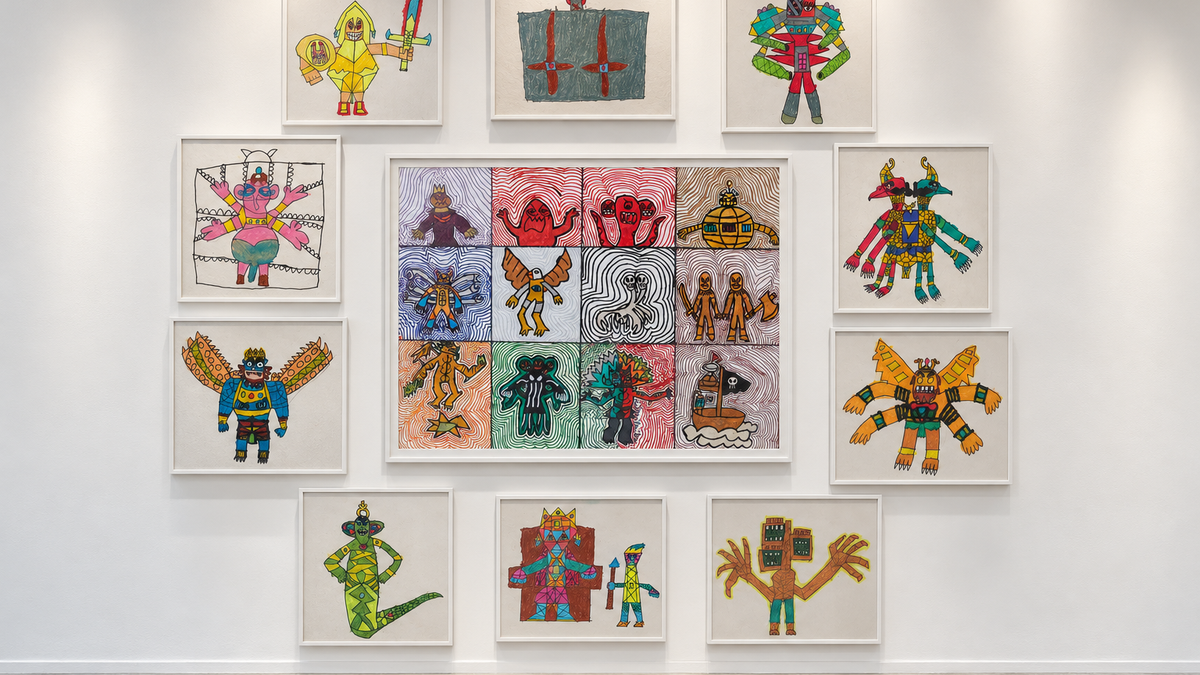
There are stories that words struggle to tell. For 13-year-old Rudranil Mitra, they often take the shape of clay figures with multiple heads, creatures with too many eyes, little kingdoms populated by gods, demons and characters caught somewhere between mischief and melancholy. His is a world where the ordinary is continually being dismantled and put together again, with a rather unusual cast of inhabitants.At the Basement Gallery of the India International Centre Annexe in New Delhi, The Imaginarium of Rudranil Mitra, curated by art historian Uma Nair, brings together this sprawling universe of drawings, paintings and ceramic sculptures. Running from November 15 to 22, the exhibition is an introduction to a young artist whose imagination has found its most fluent expression through his hands. Rudranil Mitra | Photo Credit: Special Arrangement A langauge of his ownRudranil, who has autism, ADHD and significant language impairment, began speaking his first words at six and a half. He had, however, been making things since he was 18 months old. What began with coloured play-dough, tiny arrangements of objects and curious patterns gradually grew into an expansive practice of sculpting and drawing. His father, Ankon Mitra, a landscape architect and sculptor, recognised early on that there was something distinctive taking shape. Ankon says, ”For a 13 year old there is a sense of a developing design sensibility, a recurring motif of comic-strip organisation of narratives. He communicates through visuals and sculptures. This is his medium of expression.” Chaos, Earths, Mad Multiverses by Rudranil | Photo Credit: Special Arrangement Over the past four years, Rudranil has worked closely with ceramic artists Ambar and Monica Agnihotri, who have encouraged him, offering technical guidance without imposing too many rules. More recently, he spent over three weeks at the Jaipur studio of ceramic artist Keshari Nandan, producing an extensive body of work in stoneware.The results are curious, sometimes comic, occasionally unsettling and almost always animated by an unmistakable sense of play. Figures have multiple hands and heads, their expressions exaggerated, their bodies seemingly caught in the middle of some private drama. There are mothers holding children, angry demons, laughing monsters and characters wearing expressions of happiness, despair and bewilderment. In Rudranil’s hands, the mythological vocabulary of devatas and rakshasas finds room alongside the creatures of contemporary animation. Migration by Rudranil | Photo Credit: Special Arrangement His affection for films such as Madagascar, Ice Age, Kung Fu Panda and The Bad Guys is evident. These imagined worlds seem to have become part of his own, populated by friends and adversaries with whom he continues to negotiate through his sculptures. As Ankon observes, Rudranil sometimes fashions these figures as toys, returning to them to enact the battles and relationships that occupy his imagination.An exercise in transaltionm Ankon has organised the works according to colour, nuance, flow and spatial narrative. During the installation, Rudranil himself was present, subtly suggesting that certain works be moved as he watched the stories inside his head find connections on the gallery walls. Glass bottle paintings by the artist | Photo Credit: Special Arrangement The exhibition also reveals a young artist attentive to the possibilities of everyday materials. Empty glass bottles become painted surfaces; pencil shavings are fashioned into birds. His drawings often function as complete stories compressed into a single frame. Paintings made during travels reveal an appetite for colour and an ability to break down familiar subjects into unexpected, anthropomorphic forms.A visit to Italy, particularly its museums and architecture, has opened up another visual vocabulary. Uma points to a series of white sculptures reminiscent of the Pietà and a grid of cathedrals inspired by Milan. “Design and architectural symbolism flow out of him,” she observes.Away from his art, Rudranil continues to find the conventional demands of school difficult. He is now in Class VIII. though academics remain a struggle, with mathematics and art among the subjects he particularly enjoys. The contrast is striking, but perhaps it also raises a larger question about the ways in which talent is recognised and nurtured.Uma sees the exhibition as an invitation to look beyond the narrow measures through which children are often assessed.For Ankon, documenting his son’s thousands of experiments has been a way of recognising the emergence of a body of work. For visitors, the exhibition offers something rather different: an opportunity to enter a world without insisting that it explain itself.
How 13-year-old Rudranil Mitra finds his voice through art and sculpture
Full Article
Original Source
Read the full article at Thehindu →KhanList aggregates and links to publicly available news content. We do not host full articles from third-party sources. Always verify important information with original sources.