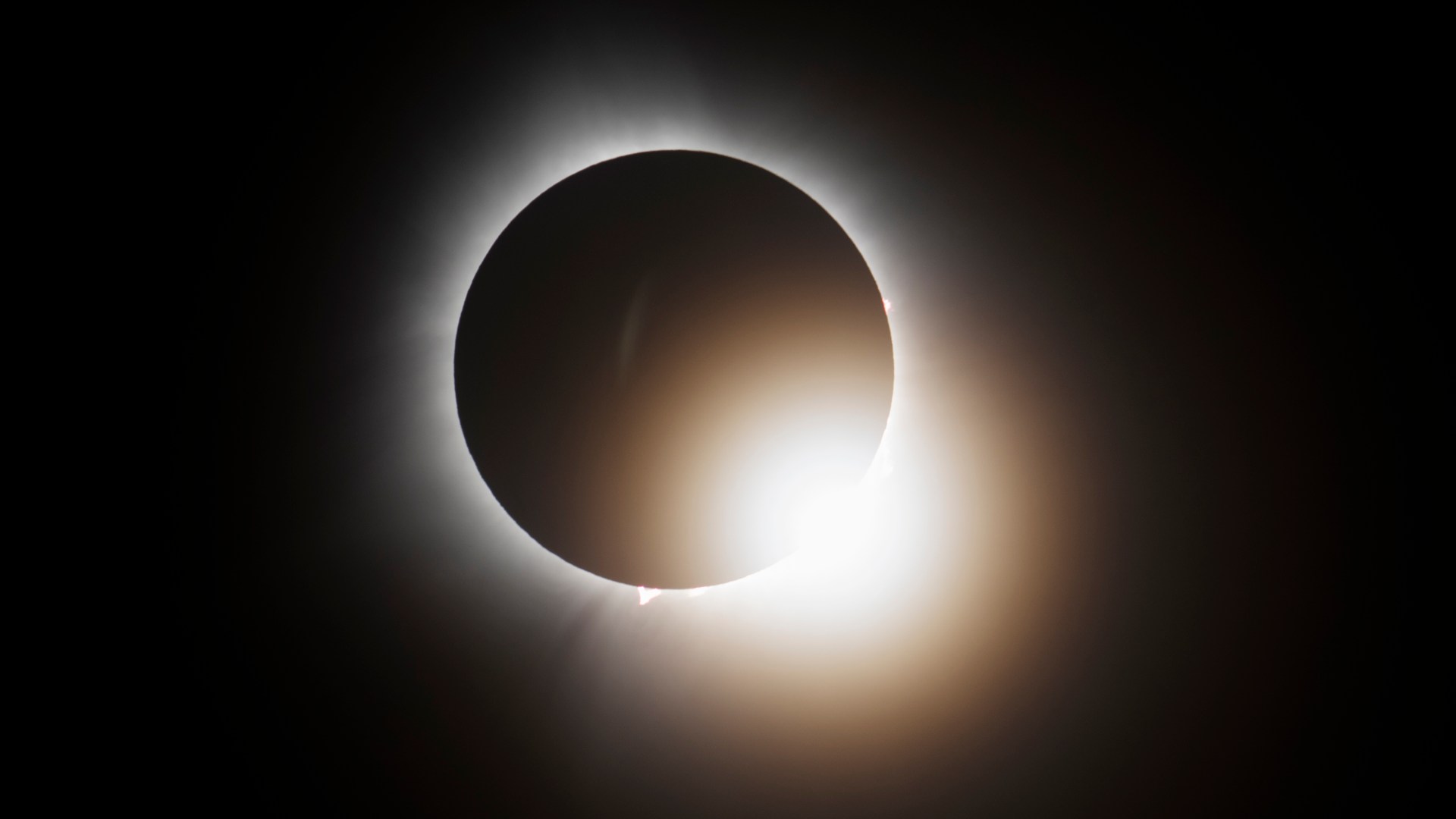
DON’T worry, it’s not the apocalypse – the sun is set to go dark over the UK in days for a far cheerier reason: a rare solar eclipse. Brits will be able to see a near-total eclipse, or fully total if you take a short flight to a common holiday hotspot. We reveal the perfect time to look up, the best places to see the eclipse at home and abroad, and the exact number your stargazing specs need to keep your eyes safe. A gorgeous eclipse photo captured from the Indianapolis Motor Speedway during the April 8, 2024 eclipse in the USA Credit: Getty WHEN IS THE NEXT SOLAR ECLIPSE? The next total solar eclipse to grace Earth‘s skies is on August 12, 2026. For Brits, it’s a major partial eclipse that will cover about 90% of the Sun. Sign up for the Tech newsletter Thank you! An eclipse happens when the Moon moves between the Sun and Earth, putting Earth in the Moon’s shadow. But because the Moon is very small, that shadow only covers part of the planet at a given time. Read more on solar eclipses If the Moon completely covers the Sun from your point of view, that’s a total solar eclipse. You’re watching from the “umbra”, which is the darkest part of the shadow. But if you’re not quite on that “path of totality”, you might only see the Moon covering part of the Sun. That’s what’s happening in the UK in 2026, and it’s called a partial solar eclipse. In the UK, the bulk of the eclipse is just after 7pm. Most read in Tech For instance, in London, it’ll begin at 6.17pm, peaking at 7.13pm, before rounding out at 8.06pm. Down in Cornwall, where viewing is slightly better, it’ll all be happening about two to three minutes later. This stellar eclipse snap was captured in Nerja, Andalusia. South of Spain Credit: Getty The Sun seen eclipsed by the Moon in Torquay on August 11, 1999 Credit: PA:Press Association WHERE TO SEE THE NEXT SOLAR ECLIPSE? The totality of the August 12 solar eclipse is mostly over the ocean, which is a problem for any of us without boats. However, it does swing across some prime parts of Europe. You’ll want to either be on the Balearic Islands or in the middle of Spain, heading up north. The curved arc clips northern Portugal, then heads out into the sea west of the UK. Eventually it crosses the very western edge of Iceland, before heading up into eastern Greenland. Both the “Greatest Duration” and “Great Eclipse” will be off the coast of Iceland. Your best bet for a full view, then, is heading to Spain, which is handy if you already had your summer hols booked there. It’ll cut right across La Palma, and falls just south of Barcelona, so a short drive from there will get you an excellent view of the totality. Top 9 UK locations to view solar eclipse Try to make it to one of these scenic viewing spots... Hugh Town Land’s End Galloway Forest Dark Sky Park Giant’s Causeway Llŷn Peninsula Strumble Head – pictured above Rhossili Bay Exmoor Dark Sky Reserve Boscastle So what does all of this mean for stay-at-home Brits? Well, the best views of the eclipse from the UK will be the most westerly parts of the country. If you can get down to Cornwall, you should have a slightly better view than someone living over in Great Yarmouth. And if you can get to the southwest corner of the Republic of Ireland, that’ll be your best bet locally. ECLIPSE TIMINGS – WHEN AND WHERE TO SEE IT The BBC‘s Sky at Night Magazine made a handy chart for the eclipse, complete with locations, timings and coverage: Valencia, Spain – total eclipse – 8.33pm CEST – 100% coverage Bilbao, Spain – total eclipse – 8.27pm CEST – 100% coverage Zaragoza, Spain – total eclipse – 8.29pm CEST – 100% coverage Valladolid, Spain – total eclipse – 8.30pm CEST – 100% coverage Madrid, Spain – partial eclipse – 8.31pm CEST – 99.97% coverage Barcelona, Spain – partial eclipse – 8.29pm CEST – 99.8% coverage Bragança, Portugal – partial eclipse – 7.30pm WEST – 99.9% coverage Lisbon, Portugal – partial eclipse – 7.36pm WEST – 94.5% coverage Porto, Portugal – partial eclipse – 7.32pm WEST – 98.2% coverage London, UK – partial eclipse – 7.13pm BST – 91.3% coverage Cardiff, UK – partial eclipse – 7.13pm BST – 93% coverage Edinburgh, UK – partial eclipse – 7.05pm BST – 91% coverage Belfast, UK – partial eclipse – 7.08pm BST – 93% coverage Dublin, Ireland – partial eclipse – 7.10pm IST – 94% coverage New York, NY, USA – partial eclipse – 1.54pm EDT – 9.5% coverage Boston, MA, USA – partial eclipse – 1.55pm EDT – 16% coverage Chicago, IL, USA – partial eclipse – 12.28pm CDT – 0.1% coverage Anchorage, AK, USA – partial eclipse – 8.21am AKDT – 27.9% coverage St John’s, NL, Canada – partial eclipse – 3.35pm NDT – 53.2% coverage Montreal, QC, Canada – partial eclipse – 1.45pm EDT – 18% coverage Winnipeg, MB, Canada – partial eclipse – 12.02pm CDT – 5.4% coverage Source: Sky At Night HOW TO WATCH SOLAR ECLIPSE SAFELY Partial solar eclipses can actually be much more dangerous than total solar eclipses. During a total solar eclipse, there is a very brief window of totality where it’s safe to view the event without protective glasses. That’s because the Sun is totally covered, albeit only for a few minutes. But during a partial eclipse, there is no window of totality, which means it is never safe to look at the Sun without protection. Even if it looks as though most of the Sun is blotted out, it still isn’t safe to gaze up without proper protection. It’s also important to remember that regular sunglasses (even very expensive ones) aren’t safe for solar viewing. You need to purchase approved solar glasses to be able to safely look at the Sun during a partial eclipse. To check, you’ll want to look for an ISO 12312-2 international safety rating, as well as an Optical Density 5.0 or higher. This image shows the Sun as seen from London during the partial 1999 eclipse on August 11 Credit: PA:Press Association The Moon seen moving away from the Sun during an annual solar eclipse pictured at San Juan Capistrano, California in October 2023 Credit: Getty ‘ECLIPSE OF THE CENTURY’ We’re actually expecting an even better solar eclipse next year. This epic event has been dubbed the “eclipse of the century” because the Moon is close to its nearest point to Earth. And it’ll have the longest totality over land for the 21st century. Your best option is viewing it from 37 miles southeast of Egypt‘s Luxor, where you should see a totality lasting a whopping six minutes and 22 seconds. This was technically beaten in 2009 by an eclipse with a totality of six minutes and 39.5 seconds, but that was over the Pacific Ocean, and the longest point over land was above uninhabited North Iwo Jima. There won’t be a longer totality over easily accessible land until June 3, 2114. The third eclipse to look out for in the near future is July 22, 2028, which is down in Australia and New Zealand. Sydney hasn’t had a total eclipse since March 26, 1857, so this is a big deal. But if you want a total eclipse over the UK, you’ll be waiting until September 23, 2090. Comment now
When to spot stunning solar eclipse blot out Sun over UK in DAYS – but view is even better in top Brit holiday hotspot
Full Article
Original Source
Read the full article at Thesun →KhanList aggregates and links to publicly available news content. We do not host full articles from third-party sources. Always verify important information with original sources.