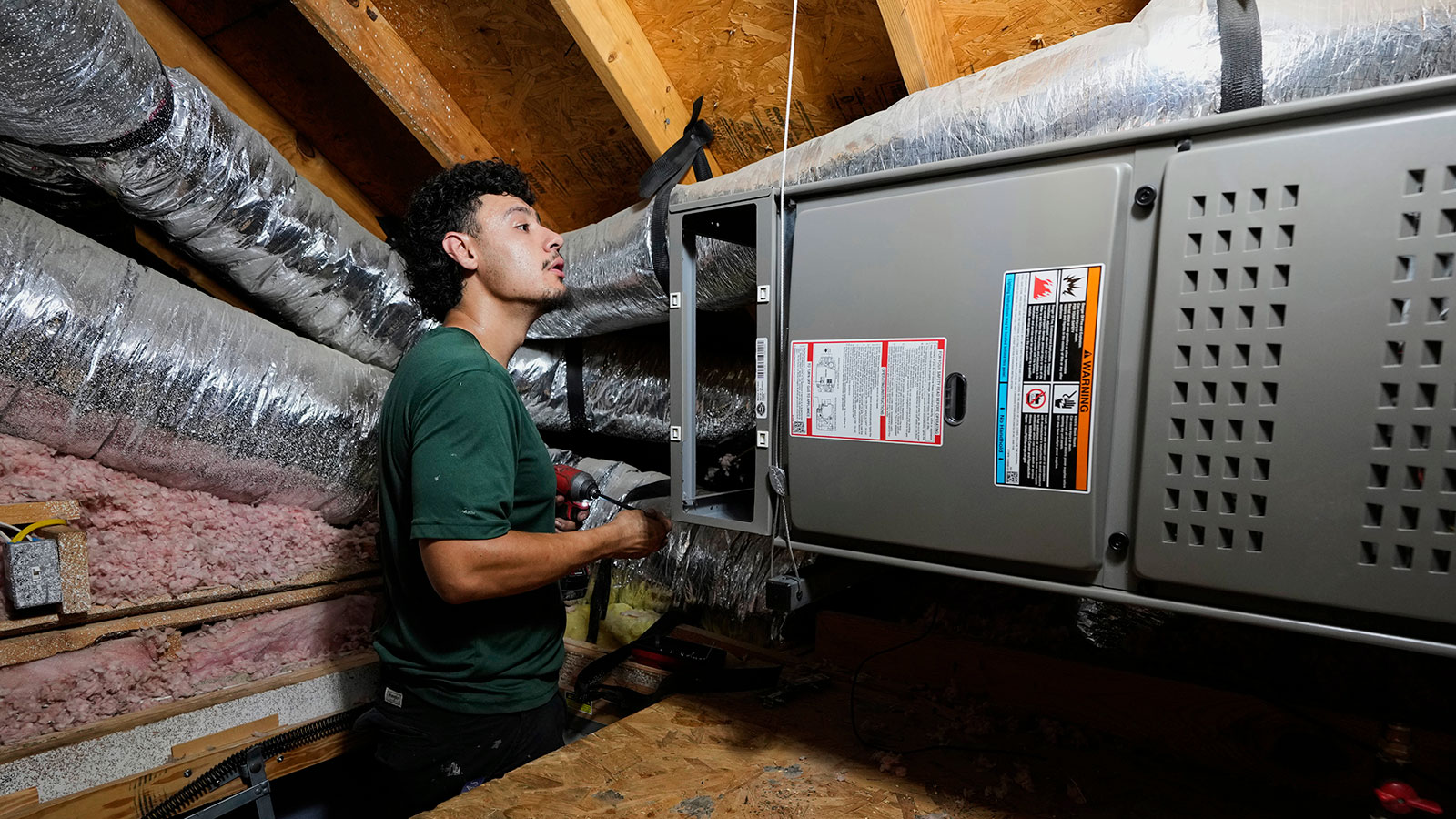
Ruben Guerrero, an installer with Homestead Heating and Air, works on installing a new HVAC system in a residential home in Fate, Texas. (AP Photo/Tony Gutierrez) Transcript: On sweltering summer days in Austin, Texas, most homes have the windows shut and air conditioners pumping. But some people cannot afford to run their AC enough to adequately cool their homes. And if the power goes out in a storm, air conditioners do not work. So some houses can quickly become dangerously hot inside – especially older, drafty homes that allow heat to seep in faster. Coudert: “We have a lot of houses … with zero insulation.” And Marc Coudert, Austin’s climate adaptation and resilience manager, says the threat is growing as the climate warms. Coudert: “You know, in the 1970s, we would get an average of 10 days over a hundred. Now we’re seeing, in like 2023, 80 days over a hundred.” So the city funds programs to help low-income residents make energy efficiency improvements, like adding insulation or reflective roof coatings, which can help homes stay cooler without using as much AC. And the city maintains a network of cooling centers where people can go during heat waves. But some residents, including those who are elderly or ill, may be unable to leave their homes. Coudert: “A lot of the people who are most vulnerable to heat are people who are isolated.” So he says it’s also important for people to check in on their neighbors and help make sure they’re safe. Reporting credit: Sarah Kennedy / ChavoBart Digital Media Republish our articles for free, online or in print, under a Creative Commons license.
When the power goes out, homes can become heat traps
Full Article
Original Source
Read the full article at Yaleclimateconnections →KhanList aggregates and links to publicly available news content. We do not host full articles from third-party sources. Always verify important information with original sources.