
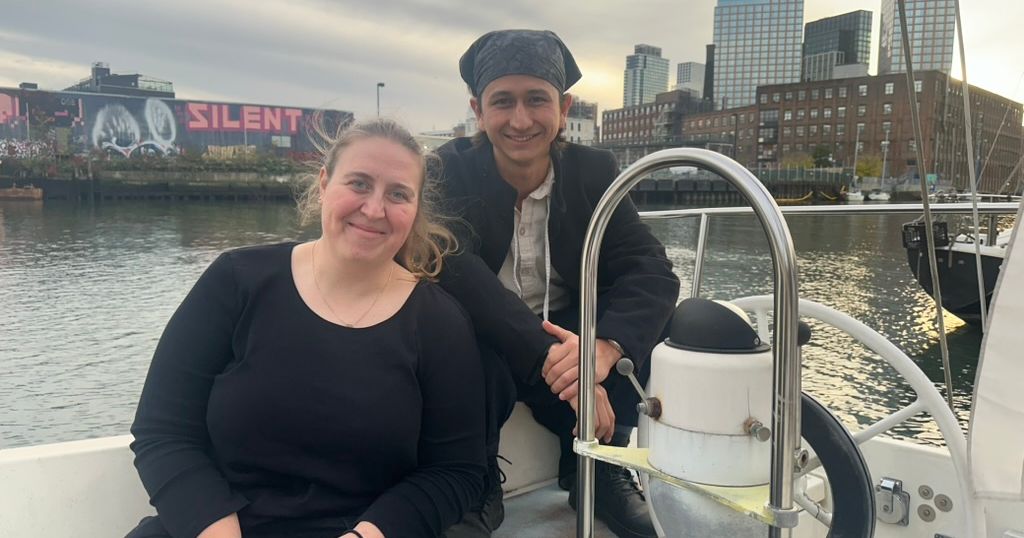
When Home Is a Sailboat on Newtown Creek There are no walls and no running water, but the rent’s just $360 each. By , a contributing writer at Curbed and author of the Substack newsletter Café Anne Kai Tattersall and Jo Mayfield in the decommissioned sailboat they share that’s docked on Newtown Creek. Photo: Anne Kadet Kai Tattersall and Jo Mayfield in the decommissioned sailboat they share that’s docked on Newtown Creek. Photo: Anne Kadet On a recent afternoon, Kai Tattersall met me at a Long Island City subway station to take me to the home he shares with his roommate Jo. The 26-year-old filmmaker led me past a series of scrap warehouses and over the railroad tracks before we traversed a crumbling, truck-filled parking lot and squeezed through a gap in the chain-link fence bordering Newtown Creek, an industrial, 3.5-mile waterway on the border of northeast Brooklyn and Queens. We inched along a narrow ledge high over the tall concrete bank before we finally arrived at his doorstep. Well, sort of. Home, in this case, is a small, decommissioned sailboat docked on the canal. To reach it, we had to clamber down a rickety, handmade ladder mounted on the creek wall before making a terrifying four-foot leap onto the deck of a neighboring houseboat, clamber across it, and make a second jump to the deck of the sailboat where he lives. The water, I should mention, is filled with spilled oil, toxins and sewage — the creek is a federal Superfund site, designated the same year as the Gowanus Canal, but its own cleanup has been delayed for more than a decade. For Kai, who dresses a bit like a pirate and exhibits the agility of an acrobat, getting on and off the boat is no big deal. For his roommate Jo Mayfield, who greeted us inside the cabin, it’s still a bit of an ordeal. The 29-year-old freelance producer says that during her first week living on the boat, she obsessively checked the tide levels on her phone app to avoid boarding at low tide when the jump off from the ladder is its most treacherous. No one wants to land in the filthy water. She’s since adapted. “But it gets more complicated if I have a suitcase, or I’m doing laundry,” she says. “There are times I need Kai to be here to hand things off.” It’s barely a home, they say, but they only pay the boat’s owner $720 a month in rent. Jo waving from the sailboat she and Kai share, behind the boat they have to cross to get to theirs. Photo: Anne Kadet The ad-hoc stairs that Jo and Kai need to use to get closer to their boat home. Photo: Anne Kadet The boatmates gave me a tour of their home. It did not take long; there’s just one room that’s roughly 80 square feet, the equivalent of a walk-in closet. The padded bench on the left side of the cabin serves as Kai’s bed. A fake bamboo partition screens the pump toilet from view (“But you still hear everything,” says Jo.) Her sleeping alcove, which she refers to as “the coffin,” is a windowless berth behind the toilet on the other side of the partition. The kitchen area on the right side of the cabin includes a microwave overlooking the toilet, a tiny sink, a single-burner camping stove, one small pot, one frying pan, and a modest set of plastic dishes. The boatmates discovered early on that when a speed boat cruises by, their home rocks so hard all the tableware lands on the floor. “We definitely don’t have much glass here,” says Kai. “We’re not going to bring home a vase with flowers.” The mini-fridge, meanwhile, is just big enough to hold its paltry contents: a jar of pepperoncini, a packet of Japanese sugar candy, a tiny container of berry yogurt, and four Modelos. The two roommates in their shared cabin. Photo: Anne Kadet From left: The padded bench where Kai sleeps. Photo: Anne KadetThe view into Jo’s sleeping berth. Photo: Anne Kadet From top: The padded bench where Kai sleeps. Photo: Anne KadetThe view into Jo’s sleeping berth. Photo: Anne Kadet There’s no shower and no water hookup; every few days the boatmates fill eight one-gallon jugs at the nearby gym (or, on one occasion, a nearby fire hydrant) to fill the water tank. The small television is powered by solar panels and two rechargeable lithium batteries. There’s no AC, but there are several tiny electric fans and a gasoline-powered heater. And that’s about it! The boat has little in the way of storage, so they can’t keep much aboard. They stow their dirty laundry in a Key Food bag on a hook. Their shared “closet” is a single hanger hung on a knob on the wall which holds Kai’s coat and a few of Jo’s shirts. Beneath that is the “Box of Hell,” a bin full of items they had to rescue during a recent heavy rain when the cabin walls sprang several leaks. “We panic-shoved all our valuables in there to avoid it getting wet,” said Kai. I rummaged through its contents including headphones, a receipt printer, contact lenses, a pair of pants, and a bag of shrooms. “It remained like that because we haven’t fixed the leak yet,” says Kai. From left: The kitchen area includes a microwave and a mini fridge. Photo: Anne KadetPhoto: Anne Kadet From top: The kitchen area includes a microwave and a mini fridge. Photo: Anne KadetPhoto: Anne Kadet Kai owns just five shirts and two pairs of pants, all of which he sewed by hand and keeps in a zipped plastic bag on the bench. All his worldly possessions—including a laptop, an umbrella and a sewing kit—fit in his backpack. “Everyone should do it. It gives you so much freedom,” he says. Jo, who has a more extensive wardrobe and owns an actual suitcase, rents a nearby storage space and rotates items on and off the boat as needed. While she’s a minimalist, she’s no match for Kai. He admits to rolling his eyes when she brought two golf clubs to the boat, which are now stored in a corner of the cabin; there was a minor dispute when she bought a six-pack of toilet paper rather than the single roll Kai prefers. “You know what? You’ll be happy when we have extra rolls,” she told him. The pump toilet flushes into the canal. Photo: Anne Kadet Kai and Jo met several years ago on a film set in L.A. Jo, who has lived in New York for a decade, was on a work trip and Kai offered to let her stay at his L.A. apartment when her Airbnb rental ended. Soon after, Kai visited Jo in New York, and they enjoyed a 18-hour walking odyssey across four boroughs, covering 45 miles in one stretch. They hit it off (in a platonic way). Each says the other is the most easygoing person they’ve ever met—which is why they decided to take the risk of sharing tight quarters. “Kai’s probably the only person I could do this with,” says Jo. “We don’t get bothered by a lot. We’re pretty chill.” But they never set out to live on a boat. Kai gave up his apartment first, in 2024, leaving L.A., booking a one-way ticket to Paris, and spending the next two years backpacking around the globe — Japan (where he grew up), Korea, Amsterdam. He does rotoscope animation, which has him filming live actors on set and then digitally painting over the scenes frame-by-frame, a task he can do anywhere in the world. When he decided to settle down again, he chose New York — a town where he had many friends but hadn’t spent much time exploring, and took a cross-country train from L.A. to New York. “I had no plan, no place lined up, no people to live with,” he said. “And suddenly, out of the blue, I got a text from Jo, who said, ‘Hey, let me know if you know anyone looking for housing in New York, because I’m about to move out of my current place.’” When Kai arrived, the two started looking for a cheap rental — they had just a few days before Jo had to leave her apartment. It was Jo who found the boat rental ad on Craigslist. “It was just a photo of the boat and a few sentences, mostly about what it didn’t have,” she says. “No shower, no laundry, a lot of No’s.” “We were like, Fuck it; let’s just do it!” says Kai. Kai texted the owner and went alone the next day to meet him and see the boat. He remembers following the man through the gap in the chain-link fence and wondering, Am I gonna die? Is this the end for me? And then they got into such a long conversation that Kai neglected to respond to Jo’s frantic texts: “You okay, bro?” she wrote to him. “Are you dead?” Kai agreed to rent the boat on the spot and Venmoed the owner three months’ rent. They shook hands. No lease was signed. “What if he just said, ‘See ya!’ and ran off with the money?’” I asked. “We were willing to take that chance to get that cheap of a rent,” said Kai. “$360 each in New York City? Clearly it was worth the risk.” The view from their boat deck. Photo: Anne Kadet They remember their first evening on the boat, a hot July night. “A seaplane landed on the creek and we’re like, ‘What the fuck is going on?’” says Kai. “And then a dirt barge would come, and then the drawbridge would lift. We were taking photos and videos of every little thing. But it’s surprising how fast everything became normal.” Now they rise every morning to the horn calls of passing oil tankers and scrap metal barges. And since the horrible mosquito swarms have dissipated with the cooler weather, it’s fun to sit out on the deck watching the never-ending parade of kayakers, Jet Skiers, Leisure Craft, and Coast Guard patrol boats. The canal only smells bad a few days of the month, they say. I didn’t notice any foul odors on my visit. On a typical day, Jo rises at 6 am to report for work on a film set in the city. She’ll often stop first at the nearby gym, where she has a membership, for a quick shower and to check emails on her laptop. The membership costs $150 a month, but it’s worth it for the towel service, spa and cafe with Wifi. Kai, who belongs to the same gym, follows a similar routine two hours later. When Jo isn’t booked for a production, she works at the New York Public Library next to Bryant Park. Kai, less a creature of habit, has two dozen spots around the city where he works on his film. He admits to a fondness for the 34th Street Capital One Café along with the lobbies of the Ace and Empire hotels. “I work until I get kicked out, which is fun,” he says. They’ve both tried working at home on the boat, but it’s rough going. There’s no table or desk, and the single padded bench isn’t comfortable enough for an all-day work-a-thon. Getting on the boat Kai and Jo live in requires leaping from the stairs to a boat and then from that boat to the next. Photo: Anne Kadet Both say they also eat most of their meals out. Jo often gets free lunch on set. Kai opts for Halal carts or Chinese. And as there’s not much stocked in the boat pantry beyond rice, noodles and tea, they’ll often eat dinner out as well. They both go out to movies or visit friends in the evening, or Jo will catch the game in a sports bar. In short, the boat is mainly for sleeping. Every so often, they spend the evening together at home watching TV — whatever series they can agree on. Their current pick is Silo, an Apple TV drama. “It’s about living in a tiny little bunker,” says Kai. “I wonder why we like it.” They have both hosted overnight guests. Initially, they asked each other’s permission, but they’ve since adopted an anything-goes policy when it comes to sleepovers. “If Kai shows up with three people, I’m like, ‘Okay,’” says Jo. “It’s fine; I don’t care.” There are plenty of downsides to boat life. They have to direct all their mail and deliveries to their friends’ homes. Kai misses throwing big parties. Jo does not enjoy snagging her hair in the screws jutting out from the skylight in her coffin. They miss luxuries like a table and a comfortable couch. “There’s not a lot of room for big emotions,” says Jo. “There’s not a lot of room for small emotions,” says Kai. If they have a disagreement, which is seldom, they have no choice but to address the issue immediately. “There’s no place for it to sit,” says Jo. “There’s no door we can close and not see each other anymore.” “So if you had more money, would you live in an apartment?” I asked. “Right now, we’re making decent money,” says Jo. “We could get an apartment. But as freelancers, it’s not the most reliable income. And it’s nice seeing your savings grow.” “Even if we made six-figure salaries, I’d still choose this boat,” says Kai. The plan is to stay on the boat at least through the spring. If it gets too cold this winter, they both have keys to friends’ apartments. “We’re not going to die here of frostbite because we’re freezing,” says Jo. “We’re not that stupid.” And after that? “I don’t see myself living here for ten years,” says Jo. “It’s like a temporary, fun story. I see myself with a family, so it’s not going to be a situation like this.” Kai, meanwhile, says he might make another trip overseas: “I’ve been looking into boats in London.” The 7th Floor–8th Floor Marriage Chefs on Bunk Beds, Bartenders on Boats Building a ‘Mommune’ in Harlem See All When Home Is a Sailboat on Newtown Creek Your product is saved! You’ll receive emails when your saved products go on sale. Manage preferences.
When Home Is a Sailboat on Newtown Creek
Full Article
Original Source
Read the full article at Curbed →KhanList aggregates and links to publicly available news content. We do not host full articles from third-party sources. Always verify important information with original sources.