
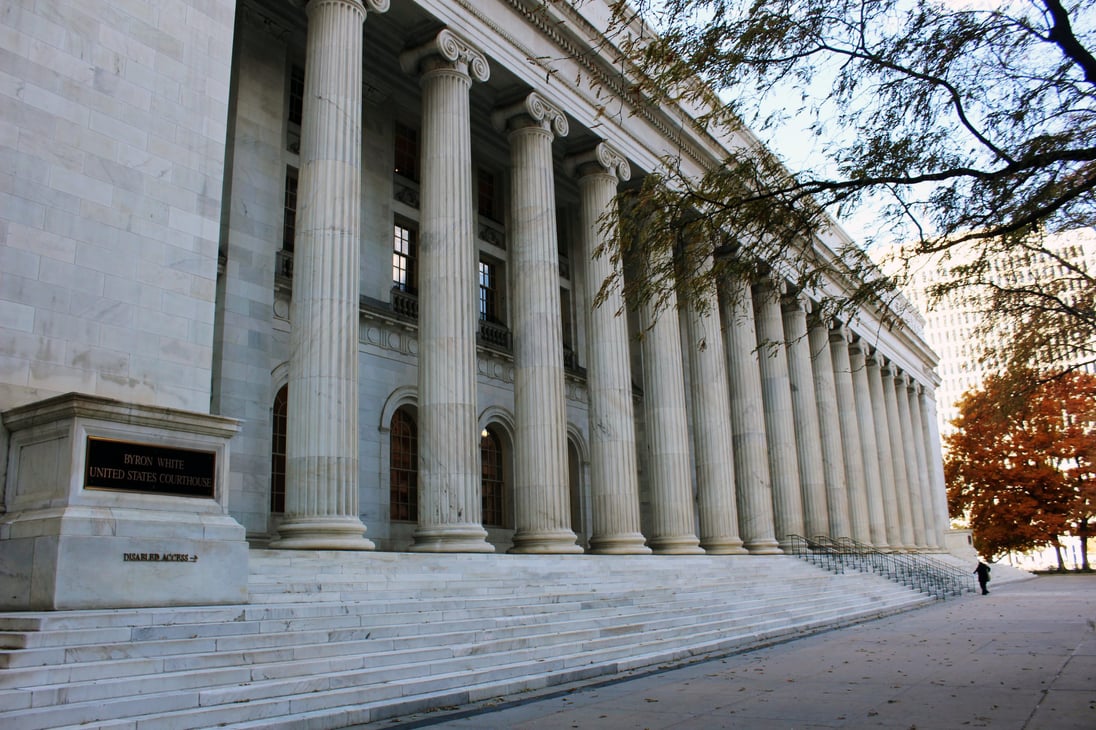
For decades, Royall Jenkins promised members of the United Nation of Islam salvation from hellfire through penance and hard work. After his death, several of Jenkins’ followers faced criminal penalties for conspiring to force children to work without pay.DENVER (CN) — Three members of an Islam-based Kansas City cult asked the 10th Circuit on Wednesday to overturn a jury’s conviction finding they each conspired to compel forced labor from children.“Aubrey is challenging the trial court’s ‘climate of fear instruction,’” explained federal public defender Josh Lee, who represents Aubrey Jenkins.Lee’s client is the grandson of Royall Jenkins, the charismatic founder of the United Nation of Islam cult, which he relocated from Maryland to Kansas City, Kansas, in the 1990s. Claiming angels took him on a tour of the universe in a spaceship, Royall told followers he received magical powers after passing through the center of the sun, and his teachings would save them from eternal hellfire.In practice, Royall forced followers to adhere to strict diets and arranged marriages, while working for the organization’s businesses without pay. Royall died in September 2021, months before federal prosecutors brought charges against several Nation members. A 2024 jury trial brought in six convictions.At the Byron White U.S. Courthouse, a 10th Circuit panel heard objections to three individuals contesting the trial judge’s adoption of an instruction guiding jurors to consider how each defendant contributed to a general “climate of fear” in addition to making explicit threats to compel labor.The instruction, Lee argued, resulted in erroneous convictions and Jenkins’ four-year prison sentence unsupported by the facts.Chief U.S. Circuit Judge Jerome Holmes questioned why the jury shouldn’t be trusted to read the “climate of fear” clause in the context of the full instructions provided.“Here you have the court saying ‘this kind of activity could satisfy the element,’ it’s not like the court is saying this activity must satisfy the element,” the George W. Bush appointee said. “It’s not a one-to-one correlation."U.S. Attorney William Glasser agreed the climate of fear instruction offered the jury a broad category that made sense in the context of the trial.“The climate of fear instruction doesn’t rewrite everything else,” Glasser explained.Randolph Hadley, another cult member who was sentenced to five years in prison, argued the statute of limitations had lapsed on instances of abuse claimed by the government, and his conspiracy conviction also improperly relied on the climate of fear instruction.In court, defense attorney Elizabeth Franklin-Best downplayed Hadley’s involvement, claiming he didn’t outright agree to join the conspiracy to force children to work for the Nation.Holmes, however, appeared hard-pressed to excuse Hadley after he dispatched children to work, participated in “beat downs,” and punished kids for messing up orders.“What do you want, an explicit contract?” Holmes asked. “If he knows what’s going to happen on the other end of that call, and he sends them to do that, ie work, then it seems like a reasonable inference that he was involved.”In addition to Royall Jenkins’ grandson and follower, one of his wives contested her conspiracy conviction and resulting four-year prison sentence.During the trial, Dana Peach argued the lower court allowed the jury to be flooded with so many disparaging hearsay statements, her defense could hardly object to every single one without derailing the entire proceeding.Peach’s defense attorney, Kari Schmidt, argued the trial judge improperly allowed prosecutors to present “categories” of information ahead of the trial, rather than providing defense attorneys a full accounting of what would be said.“Give me a case where what this court did is not the textbook way of going about doing this,” Holmes pressed.Schmidt argued the prevalence of the practice reflected a decades-long erosion of defendants’ right to be judged solely on the evidence against them.“The due process rights to only be judged based on the evidence against the criminally accused and not somebody else cannot yield to case management and docket issues,” said Schmidt, who practices with Conlee Schmidt in Wichita, Kansas. Pointing to an “easy” fix, Schmidt asked the court to remand the case so the lower court could narrow the record against Peach and reevaluate her conviction.U.S. Circuit Judge Joel Carson asked why Peach didn’t submit a list of statements that might have changed the outcome if the jury hadn’t heard them.“If we can’t rule on it at a process level, we have no way to review it,” the Donald Trump appointee said. “We don’t have argument on every statement; we don’t have objections on every statement. Your argument requires us to look at this at a higher level.”Defending the conviction, Glasser argued all statements involving Peach were admissible, and allowing them into trial fell within the lower court’s discretion.Barack Obama-appointed U.S. Circuit Judge Robert Bacharach rounded out the panel, which did not indicate when or how it would reach a decision.Subscribe to our free newslettersOur weekly newsletter Closing Arguments offers the latest about ongoing trials, major litigation and rulings in courthouses around the U.S. and the world, while the monthly Under the Lights dishes the legal dirt from Hollywood, sports, Big Tech and the arts.Additional Reads
Members of Kansas Islamic cult ask 10th Circuit to vacate forced labor convictions
Full Article
Original Source
Read the full article at Courthousenews →KhanList aggregates and links to publicly available news content. We do not host full articles from third-party sources. Always verify important information with original sources.