
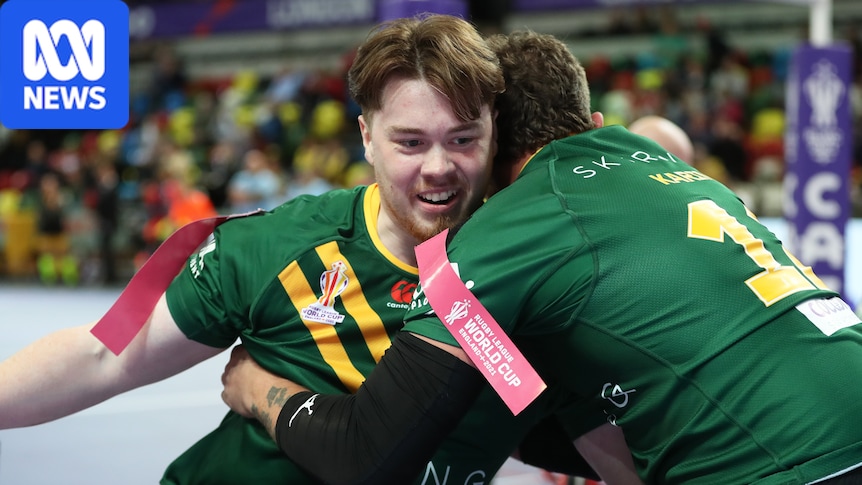
Australian wheelchair rugby league is poised for a breakthrough moment this week, with Wollongong, south of Sydney, hosting the nation's first World Cup since 2008.Bundled in as part of the larger Rugby League World Cup, which also includes the men's, women's and physical disability tournaments, the wheelchair competition will benefit from free-to-air coverage in prime-time slots.It is the kind of exposure most non-mainstream sports could only dream of, and Australia's Wheelaroos are well aware of the gravity of the moment."I think it's going to bring a whole different experience for wheelchair rugby league in Australia," Australia captain Bayley McKenna told ABC Sport."It's gonna bring people together, it's gonna bring people in to support our sport."Australian wheelchair rugby league will be hoping for a breakthrough moment at the upcoming World Cup in Wollongong. (RLWC26 Media: Mark Nolan)The Wheelaroos are currently ranked fourth in the world and are yet to claim a world title, with their game generally taking a back seat to the likes of wheelchair basketball and wheelchair rugby at a grassroots level in Australia.But coach Brett Clark has told ABC Sport his charges are ready to take the rough-and-tumble sport into living rooms across the country."We know this is a quality game for all to play and this is the opportunity for us to show it at its top level," Clark said.A unique kind of inclusionWheelchair rugby league, not to be confused with Paralympic favourite wheelchair rugby, is played on a basketball-sized court and with five athletes per side.The sport replaces tackles with tagging like in Oztag and uses AFL-style handballing instead of kicking, but otherwise, remains relatively faithful to the running game.Played across full-length 40-minute halves, it is a game filled with exhilarating chair skills, hair-raising collisions and retains much of rugby league's trademark physicality.For Wheelaroos captain McKenna — who played the running game for years before joining the wheelchair sport — wheelchair rugby league's physicality is one of its biggest drawcards."In hindsight, I've had more injuries playing wheelchair rugby league than I did in the running game," McKenna said."You can hit people as hard as you want as long as you're going for the tag."At 26, McKenna is a Wheelaroos trailblazer, being both the youngest and first non-disabled national team skipper.Wheelchair rugby league is unique among international wheelchair sports in allowing teams to field up to two non-disabled players at any given time.Bayley McKenna is his country's first non-disabled and youngest-ever skipper. (Getty Images: Richard Sellars)This policy ensures that teams at every level of the sport can attract enough players to compete, while also fostering a unique kind of inclusion that flows from the grassroots all the way to elite competition, allowing for both non-disabled and disabled friends and family to share the same court.McKenna, who began playing wheelchair sports alongside his disabled father, has seen the benefits of that inclusiveness firsthand."Being a non-disabled athlete in this sport is one of the most unreal things you can ever be a part of," McKenna said."The sport's so big, it's so broad, you can travel all across the world … it's so inclusive, because for me it gave me an opportunity to play a sport underneath my dad as a coach."Luff believes that the inclusion of non-disabled players only adds to the sport. (Getty Images for RLWC: Henry Browne)Wheelaroos squad member Liam Luff, living with hereditary spastic paraplegia, told ABC Sport the policy was an "incredible benefit"."It just opens the doors to more and more people in our sport, which is what we need to grow awareness, get more people in chairs and show how special wheelchair rugby league is," Luff said.The importance of the momentBeginning on Friday, the 2026 World Cup will be just the fifth edition of the wheelchair tournament, with France and England having split the first four titles evenly.With the sport having been first designed in France in the early 2000s, the two northern hemisphere titans have benefited from close contact and regular meetings.In England, the sport experienced an explosion in popularity after the nation hosted the 2022 World Cup, which was also held alongside the men's and women's competitions. Grassroots participation saw a sharp uptick in the year after the event, while standalone international games have attracted audiences in the thousands since.The Wheelaroos are now optimistic the 2026 tournament will have a similar impact in Australia, and Luff believes the sport is well and truly ready for it."I think more people are going to stumble across the game and find out about how special wheelchair rugby league is," Luff said.Finding a way past France and England will undoubtedly be an almighty task for the Wheelaroos, who will play three group-stage games before the knockouts.But the team is bullish on its chances in the Illawarra, and Luff is convinced the Wheelaroos are finally ready to take a seat amongst the world's elite."This is our biggest opportunity to really prove where the Australian Wheelaroos are in wheelchair rugby league," Luff said."We are gonna make sure we can prove ourselves taking on those top dogs … I think we're gonna really send a message about where we stand."
Wheelaroos out to 'send a message' in pursuit of breakthrough World Cup title
Full Article
Original Source
Read the full article at Abc →KhanList aggregates and links to publicly available news content. We do not host full articles from third-party sources. Always verify important information with original sources.