
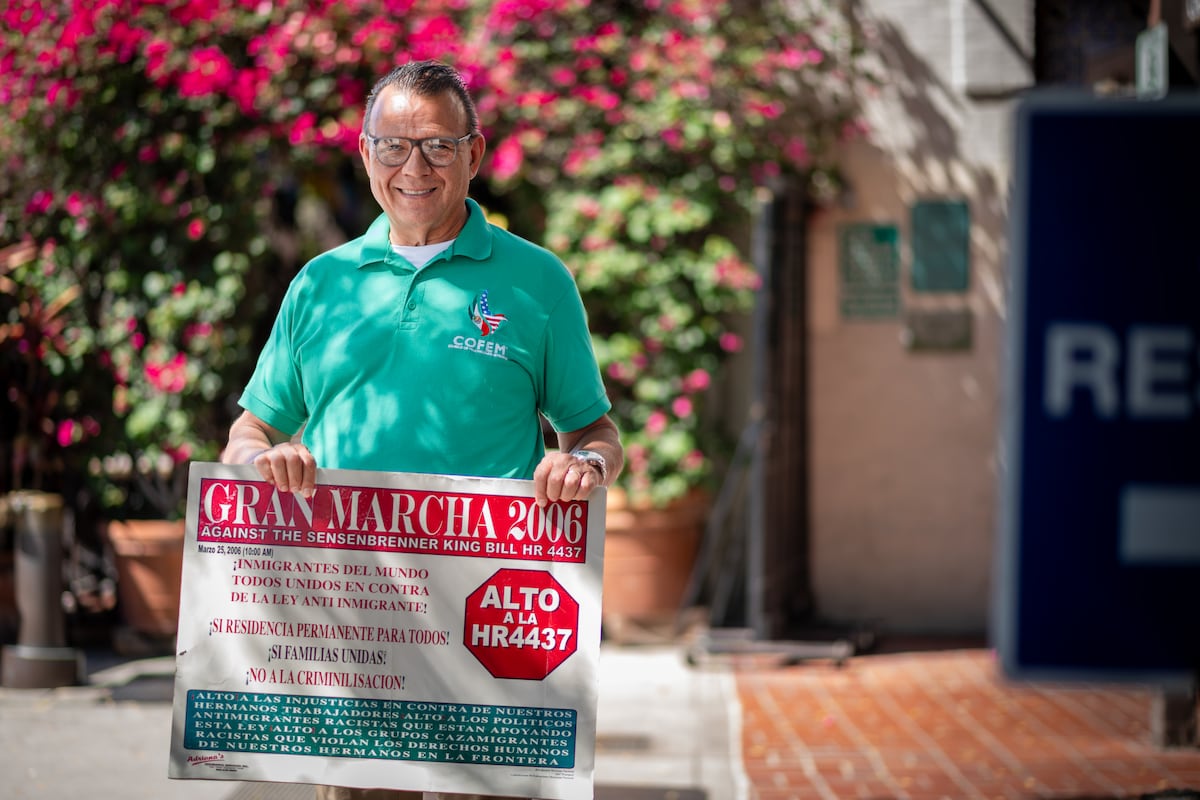
Unprepared for the bluenami — the label for the Democrats’ sweeping midterm victory — U.S. President Donald Trump spent weeks ramping up his anti-immigrant rhetoric at dozens of campaign rallies in support of Republican candidates. “There will be no amnesty for illegals,” he repeated over and over, while blaming undocumented immigrants for crime in U.S. cities and a host of other problems, claims that have been contradicted by numerous studies and reports.But Trump’s tone began to soften as he watched, like millions of Americans, a new political landscape take shape on television screens: Democrats were storming the polls, heading toward control of Congress and winning governorships in key states such as Texas. One of the president’s first reactions was to strike a more conciliatory note on the issue he had long demonized, saying he was willing to sit down and negotiate with Democrats.“We can work with them [the Democrats] on Immigration. I’ve always felt like we should be able to work on immigration,” he said in an interview with FOX News the day after those adverse elections.Activists who have spent decades marching and advocating for immigration reform see the Democrats’ control of Congress as a golden opportunity to reopen that debate. In meetings and discussions since Tuesday’s elections, they have begun talking about returning to the streets to demand an end to immigration raids and the legalization of more than 10 million undocumented immigrants whom the Trump administration has relentlessly targeted since mid-2025. They believe the president, weakened by the election results and facing reduced support in both chambers, may now be willing to compromise.“The blue wave won — what’s next for migrants? Don’t let the Democrats leave us behind and don’t let what happened with president Barack Obama repeat itself, when he said he would leave immigration reform for his second term and didn’t pass it,” says Francisco Moreno, 66, executive director of the Council of Mexican Federations in North America (COFEM). “I don’t see a Trump determined to do it, but maybe it can be achieved.”The Democrats’ blue wave has shaken Trump’s administration just as the United States approaches the 40th anniversary of a milestone event for the country’s immigrant community: the amnesty granted by Republican president Ronald Reagan to millions of undocumented immigrants in 1986.Over the past four decades, much has changed both in the way Republican presidents govern and in the recognition of a population that contributes $1.6 trillion to the country’s gross domestic product. The country has gone from opening the door to the legalization of nearly three million people so they could live and work in peace to a dark era of immigration raids and mass deportations, one marked even by the deaths of migrants and U.S. citizens during violent federal enforcement operations.The benefits of the 1986 amnestyOn November 6, 1986, when a very different political climate prevailed in the White House, Reagan signed the Immigration Reform and Control Act (IRCA), granting legal status and opening a pathway to permanent residency, and eventually citizenship, for undocumented immigrants who had lived continuously in the United States since before January 1, 1982. Migrants of Mexican origin, who remain the country’s largest immigrant group, were the main beneficiaries.During a presidential debate in 1984, Reagan had already signaled his position, defending the regularization of people living in the shadows. “I believe in the idea of amnesty for those who have put down roots and lived here, even though sometime back they may have entered illegally,” he said at the time.“Ronald Reagan did something very smart in supporting immigration reform,” says Raúl Hinojosa, professor of Chicano studies at the University of California, Los Angeles (UCLA). “Because he was from California and at that time he understood that his political base there was the farmers, who needed migrant labor.” Various studies have found that immigrants who benefited from Reagan’s amnesty saw improvements in both their earnings and educational attainment. One such analysis found that, by 1992, six years after the immigration reform, the incomes of workers who had obtained legal status had risen by an average of 15%. Women benefited the most, with earnings increasing by 21%. In addition, four out of 10 Mexicans who obtained permanent residency, or a green card, moved into better-paying jobs.“That initiative helped the U.S. economy more than any other policy decision in the last 40 years. Because it made it possible for millions of people to produce more, earn more, buy homes, start businesses, send their children to college. It was a revolution in those families’ lives,” Hinojosa says. “The problem is that today Donald Trump decided to use the anti-immigrant issue for his own political gain. Not because it benefited the country, nor because it helped the people who voted for him.” What began as a campaign talking point in 2015, when Trump claimed that Mexico was sending drug traffickers, rapists and criminals to the United States, escalated into a second term defined by relentless efforts to make life so difficult for immigrants that they would effectively deport themselves. In many cases, that strategy has proven effective through a sustained campaign of aggressive immigration enforcement operations. In the first year of Trump’s second term alone, nearly 400,000 people were detained by U.S. Immigration and Customs Enforcement (ICE).The crackdown continues despite the damage it has inflicted on sectors that depend heavily on immigrant labor, including agriculture, construction and hospitality.“They’re coming in from the Congo. They interviewed some people last night. ‘Where are you from?’ ‘Congo.’ ‘Where did you live?’ ‘Prison.’ They’re emptying out their prisons into our country,” Trump said at a rally in Ohio last week, repeating another false claim that was met with applause from his supporters.In a sign of the Trump administration’s unpredictability, one of its officials made clear, the day after the midterms, that the hard-line approach would continue. “Deportations will continue,” Markwayne Mullin, the secretary of Homeland Security responsible for carrying out the administration’s immigration agenda, warned in a post on X.Deportations will continue.— Secretary Markwayne Mullin (@SecMullinDHS) November 4, 2026 Juan José Gutiérrez, head of the Full Rights for Immigrants Coalition, also laments the direction U.S. immigration policy has taken when comparing the approaches of the Reagan and Trump administrations. “The contrast shows us that this country, which was admired and served as an example of how a democracy should work, has regressed and is now closed to migration,” he says.‘There are grounds for another amnesty’Moreno believes the case for a new form of immigration relief could build on H.R. 4393, better known as the Dignity Act, introduced in July 2025 by Representative María Elvira Salazar, a Florida Republican, and Representative Veronica Escobar, a Texas Democrat. Escobar was reelected in Tuesday’s elections, while Salazar is still awaiting the outcome of a closely contested race in Miami.The bill would allow undocumented immigrants who have lived in the United States since before December 31, 2020, to apply for protection from deportation, a work permit and travel authorization. The status would be valid for seven years and renewable indefinitely, but it would cost $7,000 and would not provide a pathway to permanent residency. It would also exclude people convicted of certain crimes, including some misdemeanors.“There are grounds for another amnesty,” Moreno says. “Regardless of how fickle the president may be, I believe this is the time to start taking action. It’s one thing that the country has turned blue and that, in theory, Democrats are more progressive in their views on migrants and are our allies; but we can ensure that this support has an impact in Congress. The ideal moment is now.”Moreno is himself a beneficiary of Reagan’s amnesty. Born in the Mexican state of Michoacán, he was 20 in 1980, when he arrived in the United States on a visit and decided to stay. He put his legal studies on hold and began working for a cleaning company in Los Angeles. He had come chasing the dream of becoming a Hollywood actor, but ended up building a different career: one in activism.In his office, he keeps a collection of mementos from the marches he has taken part in. Among them is a banner from the historic demonstration of March 25, 2006, when an estimated one million people took to the streets of downtown Los Angeles to demand the withdrawal of legislation that would have criminalized undocumented immigrants and those who assisted them. The bill in question was the controversial H.R. 4437, introduced by Republican Congressman James Sensenbrenner, which sparked one of the largest waves of public outrage and protest in recent U.S. history. “Yes to families united! No to criminalization!” reads the banner, now yellowed with age.“One of my core causes has been the fight for immigration reform, because I believe that, just as I was able to legalize my status in this country, many other people should have that opportunity and be able to live peacefully with their families,” says Moreno. “The worst part of it all is the fear. ‘Let’s see how this president turns out,’ ‘let’s see how this governor turns out,’ ‘let’s see if he starts attacking us.’ Because there have been all kinds of politicians over the last 40 years, but nothing has happened.” Sign up for our weekly newsletter to get more English-language news coverage from EL PAÍS USA Edition
‘What’s next for migrants?’: The fight for immigration reform after Trump’s midterm defeat
Full Article
Original Source
Read the full article at English →KhanList aggregates and links to publicly available news content. We do not host full articles from third-party sources. Always verify important information with original sources.