
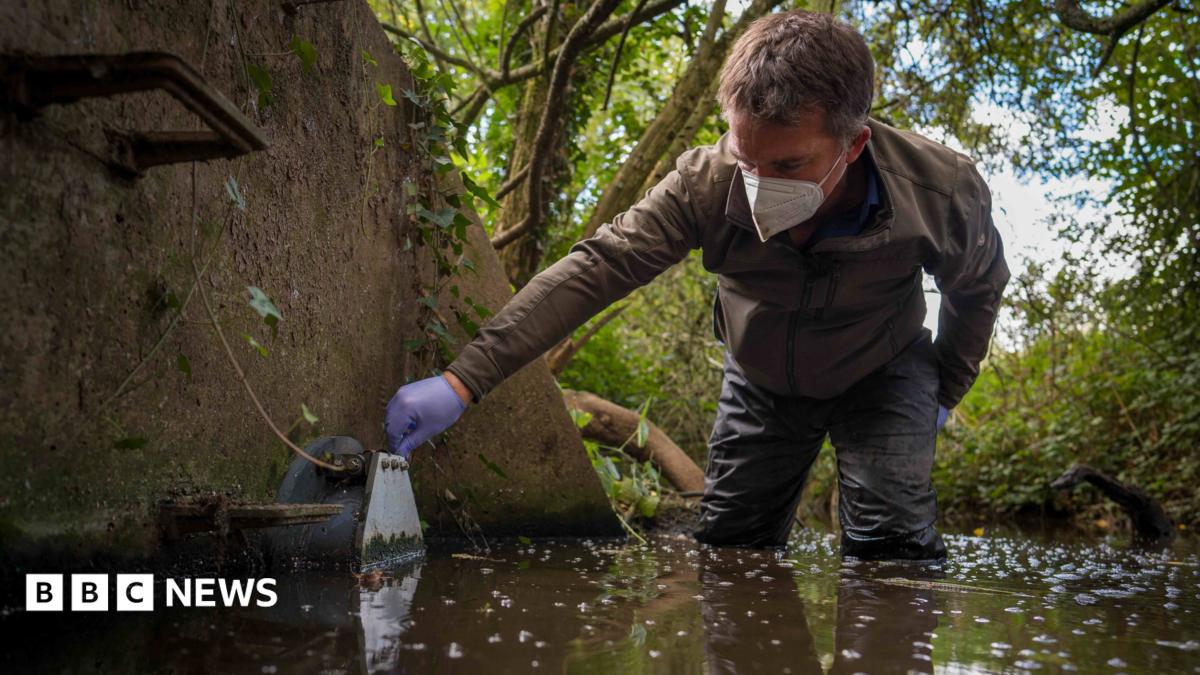
The official sign on the banks of the River Tone at French Weir Park in Taunton advises people not to swim.But that hasn't stopped Jo, Jenny, Sue and a second Jo from enjoying a regular dip together."People think, oh you're swimming down by the supermarket, that can't be very nice, but it's gorgeous," Jenny Hillier says, as the women huddle round with their coats and hot drinks after a bracing October plunge.People have been swimming at the spot on the River Tone in the centre of Taunton for more than a hundred years.But it is only since 2024 that French Weir Park has been designated an official bathing site, which means from May to September the water gets tested by the Environment Agency (EA).Those tests regularly confirm what the women's senses have been telling them for a while - the water quality is poor."There are times when we've come down and we haven't got in, either because of the look or the smell," says Jo Macdonald. "We don't take risks. We don't put our faces in. We don't swim with cuts or anything.""This summer I got quite poorly," Jenny says, explaining that she'd had diarrhoea, vomiting and muscle cramps."I'd swum and then within six hours I was unwell. I was poorly for probably about seven to 10 days and it was not nice. I think it was the river that day."So why is she back swimming in it?"There are germs everywhere, all over the place. You can catch Covid in Tesco," she says. "The counts from just outside the treatment works in my experience were high for treated effluent", Dr Rob Morley from Index Microbiology told us at his laboratory near Bristol as he peered down at small dots of E. coli bacteria on a transparent plastic plate.What was of particular interest to Morley were the results of the test on water samples we'd taken above and below the point where the treated wastewater enters the River Tone.It showed 199 CFU of E. coli above, which is fine for swimming and 7,701 CFU just below, more than eight times the regulators limit."You can see where it's seeding the river with pollution," Morley says."If we were to look further down the river, we would expect the levels to get lower with the dilution effect. But that does quite clearly show the impact that treated effluent can have on the river."We shared our findings with Dr Andrew Thompson, a fellow at the Institute of Chemical Engineers. He was involved in a 2024 report that warned high concentrations of bacteria and viruses were common, external, particularly in the summer when river levels are lower and could cause serious diseases if ingested.Thompson told the BBC the levels of E. coli we found in the River Tone were not illegal, or even particularly unusual, because there are currently no laws or regulations about how much bacteria water companies are allowed to discharge in what the industry calls treated effluent.We also wanted to know whether analysing the E. coli samples from the bathing site could give us clues to where it came from.With assistance from researchers at the University of Bristol, Morley arranged for e-DNA analysis to be carried out to identify whether the E. coli bacteria were more likely to be from a human or animal gut.The answer, as is often the case with water quality, is complex. There were lots of different types of E.coli in the samples."Some were from humans, some were from animals and some were just generic from the environment," Morley says. "It definitely suggests that some of the E. coli is definitely coming from human origins, therefore potentially from that treatment works."As with all of our testing, more needs to be done to reach firm conclusions.Both the EA and Wessex Water are investigating what's causing the water quality in Taunton to be so poor. But sources at the EA told the BBC that constant flows of treated effluent is high up the list of likely culprits.In response to our testing Wessex Water told the BBC its treatment works at Bradford on Tone was working normally and was meeting all its permit conditions set by the EA.So could steady flows of treated effluent loaded with bacteria be behind many of the problems at bathing sites across the UK?"All the sewage treatment works in the UK and in England have permits to protect the ecology and the wildlife within the river," says Jim Flory, a regional manager for the EA in the south-west."They've not set permits for bathing water regulations, which are all about protecting people who may want to be swimming, canoeing or using the water."That has led to a system where a popular bathing site gets officially designated – the testing regime discovers it has high levels of faecal bacteria – and then a lengthy process begins to try to work out where the sources are and whether it's affordable to fix them.
What's gone wrong at Britain's worst bathing site?
Full Article
Original Source
Read the full article at Bbc →KhanList aggregates and links to publicly available news content. We do not host full articles from third-party sources. Always verify important information with original sources.