
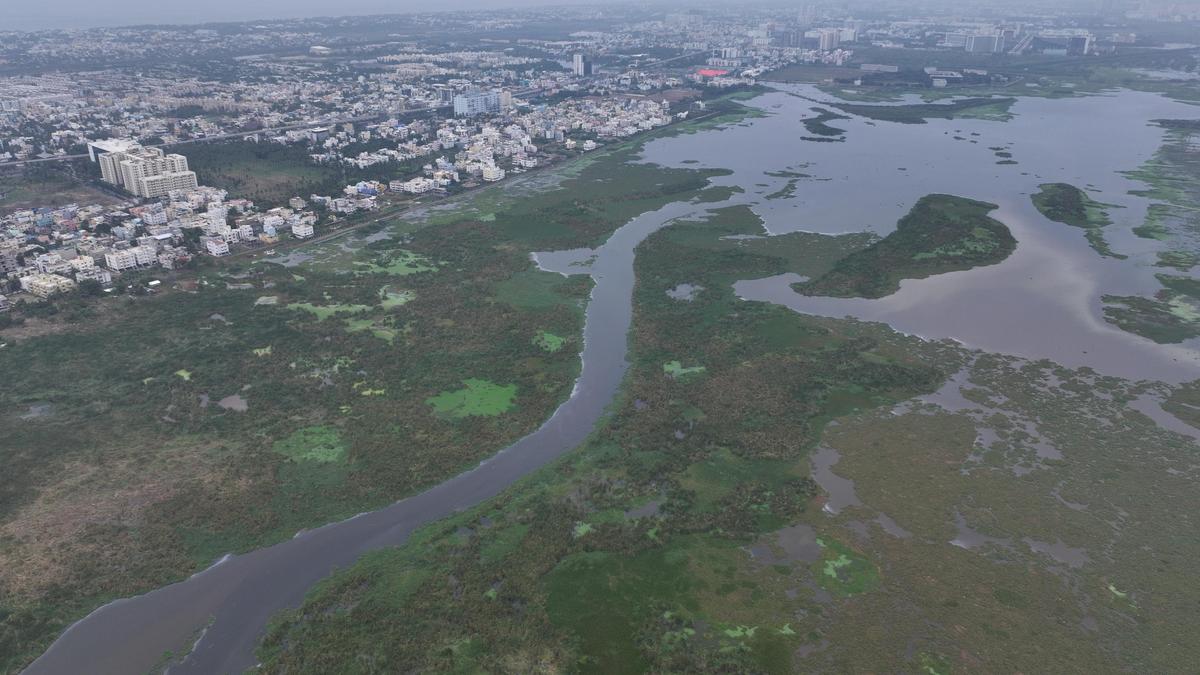
Pallikaranai marsh. File | Photo Credit: B. Jothi Ramalingam The Madras High Court on Wednesday (November 18, 2026) disposed of a batch of cases filed against a construction ban imposed by the National Green Tribunal (NGT) on a radius of 1 km around the 1,247.54-hectare Pallikaranai marshland in Chennai, with liberty to the petitioners to approach the Supreme Court for acceptance of a much smaller interim zone of influence.The First Division Bench of Chief Justice Sushrut Arvind Dharmadhikari and Justice G. Arul Murugan were of the view that since the Supreme Court was seized of the larger issue of protecting all wetlands across the country, only the top court would be the appropriate authority to take a call on the interim ZoI proposed by the Tamil Nadu State Wetlands Authority.Therefore, all the writ petitioners, including CREDAI-Chennai, before the High Court would have to approach the Supreme Court either by getting impleaded in the pending cases or by instituting fresh proceedings for the purpose of acceptance of the much smaller interim ZoI proposed over a much smaller area of 128.19 hectares in 36 survey numbers, the Bench said.The Chief Justice’s Bench also directed the TNSWA as well as all other authorities to complete at the earliest the ‘ground truthing’ exercise (an exercise that had to be carried out at the ground level to cross-verify details obtained through satellite maps) required to be done before determining the final ZoI around the boundaries of the Pallikaranai marsh.The TNSWA had come up with the proposed interim ZoI after CREDAI-Chennai and other writ petitioners before the High Court had contended that the arbitrary determination of a 1-km zone, around the existing boundaries of the Pallikaranai marsh, as a no-construction zone by the NGT had affected construction activities on 3,474 hectares in south Chennai.The petitioners contended the construction ban imposed by the NGT had affected hundreds of immovable property owners as well as realtors who had been put to hardship. They also claimed such arbitrary ban could not be imposed when the boundaries of the marshland itself had not been demarcated conclusively so far.TNSWA’s proposalDuring the hearing, the TNSWA, on its part, submitted a map of a proposed interim ZoI spread over 128.19 hectares in 36 different survey numbers. It said, even within the interim ZoI, construction activities need not be banned throughout the entire zone and that it could be regulated based on site-specific, scientific, and hydrological characteristics.The authority told the court there could be a prohibition on blocking, diversion or obstruction of established inlet and outlet channels, natural drains or hydrological pathways in the proposed interim ZoI.Similarly, dumping of solid waste, construction waste, and other waste on the drainage pathways could be prohibited and there could be a prohibition also on the discharge of untreated sewage, effluents, or wastewater into the watercourses connected with the wetland. Permanent alteration of established hydrological connections could also be banned and red-category industries with high pollution potential could be prohibited.“In case of construction, necessary no-objection certificate shall be obtained from the district-level wetlands management committee in accordance with the proposed regulatory mechanism. The proposed regulatory framework is intended to ensure that developmental activities do not obstruct the natural flow of water into or out of the Pallikaranai Ramsar site or adversely affect its ecological character together with balancing the development needs of society and the government,” the TNSWA’s report read.The court was also told the final ZoI shall be determined only after completion of scientific and cadastral exercises and ground truthing in accordance with the Wetlands (Conservation and Management) Rules, 2017, and the guidelines framed under them. Published - November 18, 2026 12:01 pm IST
Pallikaranai marsh construction ban: Madras HC asks litigants to approach Supreme Court for interim relief
Full Article
Original Source
Read the full article at Thehindu →KhanList aggregates and links to publicly available news content. We do not host full articles from third-party sources. Always verify important information with original sources.