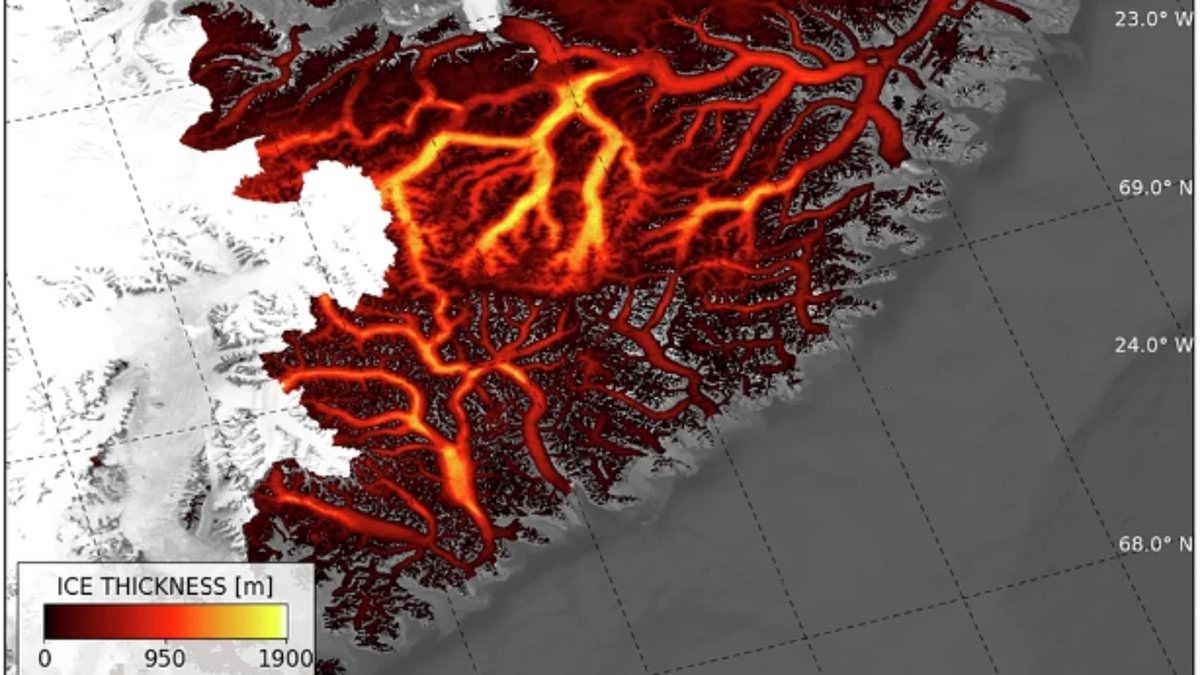
A new study has revealed just how much water is locked away in the world's glaciers – and the devastating consequences if it were all released into the oceans.Researchers estimate that glaciers outside the vast ice sheets of Greenland and Antarctica contain around 150,000 cubic kilometres of ice.If every one of these glaciers melted completely, it would raise global sea levels by more than 12 inches (32.3cm).Some glaciers are already disappearing at an alarming rate as global temperatures rise, with those in the mountains among the clearest signs of a warming planet.Glaciers in regions such as the Alps, Andes and Himalayas have suffered dramatic losses in recent decades as warmer air melts ice faster than it can be replaced by snowfall.The researchers said knowing exactly how much ice glaciers contain is crucial for predicting how they will respond to a warming climate.'We must move quickly,' said researcher Niccolò Maffezzoli, from Ca' Foscari University of Venice.'Glaciers at midlatitudes, including those in the Alps, are expected to disappear within the next few decades.' In one example the Geikie Plateau in eastern Greenland (pictured) was found to contain almost twice as much ice as previously estimated, with glaciers there reaching up to 2km thick For the study, the team developed an AI model called IceBoost v2.0, which was trained using more than seven million measurements of ice thickness collected from glaciers around the globe.It combined these observations with 26 physical and geographical factors, including the slope and curvature of the land, ice speed and temperature.The model was then used to estimate the thickness and volume of every glacier listed in the Randolph Glacier Inventory, the most up–to–date global catalogue of glaciers.Its estimates matched field observations up to 40 per cent more accurately than previous methods, giving scientists a clearer picture of where the world's ice is stored.In one example, the Geikie Plateau in eastern Greenland was found to contain almost twice as much ice as previously estimated, with glaciers there reaching up to 1.2 miles (2km) thick.The model, published in the journal Scientific Data, will be used by scientists developing simulations of how glaciers could change by 2100 and how much they could contribute to rising seas.According to the new estimates, the world's glaciers – excluding those in Antarctica and Greenland – contain the equivalent of 32.3cm (12.7 inches) of sea level rise if they were to melt completely.This could be catastrophic for the hundreds of millions of people who live in coastal cities around the world, which would become much more susceptible to extreme flooding. Some glaciers are already disappearing at an alarming rate as global temperatures rise, with mountain glaciers among the clearest signs of a warming plane. Pictured: The Bagley Icefield and Bering glacier system in Alaska The model was used to estimate the thickness and volume of every glacier listed in the Randolph Glacier Inventory, the most up-to-date global catalogue of glaciers (pictured) What are glaciers? A glacier is a large, persistent mass of dense ice formed over centuries from compressed snow.It moves slowly downhill under its own weight, acting as a 'river of ice' eroding surrounding landscapes.Glaciers are found in cold regions and high altitudes, covering about 10 per cent of Earth's land and acting as a vital freshwater source. The study also highlights another danger from shrinking glaciers – the loss of freshwater around the world.Glaciers help sustain rivers, agriculture and local communities, with around 1.9 billion people dependent on glacier–fed water to some degree.As the ice disappears, some regions could initially receive more meltwater before facing a much more serious decline once their glaciers have shrunk.Last month, a separate group of experts warned that rising sea levels could plunge 1.7 million more Brits' homes underwater by 2300 and render parts of the UK uninhabitable.Researchers from the Met Office and the University of Bristol used computer models to see how many people will be at risk of coastal flooding by future climate change.Their chilling results show that at least half a million more people will be exposed to floods by the end of the next century.Concerningly, the researchers warn that these dramatic changes are now all–but certain and will happen unless dramatic measures are taken in the coming decades.Even if all the world's carbon emissions pledges are met, over 1.4 million people will be at risk of flooding by 2200, rising by a further 0.3 million by 2300. The Novaya Zemlya archipelago, in the Russian Arctic, is covered in ice with some peaks 610m (2,000 feet) thick, the model showsThis is especially bad news for people living in the Wash and the Humber Estuary, which stand out as 'hot spots' for future coastal flooding.Lead author Professor Matt Palmer, of the University of Bristol, says: 'The oceans and ice–covered parts of the world respond very slowly to global warming, which makes sea–level rise the 'sleeping giant' of climate change.'The result is that sea–level rise is 'locked–in' for centuries to come.'Globally, the average sea level has risen by 3.64 millimetres per year since 1999, for a total of 9.38cm over the last 26 years.About 30 per cent of that increase comes from the ocean expanding as it warms, while the remaining 70 per cent mainly comes from melting glaciers and ice sheets.While this trend has been relatively stable for decades, recent satellite data shows that this increase rapidly accelerated after 2012, jumping to 4.1mm per year.GLACIERS AND ICE SHEETS MELTING WOULD HAVE A 'DRAMATIC IMPACT' ON GLOBAL SEA LEVELSGlobal sea levels could rise as much as 10ft (3 metres) if the Thwaites Glacier in West Antarctica collapses. Sea level rises threaten cities from Shanghai to London, to low-lying swathes of Florida or Bangladesh, and to entire nations such as the Maldives. In the UK, for instance, a rise of 6.7ft (2 metres) or more may cause areas such as Hull, Peterborough, Portsmouth and parts of east London and the Thames Estuary at risk of becoming submerged.The collapse of the glacier, which could begin with decades, could also submerge major cities such as New York and Sydney.Parts of New Orleans, Houston and Miami in the south on the US would also be particularly hard hit.A 2014 study looked by the union of concerned scientists looked at 52 sea level indicators in communities across the US.It found tidal flooding will dramatically increase in many East and Gulf Coast locations, based on a conservative estimate of predicted sea level increases based on current data.The results showed that most of these communities will experience a steep increase in the number and severity of tidal flooding events over the coming decades.By 2030, more than half of the 52 communities studied are projected to experience, on average, at least 24 tidal floods per year in exposed areas, assuming moderate sea level rise projections. Twenty of these communities could see a tripling or more in tidal flooding events.The mid-Atlantic coast is expected to see some of the greatest increases in flood frequency. Places such as Annapolis, Maryland and Washington, DC can expect more than 150 tidal floods a year, and several locations in New Jersey could see 80 tidal floods or more.In the UK, a two metre (6.5 ft) rise by 2040 would see large parts of Kent almost completely submerged, according to the results of a paper published in Proceedings of the National Academy of Science in November 2016.Areas on the south coast like Portsmouth, as well as Cambridge and Peterborough would also be heavily affected.Cities and towns around the Humber estuary, such as Hull, Scunthorpe and Grimsby would also experience intense flooding.
What will happen if Earth's glaciers melt? Terrifying study reveals how their demise could spark 12 INCHES of global sea-level rise - plunging entire communities underwater
Full Article
Original Source
Read the full article at Dailymail →KhanList aggregates and links to publicly available news content. We do not host full articles from third-party sources. Always verify important information with original sources.