
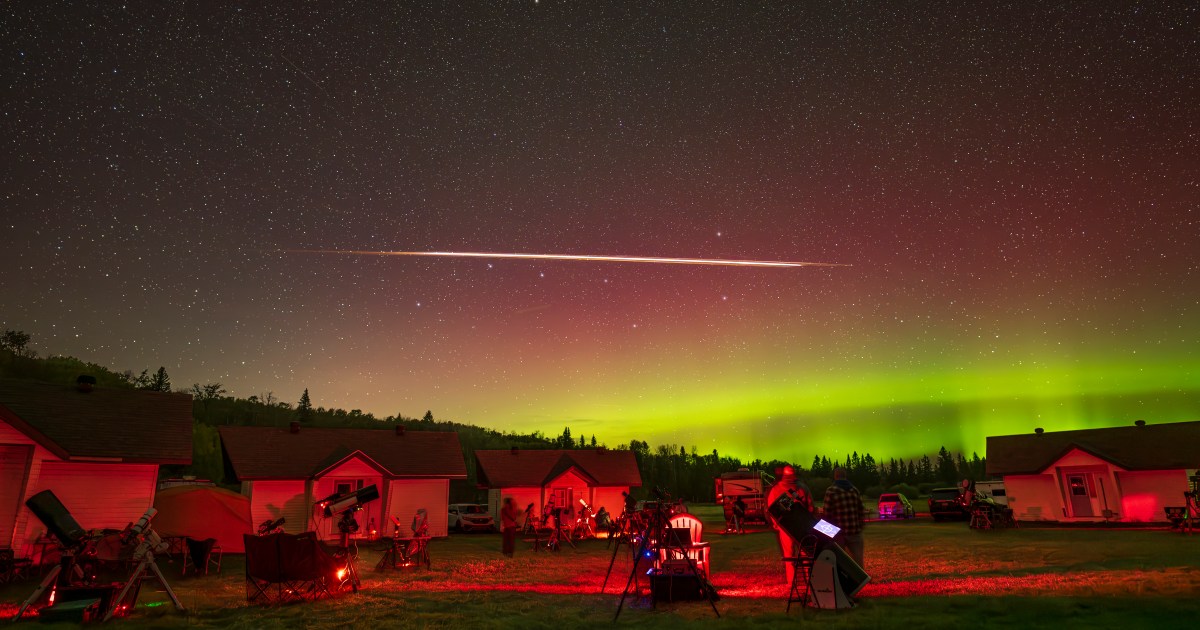
A Starlink satellite meets a fiery demise as it reenters the atmosphere, breaks up, and vaporizes in this long-exposure photograph taken at the Southern Alberta Star Party in the early morning hours of Sept. 23, 2025. Credit: Alan Dyer It was the lithium that gave it away, says Daniel Murphy, an atmospheric chemist at the National Oceanic and Atmospheric Administration. It was early 2023, in Fairbanks, Alaska, in the deep blue of winter, and Murphy and his colleagues had just sent a plane through the stratosphere, the atmospheric stratum 6 to 31 miles (10 to 50 kilometers) above Earth’s surface where the protective ozone layer lies. Their experiment came as interest was growing in controversial proposals to cool the planet by injecting certain aerosols into the atmosphere — a form of geoengineering. The team hoped to get a baseline measurement of the chemistry of the upper atmosphere, before any geoengineering experiments altered the hard-to-reach atmospheric layer. The lithium showed they were too late. A Falcon 9 rocket carrying 53 Starlink satellites lifts off from Vandenberg Space Force Base in October 2022. Credit: SpaceX/CC BY-NC 2.0 The team expected to find trace amounts of metals naturally deposited by meteoroids, which constantly bombard and burn up in Earth’s atmosphere. But their data showed way more lithium in stratospheric particles than is typically present in meteoroids. “That’s what led us to the other metals,” Murphy says. Analyzing their samples, they also found higher than expected levels of aluminum, plus significant amounts of other metals like copper and lead that are scarcely found in meteoroids and must have come from some other source. Then there were the more exotic metals like niobium and hafnium, which appeared in their samples in the same ratio as in an alloy used to manufacture rocket engine nozzles. The data pointed to an obvious culprit: human-made objects such as satellites and spent rocket stages that fall back to Earth from orbit and reenter the atmosphere. On the way down, they wear away and disintegrate under the heat of friction — a process known as ablation. Later that year in the Proceedings of the National Academy of Sciences (PNAS), Murphy and his colleagues reported that 10% of stratospheric aerosol particles carried metals from spacecraft. The number was shocking, but not altogether surprising. Reentries have been rising sharply in recent years as corporations and countries began launching megaconstellations of thousands of satellites, like SpaceX’s Starlink. And all those satellites will inevitably deorbit. Since Murphy and his colleagues’ 2023 report, it’s become clear that human-made satellites are now dumping more of certain metals into the upper atmosphere than meteoroids naturally do. This influx has raised concerns that the metals might catalyze chemical reactions that destroy ozone, alter cloud formation, or boost or buffer the greenhouse effect. Researchers say it’s too soon to know for sure if the metals are a serious environmental problem. But megaconstellations are growing faster than our ability to close these knowledge gaps. At the same time, the uncertainty over whether regulators might have to act presents a big risk to the space industry, says Martin Ross of the Aerospace Corporation, a research and development nonprofit based in El Segundo, California, and a co-author of the 2023 study. “We would call it an enterprise risk,” says Ross, “in that the longer we wait to see if there is something going on, the bigger the mitigation will be — if there needs to be any mitigation — down the line.” Design for demise From our vantage point on Earth, space may be incomprehensibly vast, but the orbital environment is not. Six years ago, according to the U.S. Space Force’s public catalog, there were some 13,700 trackable objects circling in low Earth orbit; last year, the number had climbed to nearly 25,000. Disposing of satellites in the atmosphere reduces overcrowding and the risk of uncontrolled objects crashing into each other — and potentially setting off a chain of collisions that wipe out key space-based technologies or turn Earth orbit into an impenetrable debris field. RELATED: Our increasingly cluttered skies “Reentry is the only sustainable, short-term way of cleaning up the orbital environment,” says José Pedro Ferreira, a doctoral candidate in astronautical engineering at the University of Southern California (USC) in Los Angeles, who left an industry job for academia in the early 2020s when it became clear that reentry could have unintended consequences. “We need to do it, otherwise we may undermine our capability of accessing orbit.” But operators are also typically held responsible by their national regulators for any damages their spacecraft cause on the ground, and for decades the industry has designed spacecraft to burn up as much as possible in the atmosphere to minimize the risk to lives and infrastructure on the ground, a principle known as design for demise. As a result, the space industry has long perceived its impacts to Earth as minimal. But in the age of megaconstellations, that’s no longer the case. “As with everything, we live in a closed system,” says Ferreira, “and things do not disappear.” SpaceX launched its first 60 satellites into orbit in May 2019 to bring internet to even remote regions of the globe; less than a decade later, Starlink’s constellation is more than 10,000 satellites strong. Starlink already comprises roughly two-thirds of active satellites, and SpaceX plans to grow it to as many as 42,000. Other countries and corporations are not far behind: Amazon Leo is authorized by the Federal Communications Commission (FCC) to operate roughly 7,700 satellites; China has plans to deploy some 28,000. Not only are we launching more than ever, but we’re also bringing spacecraft back down faster than ever before. For decades, spacecraft have been designed to burn up as much as possible upon reentry to minimize risks to those on the ground. As a result, the space industry has long perceived its impacts to Earth as minimal. But in the age of megaconstellations, that’s no longer the case. Historically, satellite operators had what Ferreira calls a “gentleman’s agreement” to deorbit their spacecraft within 25 years of mission termination to prevent orbital clutter. Recently, some national authorities have begun enforcing even tighter timelines. The FCC, for example, now enforces a five-year window. “If you have 50,000 satellites in orbit, which is almost surely going to be reached in the not too distant future, with a design lifetime of five years,” Murphy says, “that would mean a satellite would be reentering and burning up in the atmosphere on average more than once an hour.” Operators of megaconstellations may use even shorter timelines for deorbiting satellites, according to Ferreira, bringing them down at the first sign of malfunction. “Which is great from a standpoint of orbital sustainability,” he says, “but it starts raising the question more and more about what the impacts are in the atmosphere.” There are reasons to be concerned. Aluminum, for example, which makes up the bulk of most spacecraft, may form aluminum oxides as it breaks down during ablation, which can kick-start a chain of chemical reactions that eat away at ozone, Earth’s main shield against UV radiation. Some atmospheric models suggest that metals from spacecraft in stratospheric particles could seed polar stratospheric clouds, further accelerating ozone depletion. Injecting aluminum into the upper atmosphere is also the basis of many controversial geoengineering plans. Aluminum compounds would block radiation from the Sun, which could cool down our warming planet. But they might also entrap radiation reflected off the surface of the ocean, which could increase surface temperatures. Opposition to geoengineering has so far stymied any field experiments, but with the number of reentries rising from a few hundred to many thousands per year, an uncontrolled geoengineering experiment on a grand scale may have already begun. “The metals are at the same altitude range as the ozone layer, so we have to be concerned about what they would do,” Murphy says. “We don’t know it’s bad, but we don’t know it isn’t bad either.” Aluminum is one of the most common materials used in the structures of satellites, like the Starlink illustrated here. Credit: Astronomy: Roen Kelly/Malacodart/NASA Conflicting models One reason it’s so difficult to predict the impacts of ablation is that we don’t yet understand what happens to spacecraft during ablation. “We reenter things all the time and we have been since the moment we started launching spacecraft,” says Stijn Lemmens, a space debris mitigation analyst at the European Space Agency (ESA). “It’s fascinating, for something which is so ubiquitous, how little we actually know about it, and how little we used to care about it.” Operators have long been incentivized to design spacecraft to burn up as much as possible in the atmosphere, and decades of this design for demise ethos has given the space industry a solid idea of how much material — or how little — will make it to the ground when objects burn through the atmosphere. But in terms of that material that is ablated, “we’re really in the dark,” says Ross. Previous studies have suggested that around 90% of the bodies of orbiting satellites and spent upper stages could be vaporized, later condensing into the nanosized particles the team detected. But, says Ross, “we really don’t understand how these vehicles melt, how they break apart, how they form smoke trails.” To quantify the impacts on the atmosphere, researchers start with atmospheric models and then add ablated material, examining how those particles interact with the natural stratospheric background via complex chemical reactions and physical processes like mixing. But the outputs of the atmospheric models are currently held back by our limited understanding of the fiery, complex process of ablation — details like what compounds are being emitted and what size particles are being formed. “We’re basically guessing at this point,” Ross says. “And we’re getting to the limit of what we can do with guessing.” To do better, scientists are developing new models of the physics and chemistry of ablation itself. At USC, Ferreira and his colleagues model how ablation produces aluminum oxides in the upper atmosphere, providing atmospheric researchers with inputs for both emissions and particle size. In a 2024 study in Geophysical Research Letters, the team reported that a 550-pound (250 kilograms) satellite — about the size of your average megaconstellation satellite — could deposit some 66 pounds (30 kg) of aluminum oxide nanoparticles in the upper atmosphere. Such particles could remain aloft for upwards of 30 years, potentially catalyzing ozone-destroying reactions as they settle throughout the stratosphere for decades after reentry. But state-of-the-art ablation models don’t always agree on what products are being formed, according to Ross. A model from researchers at the University of Leeds in the U.K. suggests that aluminum hydroxide, rather than aluminum oxide, may be the main byproduct. To validate ablation models and get more useful data from atmospheric models, we need more measurements from reentries. How an object breaks apart as it tumbles through the air is a messy process — a product of astrophysics, fluid mechanics, materials science, and engineering. “You cannot reproduce it on Earth,” Lemmens says. “There is no facility large enough to, in one assessment, combine all the effects.” That means scientists need to measure ablation where it’s actually taking place — “take instruments and put them on airplanes and go out and watch these things reenter,” Ross says. Since the beginning of the Space Age, these kinds of measurements have only been taken a handful of times. Observing space objects from an airplane as they streak through the atmosphere is difficult work — and potentially dangerous. Most reentering objects are uncontrolled, making it hard to predict exactly where the object will hit the atmosphere and how much of it will burn up in the process. Researchers need a degree of certainty to avoid sending a plane full of scientists and sensors up into a debris field. “These types of reentries, which are destructive and still predictable so that you can get close, are extremely rare,” Lemmens says. But in 2024, ESA got lucky. The first of four Cluster II satellites — launched in 2000 to study Earth’s magnetosphere — was poised to reenter the atmosphere, and the agency had a pretty good idea of exactly where and when it would break up over the southern Pacific Ocean. The ESA reentry science team poses on the tarmac in Sydney with their research plane, a modified Dassault business jet, before deploying to Easter Island. Credit: Falcon Air “We could get close,” Lemmens says. “The drawback is it was in broad daylight, which had not been attempted before on this level of detail.” In daytime, the team would have no visual confirmation of reentry, and it would be harder to get clean data than at night. The team had to trust they were pointing their instruments at the right spot, and then look at their data after the fact to see if they caught it. “In the end, it’s a leap of faith,” Lemmens says. “You predict as well as you can, you fly the plane as well as you can, but in the end, you do it all in the blind,” he says. On Sept. 8, a team of scientists took off from Easter Island on a modified Dassault Falcon 900 business jet packed with instruments, and pointed their cameras just above the bright blue horizon roughly 500 miles (800 km) away. The team used spectroscopic instruments to identify which vapors were coming from the ablating satellite. Since the team knew the material makeup of the satellite, they could gauge its surface temperatures during reentry, as the appearance of specific ions would indicate a certain material had reached its melting point. Altogether, they captured about 20 seconds of the reentry. Two more satellites from the same cluster were set to reenter within 24 hours of each other on Aug. 31 and Sept. 1, 2026, giving ESA another opportunity to capture more of the reentry process and to fully reconstruct the breakup. For researchers, one upside to the rapid and unmitigated increase in satellite reentries is more opportunities to capture the process in action. Some of the best data yet to come will be collected by ESA’s Draco mission, in which the agency plans to build and launch a satellite with the “sole purpose of falling apart again,” says Lemmens. Draco will launch in 2027 with an indestructible capsule that will survive reentry, protecting the data collected from the surface of the satellite as it’s torn apart by the atmosphere. Researchers will be able to combine these onboard data with remote observations, using them to improve or validate existing models of ablation. “That means we, for the first time, will actually have the full story without any ambiguities,” Lemmens says. In September 2024, ESA sent a plane and a team of researchers to the South Pacific Ocean to observe a satellite as it burned up in the atmosphere. While not visible to the naked eye, it was captured in this photograph as a point of light outside the window. Credit: ESA/ROSIE/University of Southern Queensland. Acknowledgements: Image taken by Ranjith Ravichandran and Gerard Armstrong An enterprise risk Once a scientific consensus is reached, then mitigation measures, whether technological or regulatory, can be deployed. If research confirms that one material or another in spacecraft is particularly damaging to the atmosphere, for example, space operators can remove and replace it. “That was the basis of the success of the Montreal Protocol,” says Ross. After scientists discovered a hole in the ozone layer in the 1980s, every country in the world signed on to the Montreal Protocol, an international agreement to control the ozone-depleting substances humans were emitting into the atmosphere. The hole has been shrinking ever since. Signed in 1987, the agreement is widely considered one of the most successful environmental treaties to date. Since then, however, other global climate agreements have not fared as well. Still, many remain optimistic, including Ross. He points to the commercial space industry’s track record of working with regulators and astronomers to reduce space debris and light pollution. “There is some current flowing in those lines,” he says. RELATED: Can robots save Earth orbit? Some operators have already expressed a commitment to acting on whatever guidelines come out of research on the atmospheric risks. “The difficulty that I have as a responsible operator is, in this particular case, I don’t know what to do,” Vijay Thakur, a technical authority at French satellite corporation Eutelsat, said at an October 2025 panel at the Secure World Foundation’s 7th Summit for Space Sustainability in Paris. There are clear brightness limits he can follow to mitigate impacts to the astronomical community, he noted, but no such guidelines exist yet for atmospheric impacts. The European Space Agency’s Draco mission will send a spacecraft to orbit that will reenter the atmosphere as a test subject. Onboard instruments will collect data to help scientists better understand how satellites burn up and what compounds they release into the atmosphere. Credit: ESA “I want to put the right technical requirements, for me as the operator customer, onto industry so they can build what I need to operate and take it up and bring it back down without damaging anything from 0 kilometers to the von Kármán line,” Thakur said, referring to the commonly accepted boundary of outer space at 62 miles high (100 km). “Help.” There are some design tweaks currently available that could reduce emissions and help more of each spacecraft survive reentry, including non-ablative heat shields and inflatable aerodynamic decelerators, according to Adam Mitchell, a materials and processes evaluation engineer at ESA. Of course, the more of a spacecraft that survives reentry, the greater the risk on the ground during uncontrolled reentries — and most reentries are uncontrolled. “There is this balance between sustainability and safety, but when it comes to human safety, there is no compromise at all,” Chris Young, space sustainability senior lead at the U.K. Space Agency, said at the same Secure World Foundation panel. “Design for demise has to take priority.” Satellite builders could also consider replacing problematic metals — but that comes with its own trade-offs. In 2024, the world’s first wooden satellite, LignoSat, launched to orbit in a partnership between Kyoto University and Japanese logging firm Sumitomo Forestry. A cube of magnolia wood panels, LignoSat will give researchers insights into how well wood holds up in the space environment, and how cleanly it burns up in the atmosphere. Carbon fiber is another material of interest, according to Ferreira. But these organic materials may release black carbon into the upper atmosphere, which may absorb sunlight or reflect it, depending on the structure the carbon takes. Ross thinks we can close the remaining knowledge gaps in short order — and that those lessons can be applied almost immediately. “We can do that before the next generation of satellites comes along,” he says, “but we just need the resources.” A cultural revolution is coming for the industry, regardless of what’s discovered about the impacts to the atmosphere. “The one-use, nonrecyclable culture that we have in space, of, ‘We’ll launch something to space with rare Earth minerals that are of limited supply and then burn them all up in the atmosphere after one use,’ that is unsustainable,” said Young. A sustainable future — one that balances both Earth and space sustainability — will involve creating something we haven’t quite nailed yet in our earthbound industries. “We need to move beyond the single-use mindset that currently defines much of spacecraft design and accelerate the transition toward an in-space circular economy,” Mitchell says. Can we do in space what we’ve failed to do on Earth? Right now, researchers are gathering data as fast as they can, as fast as resourcing allows, to inform models of ablation and atmospheric processes that will eventually be validated by measurements taken during reentry. Then, equipped with actionable data, we can act. Kate Wheeling is a freelance journalist based in Santa Barbara, California. She writes about the environment and humans’ relationship with the natural world. Her work has appeared in The Atlantic, Smithsonian magazine, The Daily Beast, and Mother Jones.
What satellites leave behind
Full Article
Original Source
Read the full article at Astronomy →KhanList aggregates and links to publicly available news content. We do not host full articles from third-party sources. Always verify important information with original sources.