
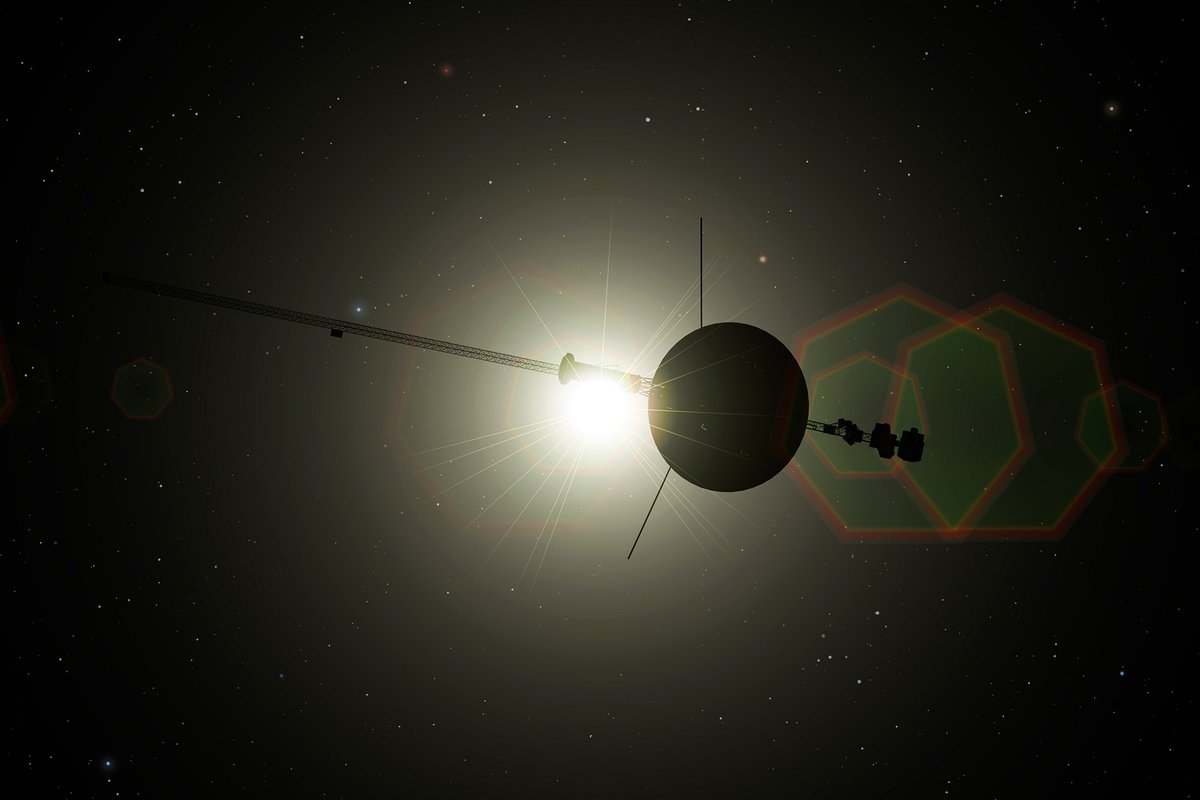
November 19, 20263 min read Add Us On GoogleAdd SciAmNASA scientists gathered on Thursday to discuss the mission’s past, present and futureAn artist’s concept of NASA’s Voyager 1, the space agency’s venerable and farthest-flung interplanetary probe. Mark Garlick/Science Photo Library/Getty ImagesOn Thursday, at around 5 A.M. EST, while we all slept on our “Pale Blue Dot,” scientists at NASA’s Jet Propulsion Laboratory (JPL) received a signal from Voyager 1 confirming it had indeed reached one light-day, around 16 billion miles, away from Earth. Technically, Voyager hit the distance on Wednesday, but because it is so far away, communications between it and Earth are delayed.Voyager 1’s milestone, the farthest any human-made object has ever been from Earth, comes after almost half a century worth of solar system exploration alongside its sister spacecraft Voyager 2. They were both launched in 1977 to explore the outer solar system and the limits of the sun’s influence.“My hope is that Voyager, just as it was inspirational to us, is inspirational to the next generation,” said Suzanne Dodd, NASA’s Voyager project manager, at a press conference on Thursday. “One light-day is a great milestone, but I think we’re going to have more milestones to come.”On supporting science journalismIf you're enjoying this article, consider supporting our award-winning journalism by subscribing. By purchasing a subscription you are helping to ensure the future of impactful stories about the discoveries and ideas shaping our world today.In its lifetime, the Voyager mission has provided insights into Saturn, Jupiter, Neptune, Uranus, and more. Now its legacy is informing missions such as the Europa Clipper, which is expected to arrive at Jupiter in 2030 to study the planet’s icy moon Europa. We would know nearly nothing about Europa if not for Voyager. The same goes for Dragonfly, a mission launching in 2028 to explore Titan, Saturn’s largest moon.“The discoveries of Voyager really opened the door to the outer solar system,” said JPL chief scientist Jonathan Lunine at the same press event.As for the Voyager spacecraft themselves, each data point we receive from them now is “precious” and unprecedented, said Nicky Fox, associate administrator at NASA’s Science Mission Directorate. Both Voyager 1 and Voyager 2 are in interstellar space, or the area between our solar system and others, and are collecting data with their active instruments about how our sun influences this in-between place. Both spacecraft have tools that measure plasma waves and magnetic fields, as well as a system that measures cosmic rays.“We’re at a very exciting time of starting to connect what we know and what we’ve seen living with this star to what is out there,” said Jamie Rankin, Voyager deputy project scientist.At nearly 50 years old, the spacecraft are aging gracefully—but aging nonetheless. As of a few days ago, NASA has not been able to receive scientific data from Voyager 1. And earlier this year the team chose to shut down several power-hungry devices on both spacecraft to conserve energy. Much of the team’s current work involves confronting and finding solutions for nearly constant new anomalies, said Kareem Badaruddin, Voyager mission manager.“An engineer with a problem is like a dog with a bone, so we are very busy and very energized to solve these problems,” he said.Voyager 1 is expected to lose power in 2036, at which point it will no longer communicate with Earth. But it will keep shooting through space. Set for a destination of 17 light-years away, it carries a “Golden Record”—a history of Earth and humanity meant for any extraterrestrial life the spacecraft may encounter.“There’s no end for the Voyager mission,” Fox said.Subscribe to Support Independent JournalismGreat science journalism requires human expertise, time, effort and creativity. And it costs money. That’s why I and the journalists here at Scientific American hope you’ll join our community.When you subscribe, you are supporting staff and freelance journalists who are passionate about telling science stories that are true, important and compelling. Our editors and reporters are often experts in their fields, which means they understand the nuances of big discoveries and can untangle the breakthroughs from the hype. With a subscription, you are also supporting rigorous fact-checking to ensure the words we publish are precise and accurate. And you’re supporting original illustrations, graphics and photos that bring you closer to an advanced laboratory, an ice sheet in Antarctica or a space mission in orbit. You’re helping us craft other types of high-quality journalism as well: Our newsletters are carefully written, edited and curated by staffers you have or will come to know and love. Our Science Quickly podcast is based on original reporting, collaboration with editors and scientists and exacting production.Subscriptions keep this engine running so we can continue to deliver thoughtful, rigorous and independent science journalism to you. In an era of viral misinformation, this work is crucial. If you value what we do, I hope you’ll consider joining us as a subscriber
Voyager 1 is a light-day away. What now?
Full Article
Original Source
Read the full article at Scientificamerican →KhanList aggregates and links to publicly available news content. We do not host full articles from third-party sources. Always verify important information with original sources.