
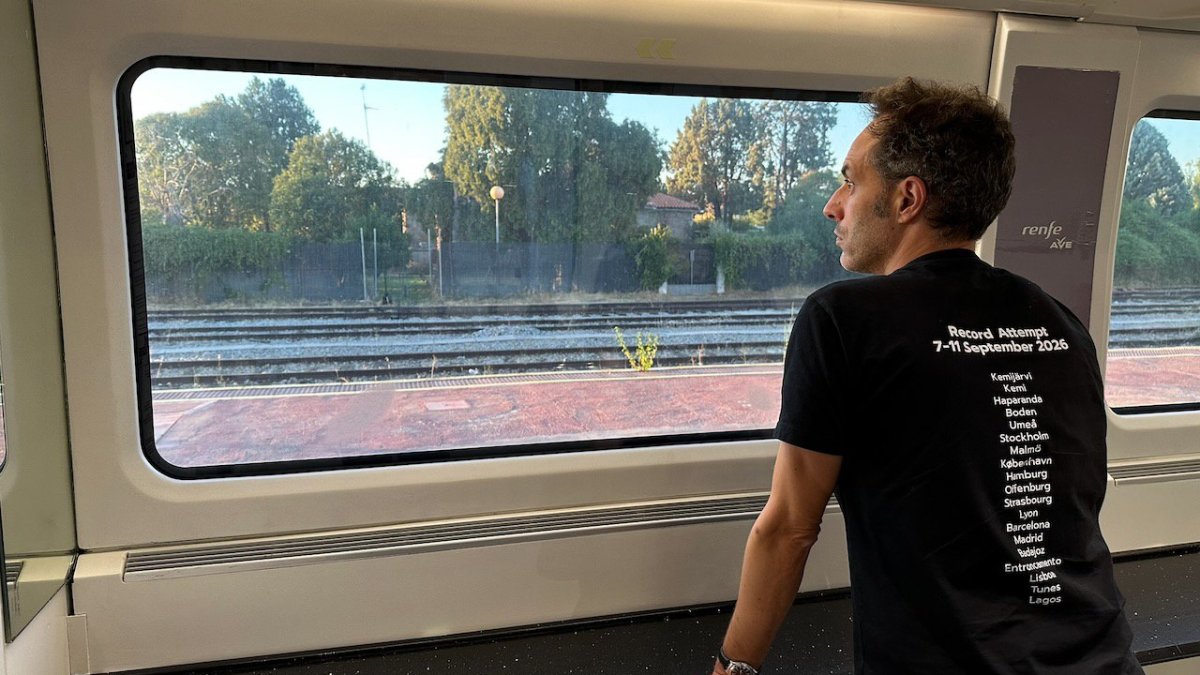
Kemijärvi in Finnish Lapland, north of the Arctic Circle, and Lagos, at the very southwestern point of Portugal, are the two places furthest apart in the European Union that are connected by trains. This month, I attempted to become the first person to make the trip between the two, and as quickly as possible. The journey is new: after 38 years without any rail service connecting the countries, since August, cross-border trains are running between Tornio in Finland and Haparanda, Sweden, at the very top of the Baltic Sea. Finland is once more connected to the rest of Europe’s railway network. The purpose of the trip was to demonstrate all the joys and all the frustrations of international rail travel. Shorts Using some of Europe’s best and most comfortable trains, including two night services, would showcase the very best of the continent’s railway network – or so I hoped. I looked forward to sitting with a coffee by the window, watching the forests and lakes of Sweden pass by on the SJ service from Umeå to Stockholm, and spotting flamingos in the lagoons of southern France from Renfe’s Lyon–Barcelona service. While I took both these trains, I spent more time researching ways around disruption than enjoying the views. The entire route, covering 6,200km (3,852 miles) by railway, would, I calculated, take just over 100 hours. But a power outage set me back 24 hours in Sweden, and a further problem in Portugal added an additional 90 minutes. In the end, the record was set – 125 hours and 31 minutes – with a hope that someone else might better me soon. Plenty of people told me my plan would fall apart through Germany due to the chronic problems with its trains, but in the end Germany posed no headaches. Replanning after the power outage problem resulted in the trip requiring 23 trains from 10 different companies, rather than the initially foreseen 18 trains from nine firms. The biggest joy were the people I met en route – both railway staff who, almost universally, were ready to help, and fellow passengers confused by someone running around in trains with a cameraman in tow. Reactions were a mixture of amazement and bewilderment – from “why would you ever do this?” to “Cool, I am glad that is possible!” Jon was looking forward to the scenery, such as views of flamingos in the lagoons of southern France (Photo: Martin Child/Getty) Just planning this trip emphasised many of the shortcomings of Europe’s railways. Even finding reliable information about when trains run is not as simple as it should be – departure times for some Spanish trains were missing in international trip planners such as bahn.de. And once a route is planned, trying to purchase tickets presents even bigger hurdles. Had I attempted this trip with regular tickets, I would have needed 11 bookings from nine different websites to cover the 18 trains I needed for the journey. For any long trip – even ones less extreme than this – an Interrail pass is the best option. With Interrail and including all seat reservations, the Kemijärvi – Lagos trip costs €308 (£265) for those under 26 or €387 (£333) for those older. Jon’s route plan included a train to Barcelona (Photo: percds/Getty) To get beds rather than seats in the two night trains adds roughly €75 (£65) per person. All that strikes me as quite a fair price for the distance I covered. Attempting the trip with regular tickets would cost at least €563 (£484). Replanning the trip ended up adding some costs, most notably an extra unplanned hotel night in northern Sweden. The thing that really struck me on the journey, more than before, was how fragile Europe’s rail infrastructure is, especially in Sweden, but also from Spain to Portugal. These connections are tiny lines with outdated infrastructure. That’s worrying. Somewhere along the route, something was going to go wrong. In both Boden in northern Sweden and Entroncamento in the middle of Portugal there were to be extremely tight connections, the latter of which was missed. The former worked, albeit a whole day later than planned. In other places – notably in Spain – it is the opposite. I spent more time not moving than I would like as the first train of the day to the border with Portugal only goes in the early afternoon, so hanging around is inevitable. The ideal would, of course, be connections not too tight and also not too long. The Tornio-Haparanda Bridge between Finland and Sweden made the whole trip possible (Photo: Jon Worth/#CrossBorderRail) Statistically, the Copenhagen – Hamburg train was the one most likely to be heavily delayed or cancelled, and I had planned a buffer there. In the end, this one, run by Denmark’s DSB, had only a small delay, but managed to get to Hamburg with only two working toilets, the train manager warning people to only go if they really needed to, as with no toilets the service would have to be terminated early. My fellow passengers did as they were told and we made it to Hamburg. Here, however, is the politically important point, and one the European Union aims to address.Were a passenger with regular tickets to miss an onward connection onto a train run by another operator, say between Denmark’s DSB and Germany’s Deutsche Bahn, and be stranded and need a night in a hotel, at the moment it is the passenger that has to cover that cost from their own pocket – a strong disincentive to attempt long journeys by train. In Haparanda I had to foot the cost of my own hotel. Earlier this year the European Commission proposed a new legal framework to solve these problems, but the plans are bitterly opposed by many railway companies, who fear that having to take better care of stranded passengers will cost them. Having to share more timetable and ticket data is also not met with universal approval. But without the fear of being stranded, more people might consider travelling long-distance by train, which would only be good for rail operators. If the European Commission’s proposal becomes law, then passengers should begin to see the benefit before the 2029 European elections. For travellers from the UK, the changes will apply to long-distance trains through the Channel Tunnel as well – and those services are set to grow, with Virgin Trains planning to launch services to the continent in 2030. The rules of the record bid, and all the maps can be found at longestjourney.crossborderrail.eu
What my 3,852-mile train trip taught me about Europe’s outdated railways
Full Article
Original Source
Read the full article at Inews →KhanList aggregates and links to publicly available news content. We do not host full articles from third-party sources. Always verify important information with original sources.