
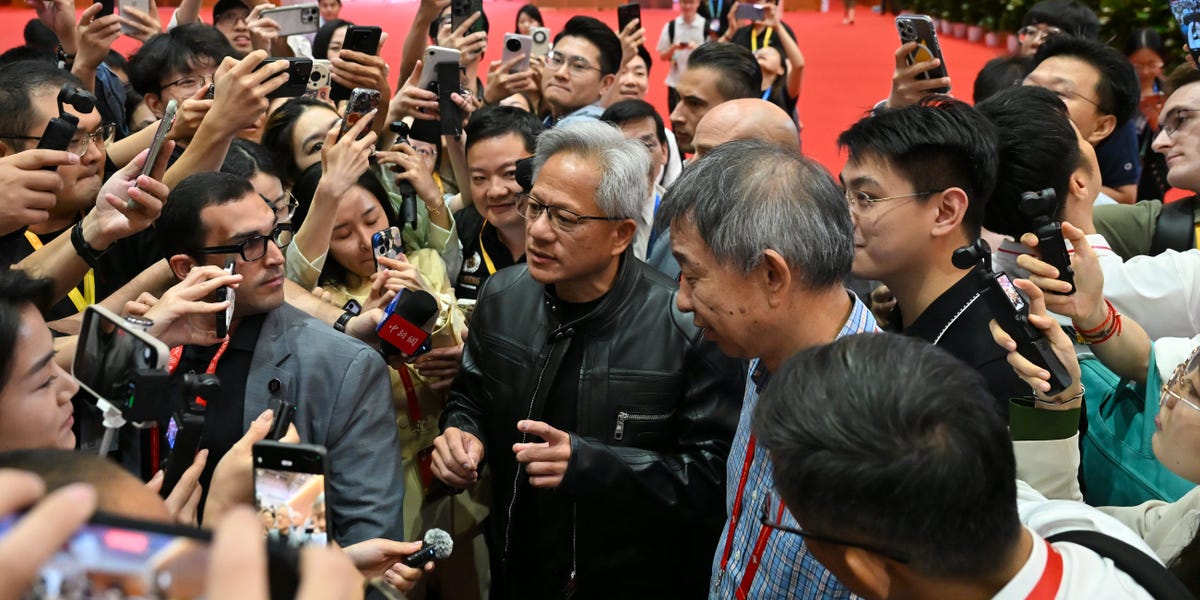
Jensen Huang during a 2025 visit to China. Zhao Wenyu/China News Service/VCG via Getty Images Jensen Huang has spent years making the case that while China is an adversary, the US should not cut itself off from the country's huge technology market.Now, Nvidia says it is investigating whether the CEO was targeted by a foreign intelligence effort. The New York Times reported that US officials believe Alice Huang, who has been an executive at Nvidia customer Megaspeed, was recruited to gather information for Beijing. She has no relation to Jensen Huang, who admitted to being unfaithful to his wife in a note to staff.Huang has often sought to navigate a "balancing act" with China, a massive market that Nvidia has largely been locked out of due to US export controls. There is no indication that Huang was influenced by the foreign intelligence effort, and the timeline of the relationship between Jensen Huang and Alice Huang is not clear.Nvidia's board said it has confidence in its CEO and has no reason to believe national security or company secrets were compromised. An independent committee will investigate, the board added. Here's what Jensen Huang has said about China in recent years. October 2026: 'We made a mistake' on China Nvidia CEO Jensen Huang during a Bloomberg Tech interview last month. Jose Sarmento Matos/Bloomberg via Getty Images In an interview with Bloomberg's Emily Chang for "The Circuit" last month, Huang said he had tried to persuade US policymakers of "the importance of engaging the Chinese market.""I think we made a mistake, and this mistake is hard to unwind," Huang said in previously unreleased footage, in an apparent reference to US restrictions that have limited Nvidia's ability to sell its most advanced AI chips in China.Huang also said that, while Nvidia competes with China, "they're not our enemies."He said that US-China dialogue was necessary on AI safety: "If we care deeply about the safety of the world with respect to artificial intelligence, then of course we must open dialogues.The same month, at Nvidia's Berlin keynote, Huang said that while the US is ahead in AI, China is "very, very serious competition." May 2026: The US and China should not build separate AI ecosystems Jensen Huang has talked bout cooperation with China on AI. Bloomberg/Bloomberg via Getty Images In an interview with Channel News Asia in May, Huang said it would be "not wise" for the US and China to create two distinct AI ecosystems."The more that all the leaders work together, cooperate together to advance this technology in harmony and for good, the better it will be for the future," he said. Huang also said that countries and companies could simultaneously compete and cooperate.That month, after joining President Donald Trump's China trip, Huang also told Bloomberg Television that he believed China's market would eventually open to US chip suppliers.He said he had not directly discussed Nvidia's H200 sales with Chinese officials. April 2026: Nvidia's China market share had fallen to zero Jensen Huang has argued that export restrictions risk strengthening China. ANDREW CABALLERO-REYNOLDS/AFP via Getty Images Speaking on the Special Competitive Studies Project's "Memos to the President" podcast in April, Huang said Nvidia's market share in China had fallen to zero.Nvidia previously said in its annual report in February that being effectively foreclosed from China's data-center computing market had enabled competitors to develop ecosystems that could challenge it internationally.The point reflected Huang's repeated argument that export restrictions risk strengthening Chinese rivals rather than slowing them. January 2026: Decoupling is 'naive' Huang has described China as both an adversary and a partner. David Paul Morris/Bloomberg via Getty Images On the "No Priors" podcast in January, Huang called the idea of US-China decoupling "naive" and said it was not based on "any common sense."China was an adversary, he said, but also "a partner in many ways." Huang said both countries should build more independence while recognizing their deep mutual dependence. May 2025: Export controls were a 'failure' Huang during the Computex conference in Taipei, Taiwan, in May 2025. Annabelle Chih/Bloomberg via Getty Images One of Huang's clearest critiques came at a press conference at the annual Computex conference in Taipei in May 2025, where he called US AI-chip export controls, first introduced in 2022, a "failure."He said they had cost US companies billions of dollars while pushing Chinese customers toward local alternatives such as Huawei.Earlier that month, he told CNBC that China's AI-chip market could reach $50 billion within two to three years and that being unable to address it would be a "tremendous loss" for American companies. September 2024: A 'balancing' between national security and US technology Huang has tried to balance national security with customers' needs. Joel Saget / AFP via Getty Images In an interview on Bloomberg's "Balance of Power" in September 2024, Huang said Nvidia was doing its best to serve customers in China while complying with US export-control requirements."We have to defer all of the policymaking to the administration," Huang said. "They understand the balancing [of] national security versus the prosperity of American technology all over the world."He added that Nvidia was exporting American technology and that it was "terrific for the United States that the world is built on American standards."He said the administration would like to see Nvidia succeed and was doing "a wonderful job." February 2024: Nvidia wanted to compete in China Huang shows off new chips in March 2024. David Paul Morris/Bloomberg via Getty Images Huang said on Nvidia's February 2024 earnings call that the company had redesigned products to comply with US export controls and had begun sampling them with Chinese customers."The US government would like to see us be as successful in China as possible," Huang said, while acknowledging that Washington also wanted to limit the most advanced Nvidia AI capabilities available there.He said Nvidia had "reset" its China product offering and would "do our best to compete in that marketplace and succeed in that marketplace within the specifications of the restriction." Read next Business Insider tells the innovative stories you want to know Business Insider tells the innovative stories you want to know Business Insider tells the innovative stories you want to know Business Insider tells the innovative stories you want to know Thibault is a tech reporter at Business Insider's London office.He covers the intersection of technology and work — focusing on AI’s impact on the workplace, job and cognitive skills, and how economic changes are affecting careers.Before moving to the trending team, Thibault covered international affairs, including the Russia-Ukraine war, tensions in the South China Sea, and Russia’s economy on the news desk.He has previously worked at the Daily Express and held internships at Agence France-Presse, Politico Europe, and Factal.Il parle français. Habla español.Email Thibault at tspirlet@businessinsider.com, connect with him on LinkedIn @ThibaultSpirlet, or follow him on X @ThibaultSpirlet and BlueSky @thibaultspirlet.bsky.social.ExpertiseAI and the future of work Job and cognitive skills in the AI economyWorkforce trendsFirst-person, "as-told-to" stories AI Artificial Intelligence China More
What Jensen Huang has said about China in recent years as a spying probe roils Nvidia
Full Article
Original Source
Read the full article at Businessinsider →KhanList aggregates and links to publicly available news content. We do not host full articles from third-party sources. Always verify important information with original sources.