
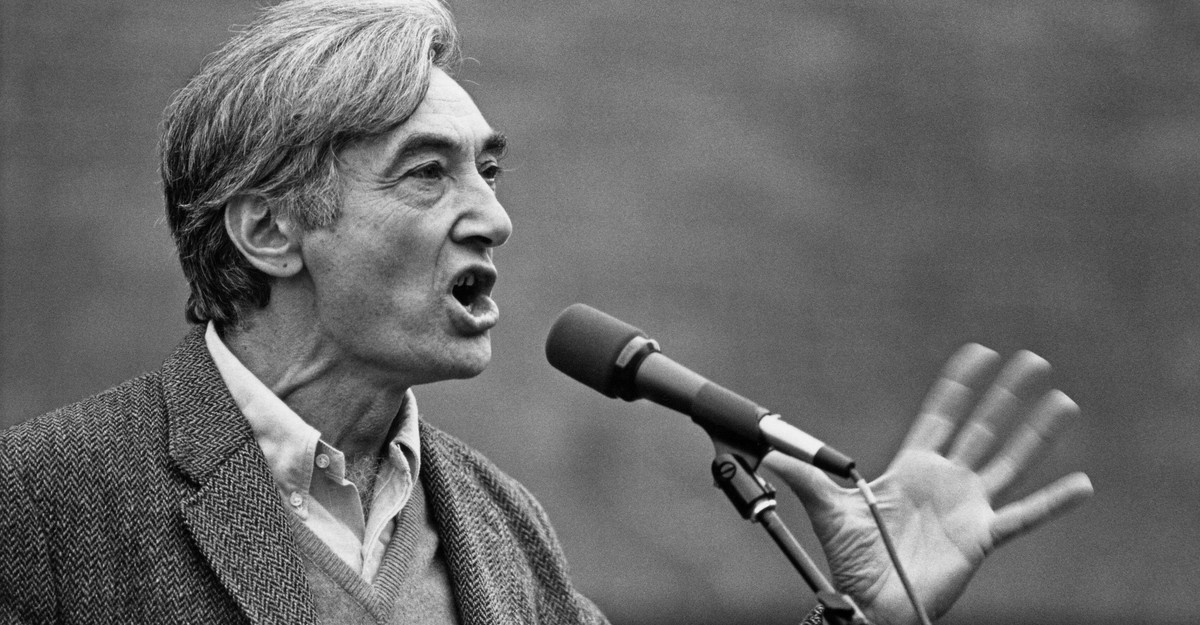
“What would Howard say?” This question, which Dave Zirin reports being “asked repeatedly” while he was working on his new biography of Howard Zinn, underscores how unusual a figure his subject cut in contemporary American life. Most historians live and die in relative obscurity. But 16 years after Zinn’s death, many people still look to him, not just as a scholar but as a kind of sage.Zinn first became famous—and, in some circles, infamous—after the 1980 publication of his best-selling work A People’s History of the United States. The book advanced an ambitious and unrepentantly radical reimagining of the nation’s past. Zinn rejected the conventional organization of history around “the point of view of governments, conquerors, diplomats, leaders” and declared, “I prefer to try to tell the story of the discovery of America from the viewpoint of the Arawaks, of the Constitution from the standpoint of the slaves, of Andrew Jackson as seen by the Cherokees.” What emerged was a new grand narrative, one that promised to reveal what mainstream history had long concealed and to offer a new moral framework for the past. In Zinn’s telling, the powerful were almost always up to no good, and ordinary people were the heroes of the American story. They courageously built movements for justice and sometimes even won, though it never took long for the oppressors to regroup. The fight was never over.Unlike most best sellers, A People’s History never stopped selling. Each year during its first three decades in print, it sold more copies than the last. The book’s fans applauded its bottom-up, justice-minded approach to history, while its detractors dismissed it as a leftist morality play masquerading as a story about the past. No one could doubt that it changed the conversation about American history, not to mention the trajectory of Zinn’s life. By the time he died in 2010, he was an archvillain for the right and a secular saint for the left.Zirin’s fast-paced biography, The People’s Historian, is an answer to the most interesting version of “What would Howard say?” One hardly needs to squint to imagine what Zinn would have thought of the current regime in Washington, and readers curious only about that can put this book down after page 4, where Zirin declares, “Fascist movements taking orders from billionaire insurrectionists were the kinds of struggles that Howard Zinn demonstrated a willingness to fight and, if necessary, die to oppose.” But Zirin himself is after something more. He knew Zinn personally and collaborated with him on projects; he admires him deeply. Zirin believes we need more than Zinn’s opinions today; he argues that we need the deeper wisdom that emanates from his life and work.Zinn’s many gifts developed in the course of what was, by any estimation, a remarkable journey. He was born in 1922 to working-class Jewish immigrants in Brooklyn. In his early 20s he rushed to enlist in the fight against fascism, serving in the Air Forces during World War II. He would long regret his short tenure as a bombardier who dropped artillery shells on behalf of a compromised colonial power—as he would later come to see the United States—from such heights that he could not be sure where exactly they landed. Zinn’s willingness to admit he was gravely wrong is part of what Zirin loves about him. The people’s historian was a radical, but he was also a “happy warrior” who believed that people could change, and so could societies.Read: The new history warsAs a participant in the civil-rights and anti-war movements, Zinn witnessed such transformations firsthand. He organized alongside his students at Spelman College as well as with famous activists, including Ella Baker and Daniel Berrigan. Together, in the 1960s and ’70s, they fought to change a country whose past and present were steeped in violence and white supremacy. The going was never easy, because, as Zirin tells it—very much in Zinnian fashion—they bumped up against so many villains in power. Sometimes it was the director of the FBI; other times, a reactionary university administrator. But the people could be powerful too. Any given campaign might be stymied, but the march went on. However dreary the news, the hope persisted for a better day.Zirin argues convincingly that Zinn’s life story vindicates one of his deepest convictions: that ordinary people and “small acts” can change the world. Zinn was right about this, and Zirin concludes the book with a quote from him that draws out the optimistic implications of his faith in bottom-up movements: “We have been surprised before in history. We can be surprised again. Indeed, we can do the surprising.” This is a compelling message for the current moment—and any other. Yet one can agree with Zinn on the power of the people to make change and still wonder whether recent history has revealed the limits of his wisdom.“Was he wrong to have faith in the people?” Zirin relates that some of Zinn’s devotees—“those politically raised on his ideas”—have asked him this question, in addition to the one about what he might say in any given situation. Zirin takes up the second query but answers it far less satisfactorily than the first. He acknowledges that “in 2024, 77 million voters checked the box for an authoritarian to take power once again,” and moreover that Trump “won masses of white working-class people and, according to political pundits, a not-insignificant number of Black and Latino men.” But Zirin does not wrestle with the meaning of these developments. Rather, he waves them away with invocations of the “tech oligarchs” and “autocrats” who are driving “our global descent into authoritarianism.” This is an homage in a way, a vintage Zinn move—evading tough questions about who “the people” are and what they really want.A People’s History of the United States appeared the same year Ronald Reagan was first elected president. In later editions of the book, Zinn would cast Reagan—like Jimmy Carter before him and George H. W. Bush after—as a creature of “the Establishment,” elected by a majority of voters but by a minority of the voting population and, hence, hardly the people’s choice. Zinn wrote something similar in 2003 amid the travails of the early War on Terror: “I wake up in the morning, read the newspaper, and feel that we are an occupied country, that some alien group has taken over.” The following year, of course, George W. Bush won the popular vote.Read: What if our ancestors didn’t feel anything like we do?Zinn was hardly the only academic to be thrown by this turn of events. The 2004 election left no doubt that the Reagan Revolution had been more than a blip; in its aftermath, American historians redoubled their efforts to understand the sources of the right’s surprising resurgence. What they have uncovered in the past two decades flies in the face of a central tenet of Zinnian orthodoxy. The sustained success of the modern conservative movement cannot be explained away as the outcome of establishment machinations or a top-down takeover. Its energy and vitality came in no small part from the grassroots: from stay-at-home moms and car mechanics, from the suburbs and the Sun Belt, from evangelicals and Catholics and more. The revival of the Republican Party’s national fortunes at various moments, going all the way back to Richard Nixon, confirms Zinn’s faith in the power of bottom-up movements, even as it confounds his almost mythic sense of “the people” as inevitably on the right side of history (that is, the left side of the political spectrum).And if ordinary folks are more complicated than Zinn and Zirin recognize, perhaps those who wield power can be too. What made the right’s political comeback so surprising, after all, was that in the mid-1960s the liberal-left coalition was winning not only in the streets but also on Capitol Hill. In those years, progressives leveraged grassroots energy into breakthrough policy change. The leaders of major civic and political institutions were rarely out in front of progressive activists, but at least some of them chose to pull levers that made the United States more equal and just. The Civil Rights Act of 1964 and the Voting Rights Act of 1965 passed with sweeping bipartisan majorities.After an outrageous assault by law enforcement on peaceful demonstrators in Selma, Alabama, President Lyndon B. Johnson memorably proclaimed—before a joint session of Congress, Cabinet officers, Supreme Court justices, and more than 70 million Americans watching on television—that “it is not just Negroes, but really it is all of us, who must overcome the crippling legacy of bigotry and injustice. And—we—shall—overcome.” His invocation of a beloved civil-rights anthem brought a tear to Martin Luther King Jr.’s eye. None of this impressed Zinn. In A People’s History, he framed both the speech and the landmark civil-rights legislation of the 1960s as “concessions.”Then and now, such unrelenting suspicion springs from genuine patterns of institutional failure and betrayal. Villains are, alas, not just a figment of our collective imagination. And yet, in 2026, with the Democrats on the outside of power looking in, progressives might nevertheless ask whether the Zinnian propensity to demonize anyone and everyone wielding authority has served their cause well. Dismissing landmark legislation as mere concessions can miss the fact that there is no path forward from righteous protest to lasting change that does not run through better—if imperfect—public policy. However “exhilarating” Zinn’s counternarrative can be, it may have encouraged millions of well-meaning readers to be skeptical of the possibility that any good could come through the slow, messy institutional work that is central to pluralistic democracy. Coincidental or not, this much is true: During the same period when Zinn’s influence was rising meteorically on the left, the right became much more adept at channeling populist enthusiasm into deliberate campaigns to reshape the major institutions of American life.“I wanted to change the world, and I thought history might be helpful,” Zinn liked to say, lightheartedly. His biographer is right to argue that Zinn, an ordinary person, did change the world—though perhaps he didn’t do it only in the ways that either of them hoped he would.When you buy a book using a link on this page, we receive a commission. Thank you for supporting The Atlantic.
What Howard Zinn Got Wrong
Full Article
Original Source
Read the full article at Theatlantic →KhanList aggregates and links to publicly available news content. We do not host full articles from third-party sources. Always verify important information with original sources.