
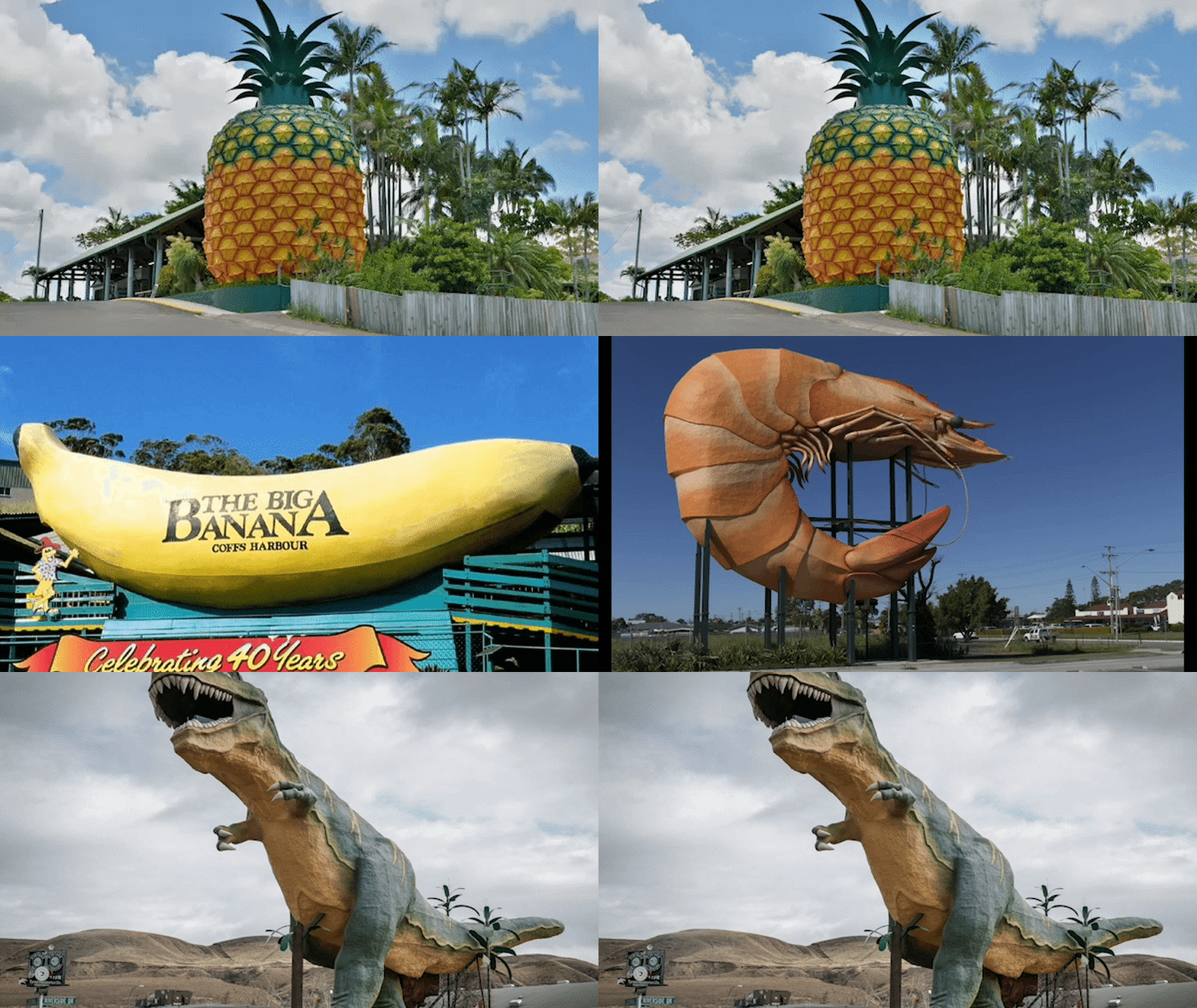
Giant roadside attractions have helped put hundreds of communities on the map. What happens when their novelty dissipates and costs pile up?Karla AdamNovember 28, 2026 — 5:00amTyra the Tyrannosaurus is very large, even by T. rex standards.At 26 metres tall, Tyra looms over Drumheller, Alberta, a town of 8000 in the Canadian prairie that is known for fossil discoveries and bills itself as the dinosaur capital of the world. Tyra is about four times the size of a real T. rex, which would have barely come up to her knee. Now, Tyra is facing an extinction event of her own. This one involves an expiring lease and mounting maintenance costs.She is not alone. Across North America and Australia, thousands of communities have used oversized roadside sculptures to put themselves on the map. Decades after their construction, these landmarks face a crossroads as novelty fades, costs escalate and local groups are left holding a hefty bill. Tyra’s fate hangs in this balance.Australian ‘Big Things’ include The Big Banana, Big Prawn, Big Bogan and Big Pineapple.iStock / SuppliedLast year, the Drumheller and District Chamber of Commerce decided to close Tyra’s site when its land lease expires in 2029, citing unsustainable maintenance costs. The decision prompted a scramble to determine her future. For a quarter of a century, tourists have stepped out of their cars near the intersection of Gorgosaurus Street and Tyrannosaurus Drive to snap photographs of Tyra. The bravest visitors climb 106 steps to peer out from between her fibreglass teeth to views of the Canadian Badlands.Tyra typifies a problem for small towns, said Amy Clarke, a historian at Queensland’s University of the Sunshine Coast who maintains a database of global roadside architecture. Residents are often fiercely proud of their giant attractions, which continue to be built, but many local authorities question whether they can be funded indefinitely, she said. Clarke has counted more than 10,000 of these structures worldwide. Most are in the United States, Canada and Australia, many erected in the mid-20th century as highways sprawled and more people bought cars.Clarke noted that American roadside giantism leaned heavily towards the commercial, featuring figures such as muffler men and pizza chefs. Canadian towns, by contrast, preferred civic-minded eccentricities, leaning into self-aware, local humour. Western Canada has approached the genre with ambition: Alberta alone is home to colossal depictions of a sausage, a beaver, a teepee, an Easter egg, a spaceship and a pierogi impaled on a 7-metre-long fork.Over-the-top monuments often inspire community devotion. When windstorms damaged the canvas of the Big Easel – a giant replica of Vincent van Gogh’s Sunflowers in Altona, in the central Canadian province of Manitoba – 68 per cent of respondents to a survey said they wanted it restored, despite local officials saying it had reached the end of its 30-year life. The town raised funds through donations, budget reallocations and insurance payouts from storm damage.Similarly, when a Norwegian town unveiled a statue in 2015 that was larger than Mac the Moose in Moose Jaw in Canada’s Saskatchewan, residents there rallied to raise money to extend Mac’s antlers and recapture his title.A lucky few qualify for heritage grants, such as Lucy the Elephant in Margate City, New Jersey, US, built in 1881, whose recent makeover cost $US2.4 million ($3.6 million). For others, the financial burden looms as large as the statues. The world’s largest hockey stick in Duncan, British Columbia, was dismantled in 2024 after 36 years, a solution that regional authorities found preferable to spending about $US1.5 million to replace the rotting wooden structure. Fans can still buy keyrings crafted from its salvaged Douglas fir timber.The adored Tyra the Tyrannosaurus, in western Canada, “didn’t come with a maintenance manual”.Alamy Stock PhotoThough the peak popularity of these sculptures has long passed, Clarke said she had noticed a recent resurgence of interest as small towns sought ways to generate tourist revenue. Local officials often ask Clarke whether building an oversized mascot is worth it. She cautions that maintenance, repainting and liability insurance quickly add up.“It may work for the first decade or two,” Clarke said, “then everyone knows the joke and you’ve got to give them another reason to keep coming back.” The landmarks that remained profitable in the long term, she said, often were used as part of wider entertainment hubs rather than as stand-alone attractions.Tyra requires painting and repairing every five to seven years. The last facelift cost about 300,000 Canadian dollars ($314,000), said Heather Bitz, the executive director of the Drumheller Chamber of Commerce.Since the attraction opened, revenue from admission tickets and the gift shop has allowed the chamber to invest more than $700,000 (Canadian) into community projects, Bitz said. But upkeep costs have roughly matched that figure and are expected to increase.Finding someone to paint a 26-metre dinosaur is also a challenge. “It didn’t come with a maintenance manual,” said Bitz, whose office shares an address with Tyra. “We need boom lifts to get at it. You can’t use a ladder and a paintbrush.”A report commissioned by the chamber found this year that Tyra was structurally sound, but that major exterior repairs would be needed in eight years and an interior overhaul in 10 years. Admission fees to climb her go into a repair fund, but chamber officials said the constant oversight and expensive overhauls distracted from their primary mission of supporting local commerce.Tyra’s impending demise has prompted intense pushback from some. AJ Frey, a business owner in Drumheller, started a petition last year to save Tyra that has gathered more than 27,000 signatures – that’s more than triple the town’s population. “People around the world love her,” he said.Doug Bos, the owner of a wildlife park in Innisfail, Alberta – about 140 kilometres north-west of Drumheller, along the main highway connecting Edmonton and Calgary – is one of a handful of people considering whether to give Tyra a new home. Moving a 66-tonne fibreglass carnivore down the highway would be a logistical headache, he acknowledged, most likely requiring crews to take down power lines to let her pass. But the payoff, in his mind, was indisputable.From our partners
What happens to giant oddities when their novelty fades ... along with the paint job?
Full Article
Original Source
Read the full article at Smh →KhanList aggregates and links to publicly available news content. We do not host full articles from third-party sources. Always verify important information with original sources.