
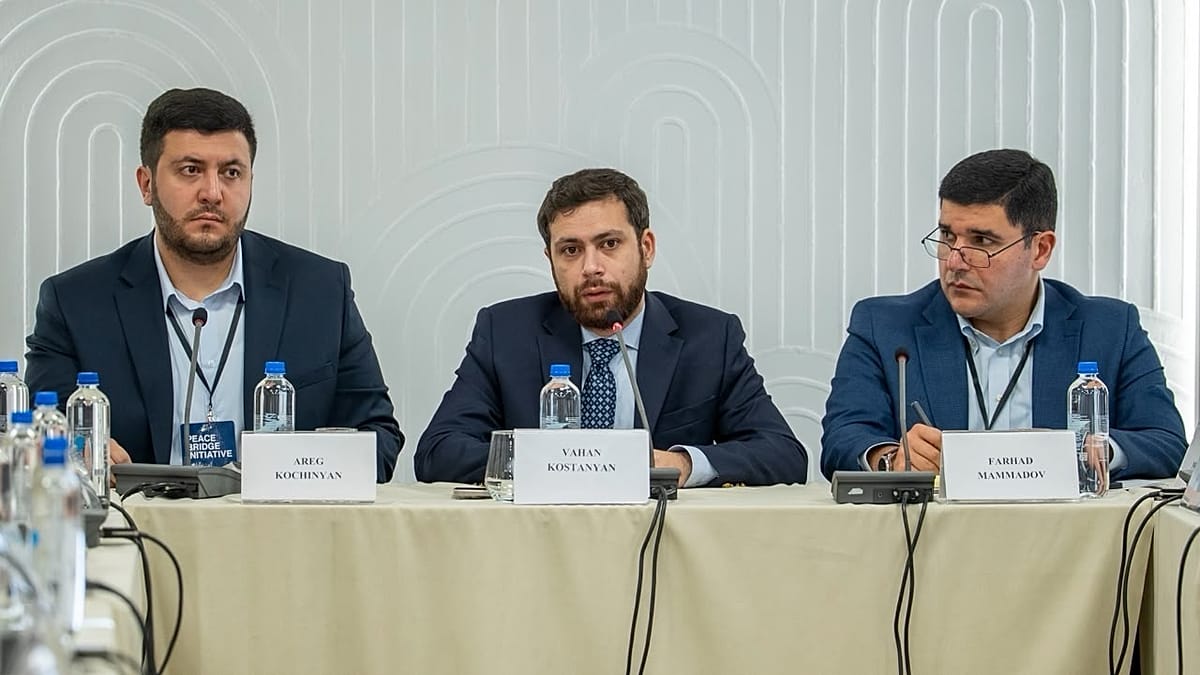
Scores of representatives from Azerbaijan and Armenia's civil societies gathered in the Armenian town of Dilijan on Thursday and Friday for the fifth round of their "Peace Bridge" programme talks, ADVERTISEMENT ADVERTISEMENT The 60 representatives in attendance marked the largest turnout since the two-track dialogue platform was established in 2025, in the historic peace agreement between the two countries. Azerbaijan and Armenia's civil society representatives focused on roads and infrastructure between the two countries, as well as economic, social and humanitarian affairs, education, and political and geopolitical issues during their new meeting, this time in Armenia, as part of the normalisation process between the two former enemies. Armenian Security Council Secretary Alen Simonyan told the gathering that roads are "the main link for cooperation between Armenia and Azerbaijan". The joint group also discussed the requirements for bilateral normalisation with Armenian Deputy Foreign Minister Vahan Kostanyan. From Azerbaijan's side, Deputy Chairman of the Board of the Centre for Analysis of International Relations and Multiculturalism Farhad Mammadov said that "there are certainly issues on which we disagree, but we hold an honest and sincere dialogue on all of them." "We try to explain what concerns our society, the issues and reasons involved, and what we can achieve," Mammadov said. "These problems have objective and subjective causes, and if we cannot resolve every problem quickly, we focus on matters where we can take concrete steps." "No topic is off limits. We can ask each other questions and receive answers," Mammadov said, describing the spirit of the discussion. "We will also consider how to overcome differences and give greater substance to peace policies," Azerbaijan's representative said. Meanwhile, Armenian Council President Areg Kochinyan, who also served as coordinator, said the expanded format allowed both sides to tackle sensitive topics openly and draft concrete recommendations for their governments. Kochinyan said that the civil society dialogue is distinct from official state negotiations, but it plays a vital role in reshaping public attitudes after decades of conflict. "Through this dialogue, rather than simply overcoming the reality shaped by decades of conflict, hostility and hatred, we are trying to create a new normal, new realities and a new history alongside the past," Kochinyan said. "We are discussing a peace agenda focused on the future and on creating conditions in which our societies can live as neighbours in peace and mutual understanding," he added. From initial talks to committees Established under the auspices of both governments following the 8 August 2025 Washington Summit, where Azerbaijan's President Ilham Aliyev and Armenian Prime Minister Nikol Pashinyan signed the peace process declaration mediated by US President Donald Trump, the Peace Bridge platform began in late 2025 with small groups of permanent experts from each country. The initiative gained momentum through reciprocal visits, starting with an initial meeting in Yerevan between 21 and 22 October 2025, followed by a roundtable in Baku between 21 and 22 November 2025. In February of this year, the third meeting in Yerevan marked a symbolic step when 19 Azerbaijani experts crossed the delimited and demarcated land border on foot between the Azerbaijani village of Ashagi Askipara and the Armenian village of Voskepar. A fourth gathering took place in Azerbaijan's Gabala district between 10 and 12 April 2026, focusing on direct contacts between non-governmental organisations and media representatives. The fifth forum comes days after Armenia and the US began preparatory construction on the Trump Route for International Peace and Prosperity (TRIPP) transit corridor in Syunik province, a key link aimed at connecting mainland Azerbaijan to Nakhchivan and reinforcing wider East-West trade routes across the South Caucasus. By expanding to 60 delegates and formalising six specialised committees in Armenia, coordinators aim to generate concrete policy recommendations, ranging from cross-border trade and environmental monitoring to youth exchanges and media cooperation, that can support official peace efforts across the South Caucasus.
Azerbaijani and Armenian civil societies seek 'new history' in new round of peace talks
Full Article
Original Source
Read the full article at Euronews →KhanList aggregates and links to publicly available news content. We do not host full articles from third-party sources. Always verify important information with original sources.