
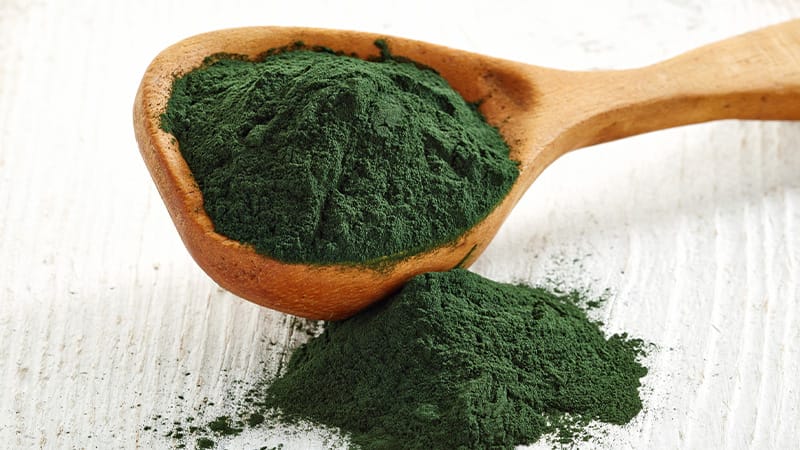
Spirulina is widely regarded as nutrient-rich and has antioxidant and anti-inflammatory properties. Its supplements are promoted for high blood pressure, elevated blood lipids, obesity, and diabetes. Recent studies suggest that some of these effects are measurable, although they are generally small and of limited clinical significance. However, convincing human data are lacking for claims related to “detox,” immune support, or cancer prevention.What Spirulina Actually IsSpirulina is not an alga but a photosynthetically active cyanobacterium. The species used commercially is primarily known as Arthrospira platensis or Limnospira platensis. In the scientific literature, however, spirulina is often classified as a “microalga” or “blue-green microalga,” and the terminology is not always strictly taxonomic.Dried spirulina is a nutrient-rich biomass with a high protein content. In addition, it contains complex carbohydrates, small amounts of lipids — including polyunsaturated fatty acids — vitamins, and minerals, as well as various pigments and other bioactive compounds. Particularly notable are C-phycocyanin, chlorophyll, beta-carotene, other carotenoids, and phenolic compounds.Of particular scientific interest is the blue-colored C-phycocyanin, a water-soluble phycobiliprotein and a characteristic component of spirulina. According to a review, researchers have described antioxidant, anti-inflammatory, and immunomodulatory effects of phycocyanin in experimental studies. Among other things, the review discusses effects on nuclear factor erythroid 2-related factor 2/heme oxygenase-1, nuclear factor kappa B, and phosphoinositide 3-kinase/protein kinase B, as well as on oxidative stress and various inflammatory signaling pathways.While such mechanisms sound promising at first glance, it is crucial to distinguish between biochemical activity and clinical efficacy. A significant portion of the described effects of phycocyanin is based on cell culture and animal experiments. Even for extensively studied potential applications such as antitumor effects, the authors of reviews emphasized that, to date, evidence is primarily based on in vitro and in vivo models, and well-designed clinical trials are still needed. The fact that phycocyanin influences oxidative stress, inflammatory signaling pathways, or cell proliferation in experimental models does not therefore automatically mean that taking spirulina prevents or treats corresponding diseases in humans.High Protein Content — But Not a Protein SubstituteIn addition to its bioactive compounds, Spirulina’s high protein content is frequently cited as a key benefit. In fact, the dried biomass consists largely of high-quality protein and also contains essential amino acids, minerals, carotenoids, and phycocyanin. However, the nutritional significance of this high percentage of protein is often slightly overestimated.This is because what matters is not only how much protein 100 g of spirulina powder contains, but how much is actually consumed. In studies and dietary supplements, typical doses usually range from 3 g/d to 5 g/d of spirulina. Even at a protein content of about 60%-70%, that works out to only about 2-3 g of protein — a small contribution to an adult’s daily requirement.For comparison, a cup of skyr, one egg, or a serving of legumes provides far more protein. Spirulina can certainly be described as protein-rich biomass, but at typical supplement doses, it is not a meaningful source of protein and does not replace a protein-rich diet.Vitamin B12It is equally important to maintain a realistic perspective regarding vitamin B12. Spirulina is frequently promoted as a natural source of B12, particularly in the context of a vegan diet. In fact, spirulina products may contain measurable amounts of B12. However, a significant portion may consist of pseudocobalamin, also known as pseudo-vitamin B12, and other B12 analogs, whose bioavailability in humans cannot be equated with that of active vitamin B12.An analytical study of Spirulina maxima from 2024 also explicitly highlights this issue. Basic analyses of spirulina’s composition had already shown that pseudovitamin B12 can account for the majority of detectable B12-like compounds.The practical implication is therefore clear: Spirulina should not be used as a reliable source for the prevention or treatment of vitamin B12 deficiency. This applies in particular to vegans at increased risk for deficiency, for whom a reliable supply from specific sources of vitamin B12 is crucial.Cardiovascular and Cardiometabolic EffectsUltimately, more interesting than the composition alone is the question of whether taking spirulina actually yields measurable health benefits. The body of clinical evidence on spirulina has grown significantly in recent years. Potential effects on blood pressure, blood lipids, body weight, and glucose metabolism have been particularly well studied.One of the most comprehensive reviews to date includes 35 randomized controlled trials. The meta-analysis revealed statistically significant improvements in several cardiometabolic parameters. However, the strength of the evidence varied depending on the endpoint; among other things, the evidence for low-density lipoprotein (LDL) cholesterol, fasting glucose, and A1c was rated as low. Taken together, the various studies point to a fairly clear pattern: Spirulina can measurably improve some metabolic parameters, but the effects are generally small. In addition, most of the studies focused on surrogate markers such as blood pressure, laboratory values, or body weight. Whether those changes translate into clinically meaningful long-term benefits — such as fewer heart attacks, strokes, or diabetes complications — has not yet been proven.Blood PressureBlood pressure findings are the most consistent. A systematic review and meta-analysis of randomized trials found that spirulina lowered systolic blood pressure by an average of 4.4 mm Hg and diastolic blood pressure by 2.8 mm Hg. In general, people with higher baseline blood pressure and those who took spirulina for longer periods appeared to benefit more.Another large meta-analysis arrives at very similar figures: On average, systolic blood pressure decreased by about 3.9 mm Hg, and diastolic blood pressure by 3.1 mm Hg.Thus, spirulina does appear to slightly lower blood pressure. As an adjunctive effect, that may be of interest; however, the evidence is insufficient to support its use as a treatment for hypertension. Most importantly, it has not yet been shown that the observed blood pressure reduction translates into fewer cardiovascular events.Blood LipidsA similar, though somewhat less consistent, pattern emerges regarding lipid metabolism. In a large meta-analysis of 35 randomized controlled trials, spirulina reduced LDL cholesterol by an average of about 7.7 mg/dL, triglycerides by 14.8 mg/dL, and total cholesterol by 11.5 mg/dL; HDL cholesterol increased slightly.However, not all recent analyses confirm these effects to the same extent. Another systematic review showed no statistically significant improvement in the lipid parameters examined with spirulina, but merely a trend toward lower total cholesterol. Accordingly, the authors were cautious in their assessment of the potential clinical significance.Overall, the current evidence thus suggests that spirulina can slightly to moderately improve blood lipid levels, although the results vary across studies. Therefore, the same applies here: Spirulina may, at best, provide an additional benefit, but it is not a substitute for indicated lipid-lowering therapy.Weight LossThere is now also fairly consistent evidence of a small effect on body weight. An analysis of 23 studies involving a total of 1035 adults with overweight or obesity found a statistically significant decrease in body weight with spirulina. However, the authors assessed the effects on body composition and glucose metabolism as limited overall.Another large meta-analysis reports an average weight loss of about 1.8 kg and a reduction in BMI of approximately 0.6. In this analysis, the evidence for the weight-loss effect was rated as comparatively high.A small effect on body weight therefore seems plausible. However, the magnitude of that effect should be presented realistically: An average weight loss of 1-2 kg does not make spirulina an effective “weight-loss supplement” or a standalone treatment for obesity. Rather, the finding is of interest as a possible additional benefit in the context of a more comprehensive lifestyle intervention.Diabetes and Insulin ResistanceWhen it comes to glucose metabolism, the evidence is already weaker. A large meta-analysis of 35 randomized trials found that spirulina was associated with an average decrease in fasting glucose of about 5.5 mg/dL, as well as slight improvements in Homeostatic Model Assessment of Insulin Resistance and insulin levels. However, the certainty of the evidence for fasting glucose and A1c was rated as low.The meta-analysis with 1035 adults with overweight or obesity was even more cautious. Spirulina alone showed no significant effect on either fasting glucose or insulin; the evidence was rated as very low in both cases.Even in people with type 2 diabetes, the evidence to date is not convincing. An older meta-analysis did find a decrease in fasting glucose but no significant improvement in A1c.Overall, while there are indications of minor metabolic effects, there is no convincing evidence of a clinically relevant improvement in diabetes control. In particular, there is no consistent effect on A1c, and data on diabetic complications are not available. Spirulina is therefore not a treatment for diabetes mellitus and cannot replace established therapies.Anti-Inflammatory EffectsThe frequently touted “anti-inflammatory” effect should be evaluated with even greater caution. The most recent meta-analysis paints a significantly more sobering picture in this regard. The analysis included eight randomized controlled trials with dosages ranging from 1 g/d to 8 g/d of spirulina over 3-16 weeks; the literature search extended through August 2025.Although C-reactive protein (CRP) levels decreased statistically significantly, the average reduction was only 0.09 mg/L. In contrast, no significant reduction was observed for the pro-inflammatory cytokines interleukin (IL)-6 and TNF-alpha. Furthermore, the results of the individual studies differed considerably from one another.Thus, while there is evidence of a measurable effect on individual inflammatory markers, a clinically relevant “anti-inflammatory effect” cannot be inferred from this. A slight change in CRP is not yet proof that spirulina prevents or treats chronic inflammatory diseases.‘Detox,’ Immune Support, and Cancer PreventionThe farther the evidence moves from the relatively well-studied cardiometabolic parameters, the thinner it becomes. Spirulina is said to “detoxify,” strengthen the immune system, protect the liver, slow aging, and even prevent cancer. Although interesting in vitro and in vivo studies support many of these claims, they do not establish efficacy in humans.Furthermore, a change in individual immune or inflammatory markers is not synonymous with a clinically relevant “boost to the immune system.” For example, the most recent meta-analysis of randomized trials on inflammatory parameters found only a slight reduction in CRP, while IL-6 and TNF-alpha were not significantly affected.Even for diseases in which immunological effects would be of particular interest, human evidence remains limited. A systematic review of patients infected with human immunodeficiency virus and hepatitis C virus found only a few suitable clinical trials and, accordingly, limited evidence.Caution is also warranted when evaluating claims of liver protection. A recent systematic review of dietary interventions for metabolic liver disease found isolated metabolic effects of spirulina, but no convincing evidence that it improves fatty liver or other relevant hepatic endpoints.The gap between marketing claims and clinical evidence is even wider in the context of cancer prevention and treatment. Antiproliferative, antioxidant, and proapoptotic effects of spirulina or phycocyanin have been studied primarily in preclinical models. To date, these studies do not provide reliable evidence that spirulina prevents or treats cancer in humans.Safety and Product QualitySafety should also be taken into account when considering supplementation. In clinical studies, spirulina is generally well tolerated. When side effects occur, they are often nonspecific complaints such as nausea, bloating, or other gastrointestinal symptoms. Allergic reactions have also been reported, albeit rarely. Although a 2024 review found only five published cases of spirulina allergy, four of these were classified as anaphylaxis. Severe allergic reactions thus appear to be very rare but are, in principle, possible.At least as important is the quality of the product in question. Cyanobacteria are often cultivated in open culture systems, where contamination by other microorganisms or by toxin-producing cyanobacteria is possible. In a study of commercial spirulina products, for example, potentially pathogenic bacteria and microcystins were detected.More recent studies also show that quality and potential contamination remain relevant issues. An analysis of commercial spirulina and other microalgae supplements published in 2025 illustrated that commercial products can vary in terms of their composition and potential contaminants and that appropriate analytical testing is advisable.Practical ConclusionOverall, spirulina is most likely to be considered a complementary measure for patients with mildly elevated blood pressure, an unfavorable lipid profile, or overweight. Current meta-analyses show small but measurable effects on these parameters. The evidence is weaker for insulin resistance and diabetes, and it is not convincing for clinically relevant anti-inflammatory effects.For medical counseling, the magnitude of the effects is particularly crucial. Spirulina can, at best, make a small adjunctive contribution and does not replace lifestyle measures or indicated drug therapy. Above all, it has not yet been shown to prevent heart attacks or strokes, reduce diabetes complications, prevent cancer, or lower mortality.Spirulina can therefore best be classified as a functional food or optional supplement with possible minor additional metabolic effects — not as a therapeutic agent. Spirulina should not be recommended for “detox,” nonspecific immune support, or as a reliable source of vitamin B12.This story was translated from Medscape’s German edition.
What Does Spirulina Really Deliver?
Full Article
Original Source
Read the full article at Medscape →KhanList aggregates and links to publicly available news content. We do not host full articles from third-party sources. Always verify important information with original sources.