
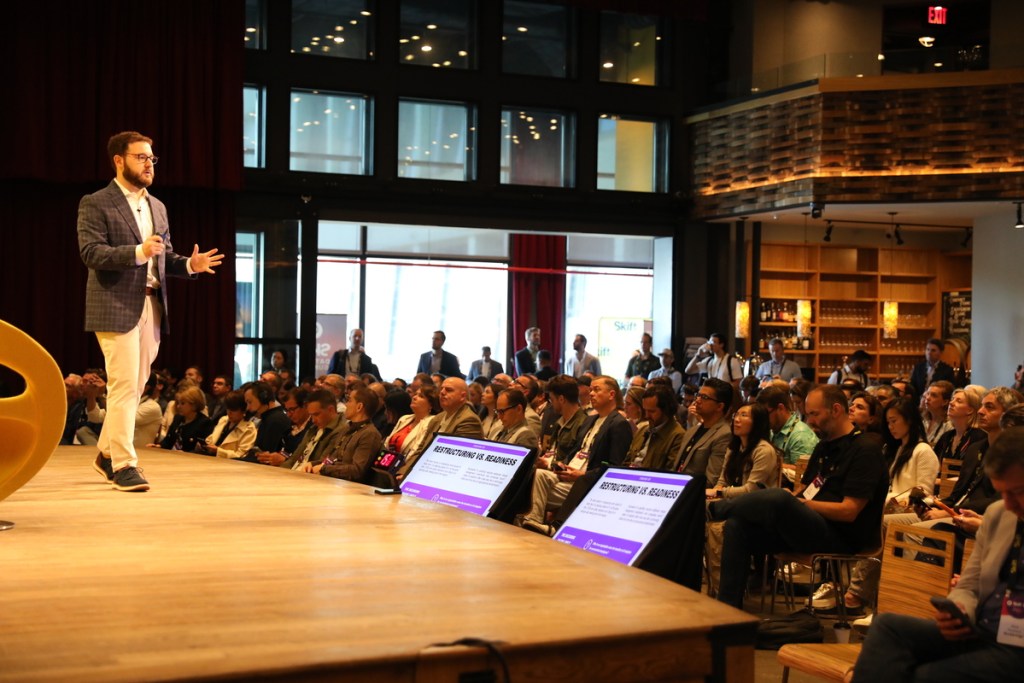
As travel companies put together their 2027 budgets, I want to hear more about the AI projects they are willing to keep paying for. What has become useful enough that employees depend on it? What has improved the customer experience? Which experiments looked promising but did not earn a wider rollout? Those are harder questions than whether a tool can produce an impressive demonstration. A pilot gives a company room to test an idea with limited exposure. A live service has to deal with the actual business: incomplete information, existing systems, busy employees and customers whose requests do not fit the expected pattern. On Oct 6, 2026, Skift Data + AI Summit Europe comes to London for the first time. Following our New York event in June, we have built the European program around the people making these deployment decisions—and the commercial consequences of getting them right or wrong. Start With the Job “Use AI” is too broad to be an operating goal. Answering a booking question accurately, reducing the time needed to process a request or helping an employee find reliable information gives a team something it can evaluate. The measure should follow the job. If an AI service answers more customer inquiries but creates additional corrections and complaints, the headline automation rate tells only part of the story. If employees save time on one task but spend it checking the output, the business needs to know that too. I want the discussion to get specific about what changed after deployment. What improved? For whom? What did it cost to achieve that improvement, including the work around the technology? Our program brings together people who can examine those questions from different positions: operators, technology providers, entrepreneurs, investors and an analyst assessing the implications for travel businesses. Make It Work Beyond the First Team A successful trial in one part of a company does not settle whether it belongs everywhere. Different brands may use different systems. Information may be stored differently. A process that works for one team may depend on knowledge that was never documented. IAG’s Ben Dias and Accor’s Nicolas Maynard will bring the perspective of large travel groups to that discussion. What should be shared across the company? Where does local adaptation matter? And who is responsible for deciding that something is ready to expand? Strawberry’s Kari Anna Fiskvik and Amadeus’s Benjamin Cany feature in a session called “What It Actually Took to Go Live.” That is precisely the level of detail I want: the changes needed to move from a working idea to something people can use in their jobs. Europe adds another test. A rollout may need to work across languages and markets from an early stage. That affects how a company tests quality, trains employees and provides support. Success in the initial market gives you a starting point; it still needs to be demonstrated elsewhere. Decide What Happens When It Is Wrong Travel is full of exceptions. A fare condition is misunderstood. A room is unavailable. A traveler needs a change the system cannot complete. Deployment planning has to include those situations. Who can intervene? Can an employee see what the AI has already done? Does the customer have to explain everything again? The answers affect both the service experience and the cost of operating it. They also connect product decisions to governance. Sheena Varma of American Express Global Business Travel brings privacy and compliance into the program. These considerations need to be addressed while a service is being designed, when teams can still make practical choices about data, permissions and oversight. Give the Investment a Commercial Test Some AI projects aim to improve operations. Others aim to protect or grow revenue. Skyscanner’s Bryan Batista and KAYAK’s Peer Bueller bring discovery and booking into the discussion, while L+R’s Joe Pettigrew and Stiplo’s Carlo Del Mistro examine visibility from the hotel side. Those investments need evidence too. Does a new interaction lead to a completed booking? Does it help retain a customer? Are the economics attractive once the full cost of delivering the service is included? Bernstein’s Richard Clarke, Felix Capital’s Antoine Nussenbaum and the founders of D3x and hivr.ai add perspectives on what is worth building, buying and backing. For a team preparing next year’s budget, knowing which projects to stop could be as useful as finding the next one to start. We have designed the London room around operators, with vendor attendance capped. Bring a decision your team is working through, and the colleague responsible for making it happen. The value of the day will be in how much more clearly you can make that decision afterward. Join us at Skift Data + AI Summit Europe on Oct 6, 2026 in London. Operator tickets are £545, with group rates available. See the agenda and book your place.
What Does It Take to Get Travel AI Out of the Pilot Stage?
Full Article
Original Source
Read the full article at Skift →KhanList aggregates and links to publicly available news content. We do not host full articles from third-party sources. Always verify important information with original sources.