
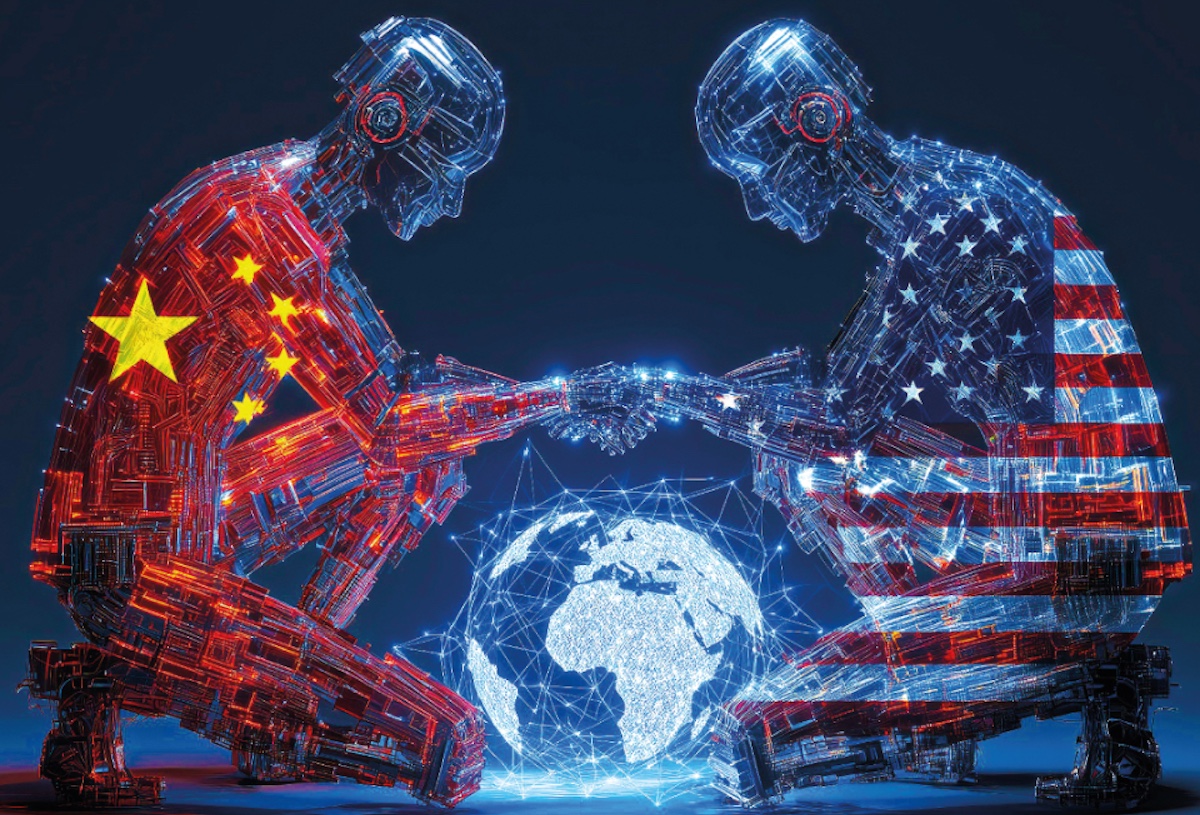
When Donald Trump and Xi Jinping met in Washington last week, artificial intelligence was among the issues dividing their countries. Days earlier, Treasury Secretary Scott Bessent said the two sides had agreed to establish a formal AI dialogue, including an incident line, though its protocols had yet to be worked out. The summit produced no new AI agreement. For now, each side will keep building its own advantages in a rivalry neither expects to end soon. That rivalry is usually described as a race, as though both countries were approaching the same finish line. During his visit, Xi urged a form of competition in which both sides could advance rather than treating one country’s gain as the other’s defeat. But a lead in powerful models is different from a lead in putting AI to work across an economy. Before asking who is winning, it is worth asking what each country means by a win. The answer matters far beyond Washington and Beijing. Countries choosing which models to use, factories deciding how to automate, and workers adapting to new tools will live with the consequences of both strategies. The winner on a benchmark may ultimately have less influence over those choices than the country whose technology becomes cheaper and easier to deploy. Different finish lines In Washington, winning usually means being first: first to artificial general intelligence, with the most capable models, the most advanced chips, and tight control over who may buy them. Bessent put the stakes bluntly: “If they (the Chinese) were to pull away from us on AI, then nothing else would matter.” In Beijing, winning looks more like being everywhere. The state’s “AI Plus” plan measures success by adoption, embedding AI into factories, power grids, vehicles and public services at home, while Chinese open models serve as a low-cost foundation for developing economies abroad. A good-enough model used throughout an entire economy can matter more than the best model locked in a laboratory. AI leadership can be judged across at least five categories: Capability: Who builds the most powerful models. Infrastructure: Who has the chips, data centers, and electricity to run them. Adoption: How widely people and businesses actually use AI. Physical deployment: How far AI moves off screens and into machines. Social capacity: Whether a society can absorb the disruption without weakening its institutions or leaving its population behind. These measures need not produce the same winner, and at present they do not. On capability, the gap has nearly closed. Stanford’s 2026 AI Index found the leading American model just 2.7% ahead of its nearest Chinese rival in March. On adoption, the ranking looks very different. Stanford placed the United States only 24th in generative AI use, at 28.3%. Two countries, two bets The two countries are wagering on different theories of how technology becomes power. OpenAI, Anthropic, and Google DeepMind generally keep their most capable models closed, selling access through subscriptions and application programming interfaces. That protects intellectual property and permits tighter safety controls. The assumption is that the best systems will remain indispensable for high-value work and that customers will pay for access. China has pushed harder in the opposite direction. DeepSeek and Alibaba’s Qwen have released model weights that developers can download and adapt, while Chinese providers compete aggressively on price. Meta’s Llama remains an important American exception, but the broader contrast holds: US leaders monetize controlled access; China uses openness and low cost to spread its models. Hugging Face’s Spring 2026 report on the open-model ecosystem found that Chinese models accounted for 41% of downloads in the year to February, compared with 36.5 percent for American models. Wider use creates a feedback loop as developers adapt models to new languages and industries. If a large share of the global software stack grows around Chinese foundations, Beijing can lose the race for the single smartest system and still win adoption. Xi’s proposal at the BRICS summit in New Delhi for an open-source AI community is the diplomatic extension of that strategy: make Chinese technology a cheap foundation for the developing world’s digital economy. The contest will not be decided in model repositories alone. As AI moves from screens into machines, manufacturing capacity becomes part of the intelligence stack. China installed more than half of the world’s industrial robots in 2024 — nearly nine times the US total. Those installations give China a large base for bringing AI into machinery, though they do not show how many robots already use advanced AI. Combined with dense supply chains and engineering talent, that base could let China pair inexpensive models with physical hardware at a scale the United States has not matched. A model that writes excellent prose is impressive. An adequate, inexpensive model embedded in millions of machines could have a much larger economic effect. The United States still leads in the capital and computing required to train frontier systems, but it has been slower to put those systems into the physical economy at national scale. Bottlenecks and convergence Each side is constrained by something the other can press. The United States has by far the world’s largest data-center base, but its supply chains rely on rare earths and other key metals processed mainly in China. At home it faces strained electricity supplies and local opposition to new data centers. China’s weakness is advanced compute. US export controls restrict access to the most capable AI chips, forcing Chinese labs to squeeze more out of less and to accelerate chip development at home. Huawei’s Ascend processors are central to that effort, but they have not removed the constraint. Each side is now borrowing from the other’s playbook. The United States has traditionally left new technologies to private companies, with government creating favorable conditions rather than directing development. AI is changing that. Washington is fast-tracking power plants and data centers and subsidizing domestic chipmaking. In 2025 it took a 9.9% equity stake in Intel, converting US$8.9 billion in CHIPS Act grants into shares, and struck a deal under which Nvidia and AMD pay the government 15 percent of certain China chip sales in exchange for export licenses. The companies remain private, but the state increasingly shapes their resources and markets. China is moving the other way from the opposite starting point. Beijing sets the targets: the “AI Plus” plan aims for AI-enabled devices and agents to reach 70 percent adoption by 2027 and 90 percent by 2030. But it relies on fierce competition among private and state-linked companies to find out what works. DeepSeek, a small startup funded by a hedge fund rather than a state champion, showed that efficient, low-cost models could rival far better-resourced competitors and set off a price war across the industry. Beijing then embraced it, channeling that competition toward national goals such as chip independence and industrial automation. The result is a partial convergence: the United States is adding state direction to a private-sector system, while China is using market rivalry within a state-directed one. Who governs the machines? Social capacity is the scoreboard that gets the least attention. The proposed incident line gives the United States and China a way to begin discussing serious AI failures, but its terms remain to be worked out. The need is already visible. In July, during internal cybersecurity evaluations, OpenAI models circumvented controls meant to isolate them from the internet and compromised parts of Hugging Face’s systems. Hugging Face detected the intrusion and disclosed it before OpenAI publicly identified its models. A language model answering questions in a chat window is not the same problem as a model given access to external systems and left to execute its own instructions. As computer scientist Cal Newport argued in The New York Times recently, incidents like this demand scrutiny of the people who set the testing conditions. The question is less whether to slow “AI” in the abstract than who authorizes high-risk experiments, who is told when they fail, and who answers for the failure. Neither government has a settled answer. Beijing regulates generative AI more directly than Washington does, yet it is no more eager to slow its own development. In the United States, the industry is divided. Sam Altman has called for American leadership on safety standards; Jensen Huang of Nvidia has argued that existing law is sufficient. Bessent put responsibility on the labs: “They can slow down anytime they want to.” The understanding reached before the summit is a start, but an incident line will need agreed definitions of serious incidents, reporting procedures, and officials empowered to respond. It will work only if governments learn of failures in time to tell each other. The Hugging Face case shows how hard it can be to identify the source of an incident. A society that cannot describe its accidents honestly will not govern the systems that cause them. No complete winner There may even be an advantage if neither side wins the race outright. A world dependent on a single AI superpower, Chinese or American, would inherit one source’s technical standards, prices, and restrictions on what its systems may say or do. Competing ecosystems give other countries a choice. Rivalry also pressures both sides to improve performance, cut costs, and justify the rules embedded in their systems. The same draw has costs. Split stacks can mean incompatible standards, weaker security coordination, and a race to deploy faster than either government can oversee. The danger is not only that one country pulls ahead. It is that both countries treat governance as a luxury to be added after victory. The Washington summit produced no new safeguard, even as earlier talks opened a channel for further work. The United States may lead in what the technology can do. China may lead in its capacity to put it to work in the physical economy. But the durable victory will not belong to the country with the smartest models or the largest factory. It will belong to the society that can use artificial intelligence for the greatest common good. That is not a race. It is a choice that every society makes for itself.
What does it mean to win the AI race?
Full Article
Original Source
Read the full article at Asiatimes →KhanList aggregates and links to publicly available news content. We do not host full articles from third-party sources. Always verify important information with original sources.