
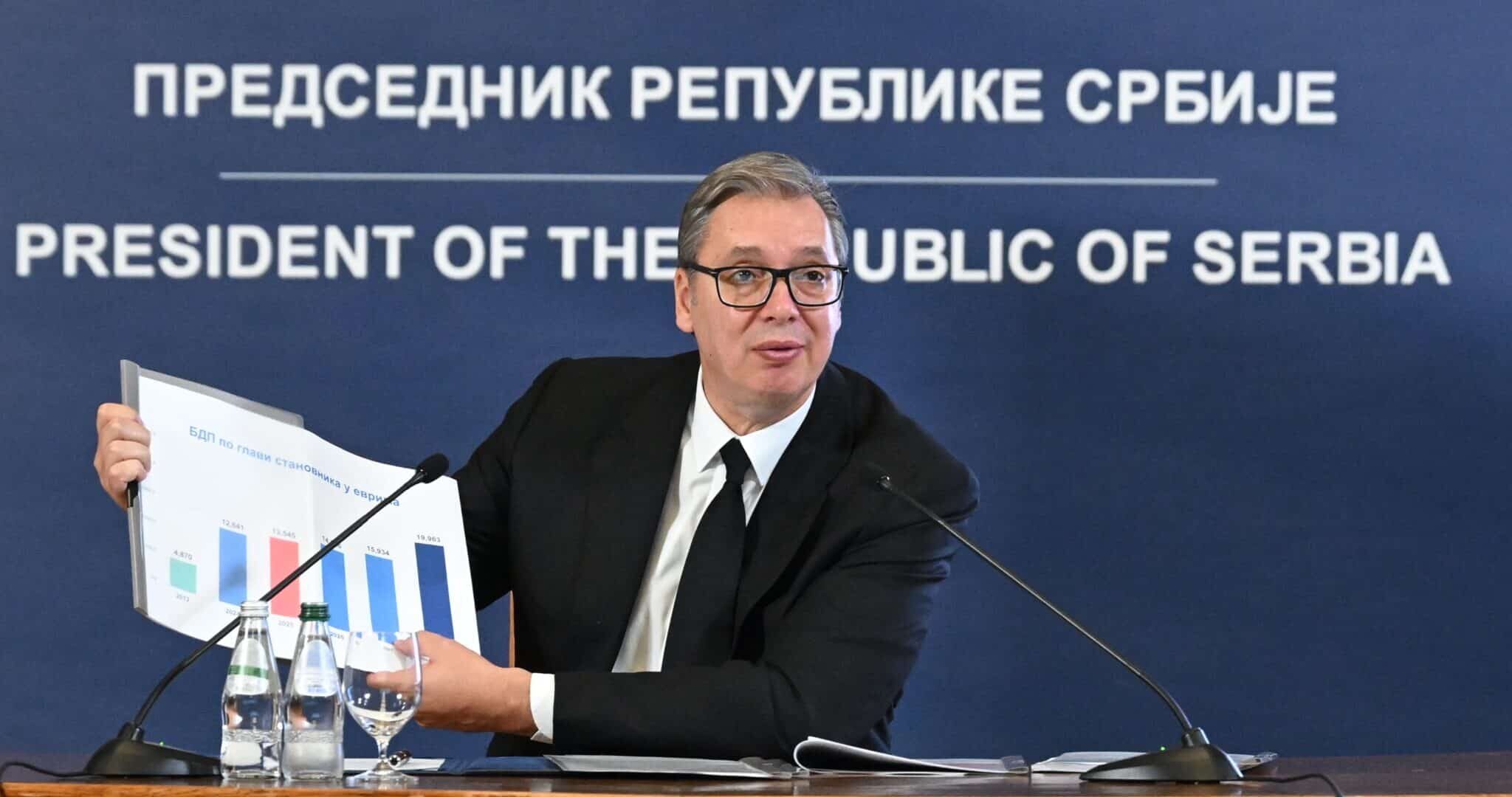
Under pressure from protesters, Serbia’s Aleksandar Vucic vowed last year to root out corruption. Dozens of arrests followed, but more than 18 months later, barely a handful of people have actually ended up in court. In January 2025, facing growing protests in the wake of the fatal collapse of an outdoor railway station canopy, then President Aleksandar Vucic announced a “fierce fight against corruption”. As if on cue, dozens of people were arrested on suspicion of graft, many of them public officials. The arrests were unrelated to the railway station tragedy, in which 16 people died, but they filled the frontpages of tabloid newspapers for weeks, as one high-profile arrest followed another. They included former power utility boss Milorad Grcic, who was arrested on suspicion of corruption; former Belgrade property permits chief Nemanja Stajic, whom prosecutors accused of earning millions by illegally legalising properties; and Dragana Sotirovski, the former mayor of the southern city of Nis, who was arrested on suspicion of tampering with public tenders. In total, Belgrade’s Higher Prosecution said it had “processed” 111 people in the first 17 days of February 2025 for corruption-related offences and filed indictments against 64 of them. Since then, however, only four have reached trial. By July, the European Commission said more than 153 people had been arrested, but the dragnet “did not yield any significant judicial outcomes”, the Commission wrote in its Rule of Law Report on Serbia. “Many were subsequently released and the campaign achieved limited results, with no systemic investigation, prosecutorial follow-through or final judicial outcomes until now,” the report stated. More than a year and a half later, with Serbia nearing potentially pivotal elections, Bozo Draskovic, a former board member of the Serbian Anti-Corruption Agency, said the anti-corruption campaign was essentially “fictitious”. “We have a major problem,” said Draskovic, a researcher at Belgrade’s Institute of Economic Sciences. “For decades, the appearance of a fight against corruption has been created, while in reality there is no fight against corruption.” Arrests no indicator of success Photo illustration: Instagram/mupsrbije. The arrest of Grcic, the former head of power utility EPS, in February 2025 attracted much media attention, but more than 18 months later he has not been charged. A case involving him and 14 others has been sent to organised crime prosecutors, who say the investigation is ongoing. Stajic has been charged by prosecutors with illegally legalising buildings, but the court is yet to confirm the indictment. The Nis Higher Court confirmed the indictment against Sotirovski in December 2025, but a first preparatory hearing was held on September 30. A similar pattern can be seen across the cases that made headlines in the weeks after Vucic’s announcement, which critics say was in fact a bid to blunt the criticism coming from protesters that rampant graft was partly to blame for the railway station tragedy, in which 16 people died. Only a handful of cases have reached trial. Over the same period, Serbia has slid 11 places on Transparency International’s annual Corruption Perception Index, published in February. It now stands in 116th place out of 182 countries, the worst ranking of any country in the Western Balkans. Last year, Transparency Serbia published a report showing that for the first time since the fall of Serbian strongman Slobodan Milosevic in October 2000, the Serbian public considers corruption the biggest issue in the country. “Vucic came to power in 2012 on, among other things, a campaign of ‘zero tolerance for corruption’,” said Draskovic. “That zero tolerance has turned into absolute tolerance of corruption.” Nemanja Nenadic, programme director of Transparency, questioned the very notion of an ‘anti-corruption campaign’, given fighting corruption is the day-to-day remit of special corruption departments within the public prosecution service. “Based on what has been announced, it can be concluded that a large number of arrests presented as part of this campaign essentially have nothing to do with corruption, but with other criminal offences,” Nenadic told BIRN. “For example, cases in which owners of private companies engage in schemes to avoid paying taxes, not in collusion with tax officials, but with other private business owners.” “In 2025, the number of reported corruption cases and indictments did increase compared with the previous year. For four major criminal offences, the number of indictments was 52 per cent higher than a year earlier, but there were only nine per cent more first-instance judgments.” Arrests are the least important indicators of success, Nenadic said. “More important indicators include how quickly reports submitted by citizens are examined, which can encourage more people to report cases; the amount of benefit obtained through corruption offences or the level of damage caused to public property or the public interest; the number and seniority of those indicted; the speed of court decisions; and, finally, the value of unlawfully obtained assets that are confiscated.” Draskovic said that long-running proceedings without final judgments risk weakening public confidence. “It sends a signal that it is not worth fighting corruption,” he told BIRN. Political campaign before a court result Election campaign consultant Ana Stojiljkovic. Photo courtesy of Ana Stojiljkovic. Vucic resigned as president this month, readying for elections on October 25 in which the student-led protest movement will challenge the SNS for power. Election campaign consultant Ana Stojiljkovic said the simplest way to distinguish between an actual anti-corruption policy and the political use of anti-corruption rhetoric is to look at the outcome. “There is no other way to distinguish it except through results”, she said. Corruption, however, resonates with voters, she said, regardless of court verdicts. And that’s what political parties play on. “These topics give them some political points and help them address certain problems with their electorate,” Stojiljkovic told BIRN. “Such actions are probably supported by everyone, but when there is no follow-up, no conclusion, no outcome in court or elsewhere, they simply bury it under other topics.” “We do not have enough media outlets and journalists following these cases closely enough to keep them on the agenda and continue asking questions, so a significant part of the electorate eventually forgets that the whole thing even started.” The wider institutional picture remains challenging. In its latest assessment, GRECO, the Council of Europe’s anti-corruption body, found that Serbia had satisfactorily implemented three of 24 recommendations concerning top executive functions and law enforcement, while 10 were partly implemented and 11 had not been implemented. Transparency Serbia said the three satisfactorily implemented recommendations concerned the police, while none relating to top executive officials had been satisfactorily implemented. It argued that individual investigations cannot by themselves demonstrate systemic progress unless they are the result of broader institutional changes. For the organisation, the more meaningful test is whether documented allegations are investigated regardless of who is involved, whether cases move through the system within a reasonable time and whether unlawfully acquired assets are ultimately recovered.
In Serbia, ‘Fictitious’ Corruption Campaign Becomes Tool of Distraction
Full Article
Original Source
Read the full article at Balkaninsight →KhanList aggregates and links to publicly available news content. We do not host full articles from third-party sources. Always verify important information with original sources.