
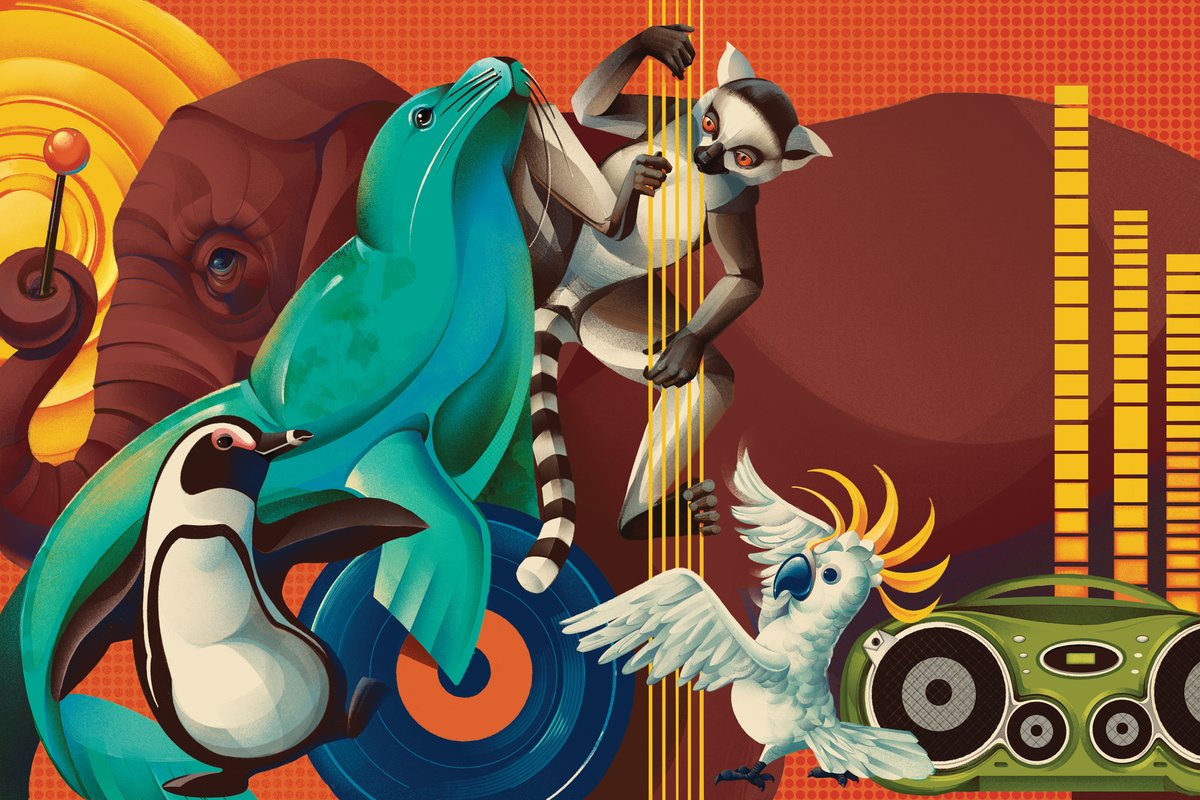
California sea lions spend their days lazing on jetties and beaches, sunbathing and squabbling. But they are also curious, high-energy and smart. They’re good at semantics (matching words and objects), logic puzzles (if A = B and B = C, then A = C) and even a variant on the classic marshmallow test of self-control (theirs involves trays laden with fish).So on a gray summer morning, I’m prepared to be impressed by Ronan, a celebrated sea lion at the University of California, Santa Cruz, Long Marine Laboratory. But she blows my expectations out of the water.Over the course of the day, Ronan shows off her skills. She pops out a tongue in response to a quick hand gesture and unlocks food puzzles. She’s been known to hoard Jell-O rewards for later so she can keep participating in particularly engaging research activities.On supporting science journalismIf you're enjoying this article, consider supporting our award-winning journalism by subscribing. By purchasing a subscription you are helping to ensure the future of impactful stories about the discoveries and ideas shaping our world today.But most impressive of all is the act that has made her famous: head bobbing to the disco funk classic “Boogie Wonderland” by Earth, Wind & Fire. Her performance—which she first demonstrated more than a decade ago—drew so much attention that the song’s lyricist, Allee Willis, once paid Ronan a visit.As the music plays, the sea lion sways her upper body to the beat, tipping her nose up and down like an exaggerated metronome, staying perfectly on meter. In fact, Ronan’s beat keeping exceeds that of many people put to the same test. “She was better than almost all the humans on almost every measure,” says Peter Cook, a comparative neuroscientist at New College of Florida who has worked with Ronan for years. “A lot of human drummers could beat Ronan, probably, on some of the metrics, but I wouldn’t bet on all of them.”Those skills have caught the notice of a corner of the scientific community dedicated to understanding the origins of music. For more than a decade, researchers have been analyzing various creatures’ abilities in the realms of meter, melody, and other musical elements. Cook, for example, is developing what he calls “Guitar Hero for sea lions.” Others look for patterns in the rain dances of chimps or the vocal performances of sand gobies.Yet at the heart of these efforts is a deep question: Did some animals, humans included, evolve to be musical creatures? Strictly speaking, biological evolution involves traits so vital to a species’ survival or reproduction that they become innate. For instance, many linguists think language is an evolutionary adaptation. Humans seem to be born with this capacity; it’s largely hardwired in our brain, and it helped our ancestors survive and multiply by supporting group cohesion. Writing, in contrast, is generally considered a technology. It’s a powerful tool, but it rests mainly on taught rather than inborn abilities.Music may fall somewhere in between, melding culture, technology and biology. Some scientists argue that music came out of language, a happy but incidental by-product of the more serious business of communication. Others say the exact opposite is true—that music evolved to help us survive. One way to resolve the mystery, scientists hope, is to look across species for evidence of “musicality,” or the ability to perceive, produce and enjoy music. By observing this trait in the animal world, researchers are finding new evidence about how and why music came to be—and embracing the messiness of a musical menagerie.Whether human music is a result of evolution or pure invention is a vexing question. For starters, it’s hard to define “music,” which encompasses Javanese gamelan, old-time rock and roll, Baroque polyphony, rap and R&B. Plus, music is unquestionably cultural. It’s shaped by societies, and it travels and transforms more dynamically than one would predict based on the movement of peoples or languages alone.Historically, efforts to link music and biology have been filled with biases. Early attempts to identify universals across human music—which would hint at shared biology shaping common features—were often framed to favor Western musical traditions over others. Given that legacy, many contemporary scholars steer clear of these topics. In his 2026 book Comparative Musicology, ethnomusicologist Patrick Savage of the University of Auckland in New Zealand likens telling colleagues he wanted to compare music across cultures to telling “a chemist I was interested in alchemy.”Some scientists argue that music came out of language, a happy but incidental by-product.But in the past decade, scientists have shifted their thinking. “We now know that it’s not all culture,” says Henkjan Honing, a music cognition researcher at the University of Amsterdam. In 2009, for instance, Honing and his colleagues published evidence that human newborns show an innate sensitivity to rhythm. By monitoring brain activity with electrodes while playing a sequence of tones, they observed that if you skip a piece of the rhythmic pattern, babies seem to register the missing beat. In 2023 he replicated those results with updated methods and 27 infants.Such work suggests that even if music itself is a cultural by-product, the cognitive capacities that support musicality in our species could be biological. The big question is no longer whether biology plays a role in our musical behaviors but to what degree—and cross-species comparison might be the key to solving this mystery.Andrea Ravignani, an evolutionary cognitive neuroscientist at the Sapienza University of Rome, has studied monkeys, lemurs, horses and dogs, among many other creatures. “It’s a zoo,” he says of his bibliography. He and his colleagues have described how the “ecstatic display songs” of the male African penguin resemble the accelerando of human music and have documented “consonant, sometimes jazzy” sounds in baby chickens. Now he’s immersing himself in the watery world of whale song, which he has called the “next frontier” for rhythm research because of the rich repertoire of vocalizations and the array of evolutionary strategies that exist among cetaceans.Human music, Ravignani explains, rests on many cognitive building blocks, such as the ability to perceive rhythm, move to a beat or reproduce a specific tune. “No single animal species [beyond our own] has all of them, but for each building block, you can find at least one other species that has it,” he says. “It’s this beautiful mosaic of musicality that we can find from crickets to chimpanzees.”Ronan the sea lion’s beat-keeping abilities have caught the attention of scientists.Joel Sartore/Photo ArkMaking these comparisons is difficult. Human-centric expectations can lead to all kinds of errors. In one public presentation, Honing played audio from a performance by the Thai Elephant Orchestra, an ensemble of pachyderms who play percussion. When Honing asked the people in his audience what they had just heard, many guessed they were listening to avant-garde 20th-century composer John Cage.And the way different species perceive “music” is complicated. Older experiments established that koi fish can separate blues from Bach and that pigeons can distinguish Bach from Stravinsky. But those studies didn’t clarify which patterns or parts of the music these creatures attend to. For instance, songbirds may be less sensitive to a specific rhythm or key and more interested in the changing timbre, or quality of sounds, over time. That’s more like the way humans listen to spoken conversation than the way we process songs, and it points to the slippery boundary our species has set between language and music—and the ways we impose those categories on other animals.So far, the richest vein in musicality research has been the study of rhythm—patterns of sounds or movements over time. Rhythm and timing are often thought to be primal and universal, and rhythm has been a major focus in human research. Some scientists suspect that anticipating a beat is part of what makes music so rewarding. Our brain’s love for patterns makes finding and syncing to auditory rhythms deeply satisfying. And it’s in this area of rhythm where Ronan the sea lion has made her biggest splash.The Long Marine Laboratory, where Ronan lives, is a watery wonderland. A series of saltwater swimming pools sit just feet from rocky cliffs overlooking the Pacific. When I enter, I pass spy-hopping bottlenose dolphins, walk alongside a swimming spotted seal and pause beneath the solemn eyes of a bearded seal, whose 500-pound bulk lets him buoy upright in his pool as if he were standing on two legs.Most of these animals are rescues who might otherwise have been euthanized, explains Carson Hood, a cognition research technician at the New College of Florida who conducts research at the lab. The animals receive targeted training and, if they demonstrate an interest, can participate in research projects. “It’s a lot like a Montessori school for marine mammals,” says Colleen Reichmuth, an animal behaviorist at the lab.When it’s time for research, Ronan pops out of the water and hustles up to a gate where her human colleagues are waiting. She’s a picture of eagerness, shifting from side to side and pointing her wide eyes expectantly at each person in turn.Over the next few minutes, I watch Ronan get to work. Within a small, sound-controlled room, she arranges herself in front of a button placed at (sea lion) nose height. She pushes the button to play a series of tones, some paced at an even cadence, others randomly. In response, she then chooses to nose-boop either a target in front of her or one to her left. If Ronan correctly matches rhythmic audio clips with one target and random audio with the other, she receives a squid snack. (Her enthusiastic gobbling of these rewards suggests she is highly motivated to succeed.)To avoid influencing her behavior, only one human is allowed in the chamber—the person tasked with doling out these slimy delicacies. That researcher faces away from Ronan and wears a hat, headphones and glasses. The elaborate get-up prevents the human from hearing Ronan’s cues and betraying any motion that might sway the sea lion’s behavior.Watching Ronan on a video feed from a second chamber, I hear a scientist whisper, “I’m so nervous for her,” like an anxious parent at a child’s music recital. In silence, we observe Ronan bop one button and then the other. Occasionally, her ears wriggle and her body tenses up. By the end of the session, she’s done well, getting the answers right roughly 90 percent of the time.When Ronan wraps up her session, I get my own turn in the sound booth to try a few rhythm-matching exercises. I have 15 years’ worth of piano lessons to draw on, but I fumble my first round, failing to hit the correct button, which is still slick from Ronan’s nose.Ronan’s beat keeping exceeds that of many people put to the same test.My mistake underscores the number and types of skills Ronan has mastered. A California sea lion does not have the benefit of human-language explanations when learning how to use this setup. On top of that, Ronan has had limited exposure to human music—particularly compared with most people, who begin listening to lullabies and jingles in their earliest days.This sound-booth activity, I learn, is just one step in Ronan’s training. The ultimate goal, after presenting the sea lion with many audio clips at varying speeds, will be to give her totally novel audio cues to test whether she is simply memorizing which audio clips match a particular button or whether she has generalized from these snippets of sound to truly recognize what makes something rhythmic. The answer to that question can tell us how deep Ronan’s musical abilities go. Then scientists can compare sea lions with other species to uncover the extent of animal musicality.Another important creature in cross-species comparisons of animal musicality is Snowball, a sulphur-crested cockatoo. He debuted in a viral 2007 YouTube video, kicking and head-bobbing along with the synth lines and syncopation of “Everybody (Backstreet’s Back)” by the Backstreet Boys.For most viewers, the dancing bird was a delightful distraction. But for Aniruddh Patel, a cognitive neuroscientist at Tufts University, Snowball was a revelation. Patel, who has spent more than three decades studying the neuroscience of music, has since worked with Snowball—and the parrot’s owner, Irena Schulz—on multiple experiments. Over the years, he has gotten to know his feathered collaborator, whom he fondly calls a bit of “a prima donna.”Patel, Schulz and their colleagues have documented the cockatoo’s repertoire of 14 distinct dance moves, some of which seem to be self-taught. In 2025 a separate research team at Charles Sturt University in Australia studied multiple captive cockatoos, cataloging 30 different moves, including feather fluffs, body rolls and sidesteps. An interesting finding was that the degree of genetic relatedness among these dancers was not linked to overlapping dance moves, suggesting the behaviors are not entirely driven by instinct and may involve individual creativity.With statistical analysis, Patel has confirmed that Snowball anticipates the beat of the music much better than he could by pure chance. Patel has also found that Snowball syncs to musical rhythms at many different tempos. The bird’s performance is not perfect—he sometimes drifts off-beat or dances through only parts of a song—but Patel argues that the movements are not so different from what you might expect from a human child.All of this together, Patel says, makes Snowball notable for several reasons. Not only can he sync, or entrain, his movements to a beat, but he does so even when hearing complex acoustic patterns, such as human music. In addition, this behavior is flexible and predictive rather than fixed and reactive. And Snowball was never formally trained to behave this way.One of the most intriguing questions, Patel thinks, is why we see anticipatory, musical beat syncing in two species as evolutionarily distant as cockatoos and Homo sapiens. Why do parrots and humans dance to beat-based music—and why don’t more animals join in? Patel’s hunch is that this ability is a case of convergent evolution, in which similar pressures and circumstances shape similar traits in otherwise distantly related species. (The classic example is flight in bats and birds—a trait they share thanks to parallel evolutionary forces rather than a common winged ancestor.)Patel thinks the key connection for parrots and people is how vocally sophisticated both species are. Before ever meeting Snowball, he had studied the ways in which language and musical capacities overlap and diverge in the human brain. Inspired by Snowball, he then identified parallels in parrot and human neurobiology, including pathways for vocal learning and control that link auditory and motor areas. Patel’s hypothesis, first developed in 2006 and then refined several times over, is that species that learn to produce complex vocalizations have special neural hardware that evolved to support this task. And as a bonus, these bits of the brain make us and other animals good at entraining to external rhythms.By that logic, animals that possess some form of complex vocal learning should demonstrate at least some degree of musical beat syncing. Elephants, for instance, show some vocal complexity and, with it, the ability to bop to a simple rhythm.When Reichmuth and Cook encountered Patel’s hypothesis back in 2010, they decided to test it with Ronan, then a newly arrived sea lion, rescued after being spotted wandering along California’s Highway 1. Ronan was two years old at the time.Her work began with training to simple metronomelike audio. She first was taught to bob her head in time and then, later, was exposed selectively to a handful of human tunes. She surpassed everyone’s expectations. By age three Ronan could find and entrain to rhythm in human music. Subsequent studies confirmed that her movements are anticipatory, much like human hand-slapping along to a beat.My own jaw drops as I watch a video of her first exposure to “Come On Eileen,” the Dexys Midnight Runners classic. The song accelerates in the middle: as the singers croon “Toora, loora, toora, loo-rye-aye,” the tempo speeds up. I’ve seen plenty of humans struggle to clap or dance along, but Ronan doesn’t miss a beat.California sea lions are not known for high-level vocal skills. For Reichmuth and Cook, then, Ronan’s abilities suggest that rhythmic entrainment is probably more widespread than Patel’s proposal alone would predict. For some researchers, including Honing, her abilities falsify the complex-vocal-learning hypothesis. “It might be partially true, but it’s not the whole story,” he says.Snowball, a sulphur-crested cockatoo, has 14 different dance moves.Irena SchulzInstead Cook suspects that many animals could keep a beat with the right training and motivation because the ability relies on predictive timing, which is helpful for hunting prey or moving with a group. Marine mammals may have particularly strong timing because they synchronize their breathing and movements with other group members. Sea lions will bark at one another in rhythmic bursts, which may give them greater sensitivity to auditory rhythm.But not everyone thinks complex vocal learning has been ruled out for Ronan. Neuroscientist Constantina Theofanopoulou of the Rockefeller University, who has studied zebra finch song and now works with human dancers, contends that there are still open questions about sea lions, including the possibility that we’ve been underestimating vocalization in this species. Both Reichmuth and Cook acknowledge that more work needs to be done to answer those questions. In fact, this past March Cook and his colleagues published findings in Science revealing that sea lion brains may indeed have some neuroanatomical features linked to vocal abilities.Cook suggests that a key difference between Ronan and Snowball might be their reasons for dancing. “It’s maybe the spontaneous motivation to interact with rhythm that might be more unique to humans and parrots,” he says. “That I’d totally buy.”In humans, movement and rhythm are tightly bound. Neuroimaging studies have revealed that listening to a beat triggers strong activity in our brain’s motor areas, as though we feel the impulse to move to rhythm even when we’re standing still. And our desire to tap to a beat, sometimes called the groove experience, may relate to deviations in rhythmic pattern. People seem to be most compelled to dance along when there’s just enough variation to be interesting but not so much that the underlying pattern is lost.It’s not clear that Snowball or Ronan experiences anything similar. Ronan showed no obvious interest in rhythm before her training began. Her enthusiasm for the studies could be about the food, the challenge or the opportunity to interact with others.Snowball, meanwhile, doesn’t perform for treats. In currently unpublished work, Patel reports that Snowball dances when nobody’s watching, which suggests some internal motivation. But Snowball rocks out far more when Schulz is present and dancing, too. And Snowball does not dance with other birds.Singing and dancing together could help groups demonstrate unity or strengthen bonds.In that sense, his behavior may be more analogous to something that parrots of certain species do with their mates. For example, one sunny afternoon in May, I visited the San Antonio Zoo to meet a pair of black palm cockatoos named Lucy and Ricky. Ricky, like other males of his species, uses a special display to impress his mate and reaffirm their bond. During the breeding season, Ricky selects a nutshell or stick and modifies it with his beak. Then he lifts his crest feathers, stomps his feet, and raps the makeshift drumstick against a hard surface. This kind of percussion makes the black palm cockatoo the only animal known to create a tool to produce acoustic effects—in other words, the birds make instruments.There’s evidence that wild male black palms pass tool-building knowledge to their sons. But no one taught Lucy and Ricky their moves. And when I meet one of their human-reared hatchlings, just 47 days old and covered in pinfeathers, the little bird is already practicing foot stomps.If components for music making are innate and found across species, that would support the idea that music might have evolved as an adaptation for survival. But if so, scientists wonder, what is the evolutionary value of this ability?In the 1990s cognitive scientist Steven Pinker of Harvard University described music as something that was clearly not an evolutionary adaptation but rather a by-product of other evolutionarily useful behaviors. He likened it to “auditory cheesecake.” By his logic, musicality piggybacks on systems we evolved for other, more pressing biological needs. Some scientists agree. Yet othes counter with a different argument, drawing on Charles Darwin’s idea that perhaps language is the by-product, and something like music is more primordial and emerged first in our evolutionary journey.Our primate cousins could offer hints toward the answer. Chimpanzees drum in special nonrandom patterns that are specific to individuals and particular regions. Their performances broadcast messages to their fellows over long distances, blurring the line once again between musicality and language. Another primate, the lar gibbon, seems to have different rhythmic strategies: when singing alone, males show varied rhythmic patterns, but when it’s time to duet with a female, they shift to a simple call-and-response with one beat per tone.In humans, an analysis of more than 700 recordings comparing music and spoken languages showed that songs generally are slower and involve more stable pitches than speech. That’s the case “even when you look at tonal languages and people who aren’t really good singers,” says Savage, who co-authored that work. The finding makes sense, he adds, if predictable pitches and rhythms are necessary for others to be able to join in.Singing and dancing together could help groups demonstrate unity or strengthen bonds within families and communities—and those functions might be significant enough to matter on an evolutionary timescale. Psychological research, after all, has shown that doing the same task at the same time, in sync, leads strangers to feel close to one another. Keeping a beat brings people together.This isn’t the only hypothesis about the evolutionary function of music, but it’s one that’s gaining support. Savage, Ravignani, and others are now collaborating on a large-scale investigation to assess whether music, more than language, supports social bonding in humans. Meanwhile the broader lesson from cross-species research seems to be that more than one evolutionary story may apply across the animal kingdom.In fact, arthropods such as fireflies and crickets “are the current champions in terms of how closely they keep a beat,” says Lara Burchardt, a behavioral biologist at Humboldt University in Berlin. Their ability to sync up performances arguably puts Ronan, Snowball and humans to shame. Still, many of these rhythms are rigid and fixed. How well a species can keep a beat may depend on physiological limits such as how fast the animal’s body can move.Toward the end of my visit at the Long Marine Laboratory, Hood noticed Ronan gamboling and playing in her pool. “You’re really seeing the animal here,” she said, noting that these were Ronan’s playful, untrained behaviors. It’s hard not to interpret them through human terms and emotions. To me, she looked joyful splashing in the water. When tackling her rhythm tasks, however, she seemed eager and energized—almost serious—as though she were hard at work.But precisely what she’s feeling as she moves to the beat remains a mystery. And ultimately, what she and other animals can tell us about the origins of music is still an open question. After all, as Hood says, “music requires rhythm, but rhythm doesn’t require music.” Rhythm, in the end, could be adaptive for many reasons. Music builds on a vast repertoire of abilities, which may each have a distinct evolutionary history. When a song comes on the radio and your foot can’t help but jiggle to the beat, you are probably tapping into something far more complex and ancient than you realize.
What animals reveal about the origins of music
Full Article
Original Source
Read the full article at Scientificamerican →KhanList aggregates and links to publicly available news content. We do not host full articles from third-party sources. Always verify important information with original sources.