
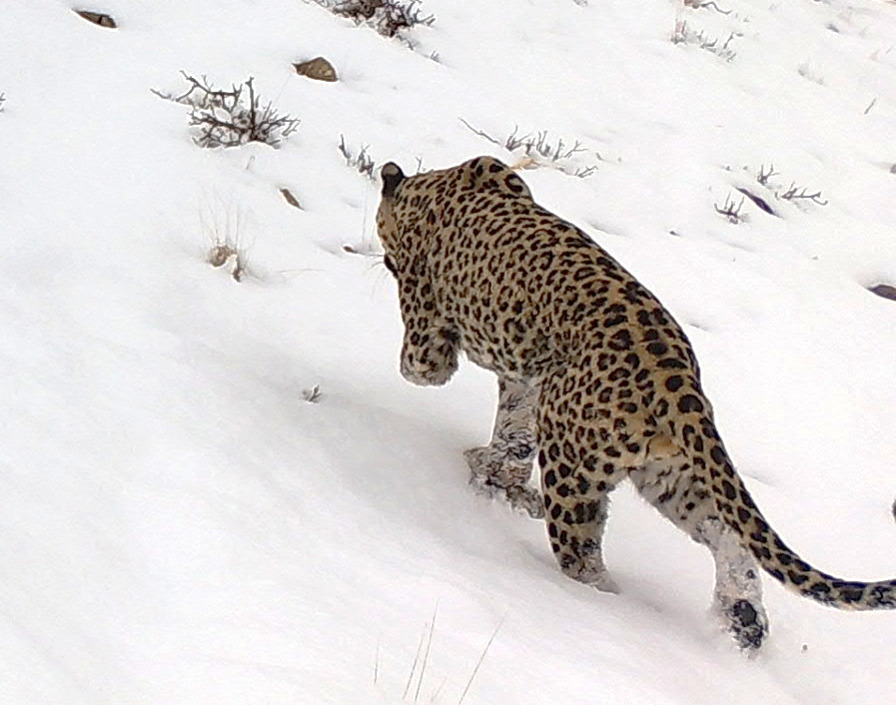
An endangered Persian leopard that researchers have named Aren recently completed a 240-kilometer (150-mile) journey through the snow-bound Caucus Mountains that straddle Russia, Georgia, Armenia, and Azerbaijan. Aren not just navigated a landscape that still contains decades-old minefields from prior conflicts, but he did so on just three legs. His journey highlights the severe hazards that border minefields and fencing pose to wildlife, Mongabay contributor Kayleigh Long told host Mike DiGirolamo on a recent episode of the Mongabay newscast. Persian leopards (Panthera pardus tulliana) are endangered, with fewer than 1,044 individuals remaining worldwide, according to the IUCN, the global wildlife conservation authority. In the past two decades, scientists have documented just three leopard sightings in Georgia and 10 in Armenia. Long’s reporting for Mongabay highlighted Aren’s trek, which was first identified by camera traps in Armenia’s Arpa Protected Area. He started off as a healthy four-legged male, but when rangers spotted him months later, the lower part of his left foreleg was missing — an injury Arpa rangers say may have been inflicted by an antipersonnel mine along the border of Nakhchivan, an Azerbaijani exclave. Such injuries are common in the region. According to WWF Armenia, three of the 10 leopards recorded in Armenia since 2002 have lost a limb. Soviet-era electric signal fences known as Sistema, along with modern border barriers, further obstruct movement across Iran, Armenia, Azerbaijan, and Georgia. “Leopards do not recognize political boundaries,” Hana Raza, founder of the nonprofit Leopards Beyond Borders, told Long. “Their survival depends on connected habitats and the ability to move safely across landscapes.” Raza added that mined areas make conservation harder by hindering monitoring and directly harming wildlife. However, Aren, lacking one limb, adapted his hunting technique by lurking in cave mouths to ambush prey like bezoar goats (Capra aegagrus aegagrus). Arpa head ranger Samvel Karapetyan described Aren to Long as thriving and “fat.” He eventually traveled northward through Armenia and crossed into Georgia’s Algeti National Park, where a deer-monitoring camera recorded his presence in September 2025. Long said conservation groups monitoring these elusive cats face severe resource constraints. Georgian NGO NACRES (Centre for Biodiversity Conservation & Research) operates on a skeleton crew led by zoologist Bejan Lortkipanidze amid global funding shortages. Still, the persistence of big cats like Aren offers a vital reason for optimism, Long added. “When you look at things like borders, they can reflect the very worst of our instincts,” she said. “Or if people are able to cooperate and recognize that we are a part of nature … we all have to get along with nature and with each other. In times like this, I sort of think hope is a moral imperative.” Listen to the full conversation with Kayleigh Long here. Banner image: Aren pictured walking in the snow by a camera trap in Armenia. Image courtesy of WWF Armenia. Credits Topics
Three-legged Persian leopard’s 150-mile journey highlights Caucasus border hazards
Full Article
Original Source
Read the full article at News →KhanList aggregates and links to publicly available news content. We do not host full articles from third-party sources. Always verify important information with original sources.