
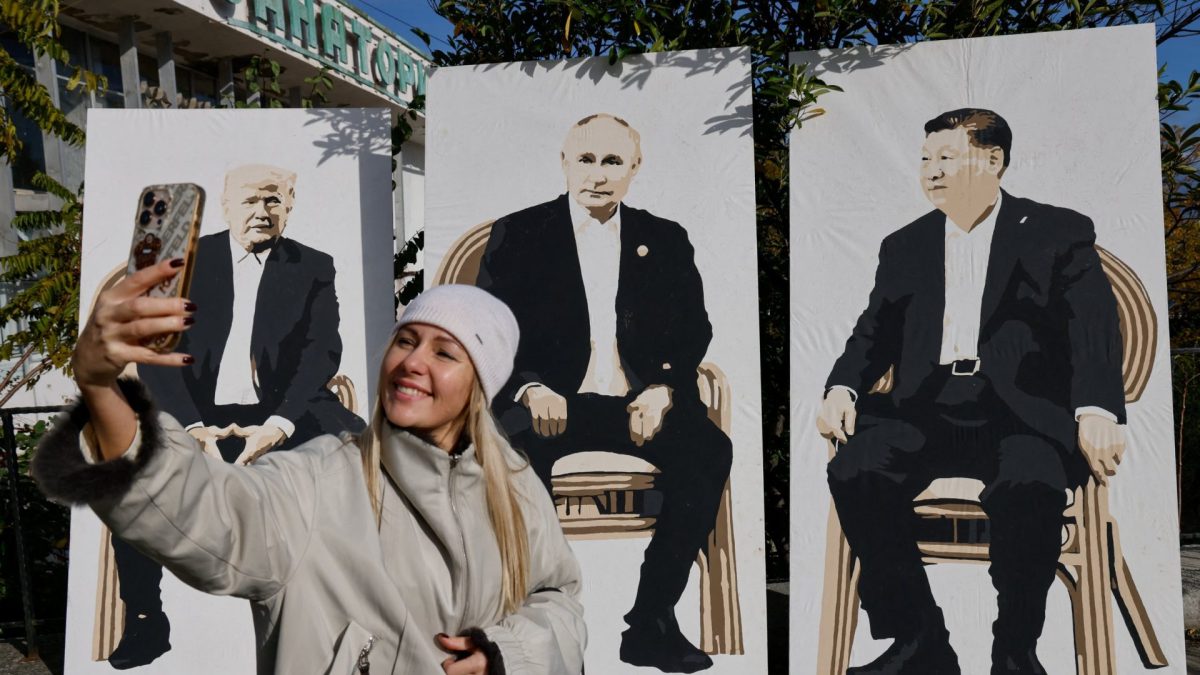
Early in Donald Trump’s first term, I was on a flight to New York City with my boss at the time, Homeland Security secretary John Kelly, when he turned to me with a question I wasn’t expecting. “What do you think it is with Trump and Russia?” he asked. “Why do you think he’s so beholden to Putin?” Here was a retired four-star general and a member of the President’s cabinet, puzzling out loud over why the commander-in-chief was so fond of one of America’s biggest adversaries. It vexed his colleagues. It vexed the country. A lot of people in Washington had a theory back then that Moscow must “have something” on Trump. I don’t know if we’ll ever know the answer to that, but I gave Kelly a simpler explanation. Trump looks at men like Vladimir Putin and sees kindred spirits. He envies them. He wants to be like them. This week, he gets his wish, as he’ll sit among them on a platform of equals. On Thursday in Shenzhen, Trump is due to meet jointly with Putin and China’s Xi Jinping, the first-ever three-way sit-down between the leaders of the United States, Russia and China. The White House says the subject is nuclear arms control, but Beijing is promising a meeting of “ground-breaking significance” (it’s been reported that Russia is pressing for the meeting to get a favourable outcome in the Ukraine war). Traditional Russian dolls depicting Chinese President Xi Jinping, US President Trump and Russian President Vladimir Putin displayed in a Moscow gift shop on Tuesday ahead of the leaders’ trilateral meeting (Photo: Igor Ivanko/AFP)I see it as bigger than all of that. I think this is the moment Trump has wanted for his entire political life: his admission into the dictators’ club. The summit has been dubbed “Yalta 2.0” — a reference to the historic 1945 conference when America, Britain and Russia carved up the world among themselves. Only this time, the democracies are outnumbered. I saw this coming more than a decade ago and tried to ring the alarm bell. After I quit the first Trump administration in protest, I wrote a book called A Warning under the pseudonym “Anonymous”, and titled one of the key chapters “A Weakness for Strongmen”. I warned that the President’s affinity for autocrats meant America was flirting with upending the balance of power that has kept us safe for decades. Inside the administration, the writing was on the wall. The President fawned over dictators and barely disguised his envy of them. After Xi moved to scrap term limits and rule indefinitely, Trump told him privately that he was a “king” for doing it. In front of donors he was even less subtle, calling Xi “president for life” and joking that “maybe we’ll have to give that a shot some day”. He also said of North Korea’s Kim Jong-un, “He speaks, and his people sit up at attention. I want my people to do the same.” Again, he said he had been joking. White House aide Natalie Harp and White House Chief of Staff Stephen Miller walk to Marine One as Trump departs Washington on Monday for the Asean summit in the Philippines and the Apec summit in China (Photo: Kent Nishimura/AFP) After one tense meeting about a foreign dictator, a top national security aide gave me the best summary I have heard. The President, he said, sees in these guys what he wishes he had: “total power, no term limits, enforced popularity and the ability to silence critics for good.” If we needed more evidence of his moral inversion of global affairs, Trump provided it in a July 2018 interview when he was asked to name America’s biggest global adversary. He didn’t lead with China or Russia. He led with Europe. “Well, I think we have a lot of foes,” he told the reporter. “I think the European Union is a foe — what they do to us in trade. Now, you wouldn’t think of the European Union, but they’re a foe.” So that was the first half of my answer to John Kelly about why Trump was cosy with Putin — that he seemed to love dictators and loathe democracies, and it showed. But the second part was simpler still: naked self-interest. In my view, Trump learned long before he entered politics that so-called strongmen are easier to do business with than democracies. A democracy has planning boards, regulatory bodies, real courts, a nosy press and officials who can say “no”. A strongman can say “yes” over a steak dinner. As far back as 2008, his son Donald Jr was telling a real estate conference that “we see a lot of money pouring in from Russia”. While Trump was running for president, he signed a letter of intent for a Trump Tower in Moscow. (Robert Mueller’s investigation did not establish that his campaign conspired with the Russian government.) Donald Trump with Xi Jinping in South Korea last year. Trump has previously called his Chinese counterpart a ‘president for life’ and joked, ‘maybe we’ll have to give that a shot’ (Photo: AP Photo/Mark Schiefelbein, File) The pattern has only grown in his second term. The Associated Press reported this year that the Trump Organisation struck around eight foreign deals in a little over a year, having made none in his first term. They include a Qatar golf project involving a government-owned company, a resort in Saudi Arabia built by a developer close to the ruling family and the sale of a stake in the family’s crypto venture to a firm linked to the UAE government. The Trump Organisation says it does no business with foreign governments and complies with all ethics laws and the White House insists there are no conflicts of interest. Readers can judge for themselves in what types of countries this family prefers to make its money. When I look at the coming Shenzhen summit, I see a man who has finally arrived where he always wanted to be, alongside the two most powerful autocrats on Earth, treated as one of them. The timing is significant. Trump just lost control of Congress in the midterm elections, and he’s hunting abroad for the wins and the flattery he can no longer get at home. Xi and Putin surely know that. And they’re expected to make trades with Trump to get him to yield on the issues they hold dearest, making sure America doesn’t meddle in their attempts to project power. Consider this week a preview of the next two years. If Trump spends the rest of his presidency catering to Moscow and Beijing, the Ukrainians will undoubtedly be sold out and abandoned, Taiwan could be bargained away and the world will be carved into spheres of influence run by men who answer to no one. That leaves the West on its back foot and the world a more dangerous place for anyone who loves freedom. Seven years ago, I wrote that our enemies believed President Trump was weak and would take advantage of him. On Thursday, they’ll be smiling for the cameras with him, ready to prove my point. The rest of us could spend a generation repairing the damage.
I warned that Trump wanted to join the dictators’ club. This week he gets in
Full Article
Original Source
Read the full article at Inews →KhanList aggregates and links to publicly available news content. We do not host full articles from third-party sources. Always verify important information with original sources.