
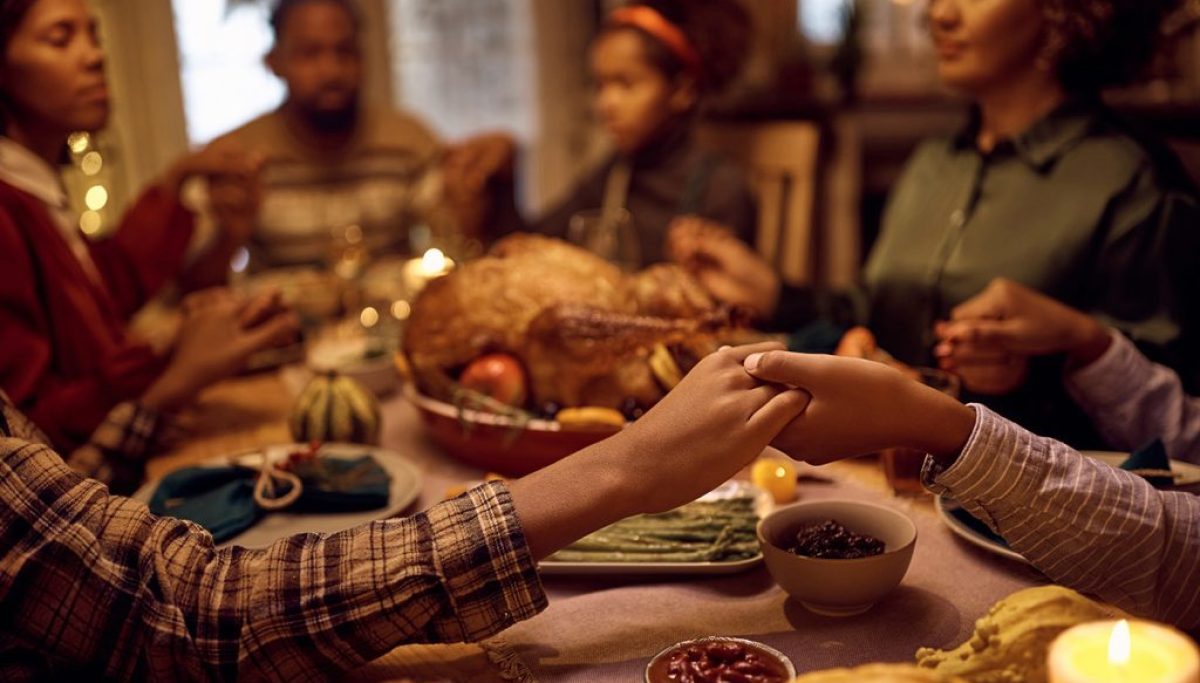
It might come as a surprise to you, but Thanksgiving, like Christmas, is an inherently religious holiday. Although many Americans now associate Thanksgiving primarily with football, family gatherings, and an abundance of food, the holiday was established for a much more important purpose: to encourage Americans to collectively express their gratitude to God for the many blessings he has bestowed upon them.In 1789, at the request of Congress, President George Washington proclaimed a national day of thanksgiving and prayer. In the proclamation, Washington recognized the duty of nations to acknowledge the providence of Almighty God, whom Washington called “the great Lord and Ruler of Nations.”In 1863, in the midst of the Civil War, President Abraham Lincoln established the tradition of an annual national Thanksgiving celebration, encouraging Americans to praise God and pray for the healing of their divided nation. THE DEMOCRATS HAVE A CHRISTIANITY PROBLEM — TRUMP’S GOP IS JUST AS LOSTFor much of U.S. history, it was common for governors, presidents, and lawmakers to designate special days of thanksgiving to God, in addition to the annual November holiday. As recently as 1945, President Harry Truman called upon Americans to dedicate a Sunday to prayer and thanksgiving following Japan’s surrender in World War II.The gradual removal of God from Thanksgiving and, to a lesser extent, Christmas is further evidence of how radically and tragically people’s character has changed.Millions of Americans will gather around dinner tables this Thanksgiving, taking turns telling one another what they are thankful for. But in many households, one of the most important questions will go entirely unconsidered: To whom are we thankful?Most of the material possessions we enjoy were not given to us as gifts by other people. We acquired them with money we earned in exchange for our labor. Even the benefits provided by government largely come from resources taken from other Americans.Who, then, deserves our gratitude for the fertile soil in which our food grows, the rain that nourishes our crops, the natural resources that make our prosperity possible, and the extraordinary conditions on Earth that allow human life to flourish?For most of American history, the answer to these questions would have been obvious. Today, the very idea of thanking God for such things is foreign to many Americans.Whether you believe in God or not, it should be obvious that a nation that has undergone such a profound transformation is fundamentally different from the one that produced the Constitution and the Bill of Rights. And that raises an uncomfortable question: Can institutions designed for a very different kind of people continue to function as intended?America’s founders understood that a free society depends heavily on the character of its citizens. A government with limited powers requires a people capable of exercising considerable self-restraint.In an address to members of the Massachusetts militia in 1798, President John Adams famously warned, “Our Constitution was made only for a moral and religious people. It is wholly inadequate to the government of any other.”There is mounting evidence that Americans are becoming increasingly incompatible with their own system of government.In a 2022 national survey I helped conduct with Rasmussen Reports, 51% of young likely voters agreed that the U.S. Constitution should be mostly or completely rewritten.In another Rasmussen survey, published in 2025, 59% of likely voters ages 18 to 39 said they would support a constitutional amendment giving the United Nations the power to oversee the U.S. Supreme Court and presidency to ensure Americans’ rights are protected.Why should we expect younger generations to cherish a Constitution rooted in principles that many of them no longer embrace?For decades, secular liberals have pursued a grand social experiment: removing God from American public life while attempting to preserve the nation’s historic commitment to individual liberty. I believe that experiment is failing.When people cease to believe their rights come from a power greater than government, it becomes much easier to convince them that government should have the authority to determine which rights they are entitled to exercise.A people who abandon God risk turning government into their god. It’s not a coincidence that the rise of socialism in America has coincided with its decline in religious observance.Of course, it’s possible other forms of authoritarianism will gain traction instead. Perhaps in the 21st century, technology will become Americans’ new savior. A 2025 Rasmussen poll found that 41% of likely voters under 40 would support giving an advanced AI system the authority to determine most public policy decisions.Whatever form our new secular religion takes, the prospects for freedom in a society without faith are increasingly dim.EVANGELICAL VOTERS LEFT THEIR DISCERNMENT IN 2022This Thanksgiving, American Christians should give thanks to God for their many blessings, but they should also pray fervently for a religious revival in America. Without such a revival, I fear America as we have known it, with all its wealth, power, influence, and extraordinary freedom, cannot survive indefinitely.Restoring Thanksgiving to the religious holiday it was always meant to be would be a good place to start.Justin Haskins is a New York Times bestselling author and president and senior fellow at Our Republic, a national nonpartisan think tank.
What America has forgotten about Thanksgiving — and why it matters for our future
Full Article
Original Source
Read the full article at Washingtonexaminer →KhanList aggregates and links to publicly available news content. We do not host full articles from third-party sources. Always verify important information with original sources.