
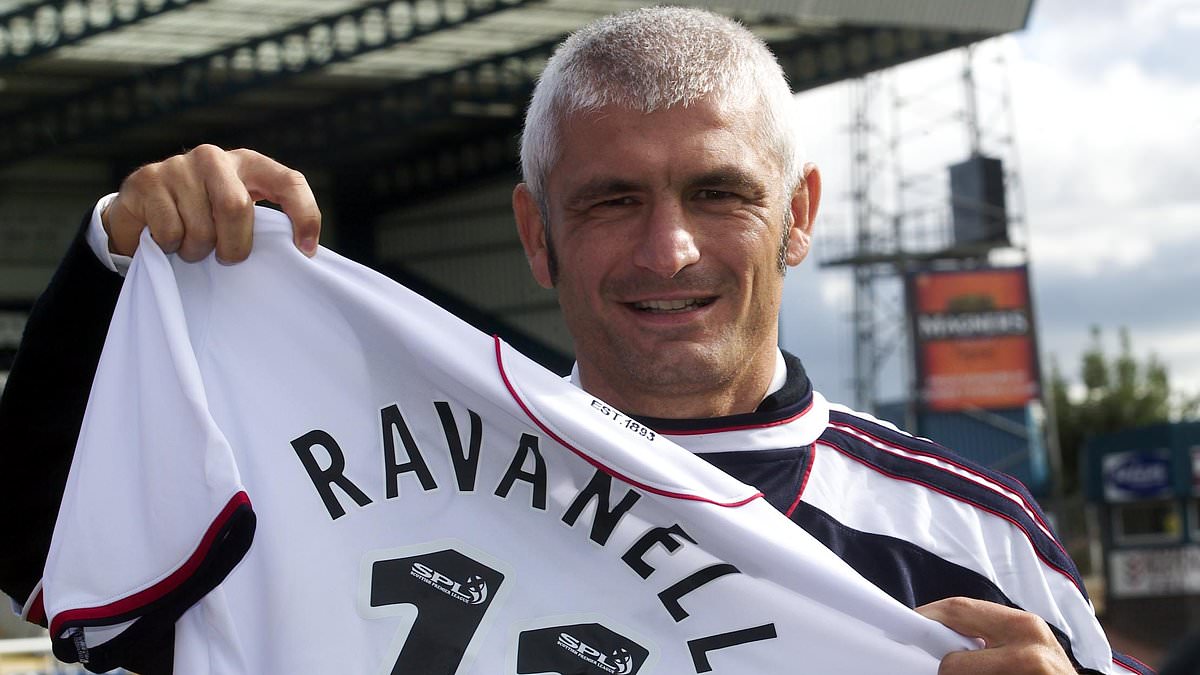
Former Premier League football star Fabrizio Ravanelli has won a High Court fight with the UK taxman over a £340,000 bill linked to his playing days 20 years ago.The Italian striker, 57, played for Middlesbrough and Derby County during two separate spells in England, with some of his earnings from the latter club being paid into an 'employee benefit trust' (EBT).The fund was then hit by a tax bill when the trustees decided to pay out in 2021, with HMRC receiving £1.2million of the £2.1million destined for Ravanelli in 'settlement' of any tax due on the money.He has since been trying to recoup £340,000 of the sum, claiming it represents National Insurance Contributions (NIC) he was never liable to pay.The former footballer said NICs were the responsibility of his employer Derby County Ltd and could not now be claimed by the taxman after the company ceased trading due to financial difficulties more than two decades ago.Mr Justice Eardley heard that while Ravanelli was only at the East Midlands club from 2001 to 2003, it paid £1million into the EBT between February 2002 and March 2006. After a hearing earlier this month, the judge has now ruled that HMRC considered his case wrongly and ordered that they reconsider whether he should get the cash.Mr Justice Eardley said the taxman had refused to reopen the 'settlement agreement' between HMRC and the trust on the basis of a wrong belief that the trust was liable for National Insurance contributions (NICs) – as opposed to the player's employer, the now dissolved Derby County Ltd. Fabrizio Ravanelli's spells in British football included playing for Middlesbrough, Derby County and Dundee - he is seen here on joining the Scottish club in September 2003 The Italian former striker, now 57, has won a court case against HMRC - he is pictured here playing for Middlesbrough against Leeds United in December 1996The judge had heard that the dispute arose because part of Ravanelli's earnings at Derby County were paid into an employee benefit trust.Although he was only at the club from 2001 to 2003, it paid a total of £1million into the trust between February 2002 and March 2006 – which due to investment gains was worth £2,136,310 by July 2021.The issue of tax arose because, faced with the prospect of an impending inheritance tax charge due to EBT rules, the trustees decided to pay the money out.The money to be paid out of the trust to the former footballer would be 'part of his remuneration as an employee', the judge was told.After discussion with HMRC, a 'settlement' was agreed by the trustee under which about £1.2million went from the trust to the taxman, with the rest going to Mr Ravanelli.It led to the former player challenging the trustee's bill, arguing that any NICs due were the responsibility of his previous employer – the long dissolved club company.He also said that tax rules state: 'If the employer no longer exists, the employee will not have to pay any National Insurance contributions.'His lawyers said that, in those circumstances, HMRC acted wrongly in refusing to 'reopen the settlement agreement' and should now pay him the £340,000 which was said to have represented NICs.Ravanelli's barrister Tim Johnston said: 'The NICs were not owed by or on behalf of Mr Ravanelli.'They remained liabilities of the employer, who had ceased to exist.'According to HMRC's own guidance, no sums should have been withheld in respect of NICs when the distribution from the EBT was made to Mr Ravanelli.'Mr Ravanelli's case is that, as a matter of tax law, NICs were never due. As a result, no amount for NICs should have been deducted from the distribution out of the EBT.'HMRC barrister Adam Tolley said Ravanelli's case that no NICs were payable because Derby County Ltd had been dissolved was 'wrong as a matter of tax law' and a misunderstanding of the NICs legislation.He argued: 'When the trustee made the distribution, for the purposes of the relevant NICs legislation it did so as the deemed employer of the claimant and he received the distribution as the deemed employee of the trustee.'As such, the trustee was liable to pay the NICs.'Giving judgment, Mr Justice Eardley said he preferred Mr Ravanelli's lawyers' analysis, with the result that HMRC's decision not to reopen the settlement agreement was 'vitiated by a material error of law'.However, he said it would be 'jumping the gun' to say that HMRC should now reopen the settlement or to hand Mr Ravanelli the money, as opposed to reconsidering his case based on a correct understanding of the law.The judge said: 'I shall quash the decision refusing to reopen the settlement agreement and HMRC will need to remake that decision, this time without any reliance upon the erroneous view that, as a matter of substantive tax law, the trustee was liable to pay NICs.'An HMRC spokesperson said today: 'We are carefully considering the judgment.'Ravanelli, who was not in court for the two-day hearing, works as a TV pundit and still plays in occasional legends' games.But he missed last month's Middlesbrough 150th anniversary game, which featured Brazilian former team-mate Juninho, due to a leg injury.Ravanelli joined Derby County on a free transfer in 2001 but was reputedly one of the club's highest-earners at a time when Derby were foundering financially – and the club was also relegated from the Premiership during his stint there.He moved on to Scottish club Dundee, after leaving Derby, later playing for his home-town club Perugia in his final years before retiring professionally in 2005.He subsequently switched to coaching, going on to help manage the Juventus youth team before taking up the post of head coach at French side Ajaccio.READ MORE: Former Premier League footballer Fabrizio Ravanelli locked in bitter court battle over £1.2million tax bill
Ex-Premier League star Fabrizio Ravanelli wins High Court fight with taxman over £340,000 bill linked to his playing career
Full Article
Original Source
Read the full article at Dailymail →KhanList aggregates and links to publicly available news content. We do not host full articles from third-party sources. Always verify important information with original sources.