
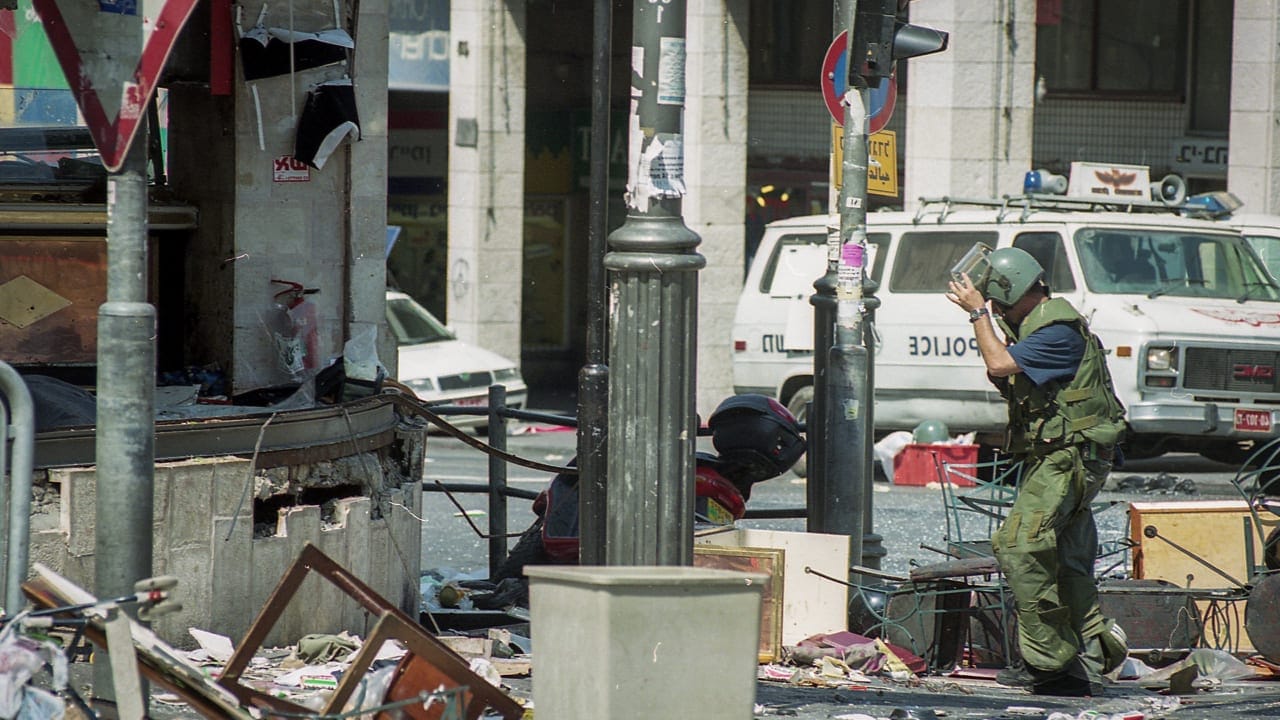
SEPTEMBER 27, 2026 14:24Updated: SEPTEMBER 27, 2026 14:29A quarter century ago, Al-Najah University in Nablus hosted a disturbing exhibition. The exhibit celebrated a suicide bombing in Jerusalem that had murdered 16 people. The bombing occurred on August 9, 2001. Soon after, the university created an exhibit. The exhibit showcases how massacres and bombings were celebrated by mainstream Palestinian institutions.The memory of this disturbing exhibit has received increased attention from an account on the social media platform X/Twitter. The account, “2001 Live (@25YearsAgoLive),” posts news from 25 years ago as if it is happening in real time. The account has gained a large number of followers because it is chronicling in real time the lead-up and aftermath of the September 11 attacks in the US.However, the account has also brought back the story of the Sbarro bombing exhibit. 2001 Live described how the university set up the exhibition celebrating the bombing, saying that the art exhibit included "props of mutilated body parts, to trumpet the perceived success of Palestinian resistance against Israel," and that "Visitors are required to walk over Israeli and American flags to enter and leave the exhibition.”It’s worth looking back at this exhibit and the 2001 bombing to draw lessons regarding the conflict. JTA at the time noted that in late September the exhibit had been closed, and that the closure had been “seen by observers as ‘too little, too late.”JTA also reported that “Palestinian Authority President Yasser Arafat bowed to pressure Tuesday to order the closure of the Al Najah University exhibit.”Women walk out of the Al-Najah University exhibition of the 2001 Sbarro bombing. (credit: Screenshot/X/@25YearsAgoLive)Palestinian Authority was pressured into banning mass murder exhibitNote how this is presented. Arafat is said to have “bowed to pressure.” Instead of banning an exhibit at a university that was celebrating mass murder, the Palestinian Authority had to wait to be pressured. This shows the support this kind of incitement to mass murder had at the time, particularly as “The exhibit was altered but was not shut down completely on Tuesday.”Let’s recall how the exhibit was described. “In one room of the exhibition, students dressed as suicide bombers, clasping a Koran in one hand and a gun in the other, conduct what is intended to be their final interview before setting out on their suicide mission,” JTA reported.“Another student, dressed in a military uniform and face mask, is featured setting a supposed bomb. This scene takes place at a replica of a restaurant with the word “kosher” written in Hebrew above the door. Sbarro was a popular kosher restaurant frequented by religious Jews.”JTA also noted that “Arafat’s delayed response was condemned by Rabbi Marvin Hier, head of the Los Angeles-based Simon Wiesenthal Center, as ‘outrageously too little, too late.’”The Associated Press also did a video on the exhibit, which is still online. The video shows how the exhibit was set up. It includes a placard that makes it look like the entrance to the Sbarro restaurant. Students step on US and Israeli flags to enter. Inside, fake blood and destruction, along with mock pieces of people, suggest the restaurant. Photos show the actual carnage. Photos of the terrorist who carried out the bombing are shown, celebrating his action. Other parts of the exhibit justify the attack by showing Palestinian victims of the Second Intifada.BBC claims Arafat was 'disturbed' by suicide bombing exhibitHow did the BBC report on the exhibit? “Palestinian leader Yasser Arafat has closed down an art exhibit which featured a recreation of the scene of a suicide bombing,” the report said on September 26, 2001. “The exhibition, at An-Najah University in the West Bank town of Nablus, was organized to mark the first anniversary of the Palestinian intifada.”The report claimed that a source from Arafat’s circle noted that "the president [Arafat] was gravely disturbed and offended by the images in the exhibit.” The BBC claimed that the exhibit “divided” those who saw it. “A university branch of the militant Palestinian group Hamas built the exhibit, which recreates the scene of last month's attack on Sbarro Pizza house in Jerusalem. A suicide bomber - Ezzaldin Almasri - blew himself and 15 other people up during a busy lunchtime at the restaurant.”The report quoted someone it said was named Alas Hmeidan, head of Islamist students at the university: "We don't like blood, but this is a way to retaliate against the massacres committed by Israel. We want to show them we can hit back."At the time, the BBC noted that then “former Prime Minister Benjamin Netanyahu showed pictures of the restaurant exhibit. He said that Mr. Arafat is not stopping terror attacks against Israel.”The Sbarro bombing was one of the worst and most tragic massacres of the Second Intifada. One of those involved in the bombing was Ahlam al-Tamimi, who was convicted in Israel for her role. She was then released in the 2011 deal with Hamas, and she lives in Jordan.The US Rewards for Justice program offered a $5 million reward for information on her. “On August 9, 2001, al-Tamimi transported a bomb and a Hamas suicide bomber to a crowded Jerusalem Sbarro pizzeria, where the bomber detonated the explosives. The blast killed 15 people, including seven children. Americans Judith Shoshana Greenbaum, a pregnant 31-year-old school teacher, and 15-year-old Malka Chana Roth were among those killed. More than 120 others were injured, including four Americans. Hamas claimed responsibility for the bombing,” Rewards for Justice noted.Jewish American organization urges US to extradite Sbarro bombing accompliceFive days before the 25th anniversary of the attack, the Conference of Presidents of Major American Jewish Organizations wrote an open letter to US Secretary of State Marco Rubio, urging the United States to demand that Jordan immediately extradite Tamimi.The story of the Nablus exhibit is important to recall because it illustrates how mainstream Palestinian institutions, such as universities, normalized massacres such as suicide bombings. It’s difficult to remember now, because so many worse massacres and wars have taken place, but during the Second Intifada there was a lot of focus on suicide bombers. In the West, they were often depicted as desperate young men driven to this act, sometimes promised paradise as a reward.The film Paradise Now, for instance, was produced to tell the story of two men preparing to carry out a suicide attack. It won a Golden Globe Award for Best Foreign Language Film and received an Academy Award nomination. This was part of the normalization of this kind of attack.The fact that it was normal at a major Palestinian university to celebrate blowing up a pizzeria full of civilians, and that students walked through an exhibit showing bloody body parts, is emblematic of the Intifada and the foundations of extremism that led to October 7, more than two decades later.Follow us on Google
What a Palestinian university’s Sbarro exhibit revealed about Second Intifada extremism - analysis
Full Article
Original Source
Read the full article at Jpost →KhanList aggregates and links to publicly available news content. We do not host full articles from third-party sources. Always verify important information with original sources.