
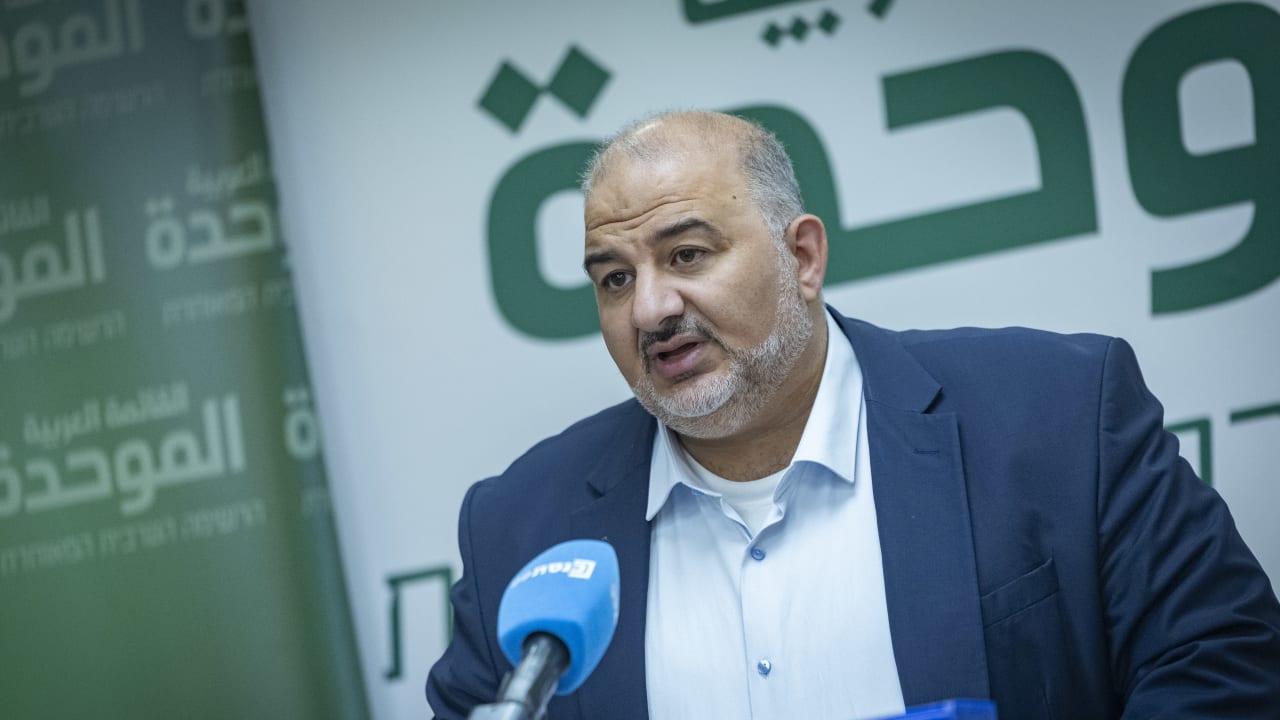
I support the decision to disqualify Ra’am from the upcoming election. I also believe that disqualifying a political party and denying citizens the ability to vote for it is bad for democracy.Those statements are uncomfortable together, but they are not contradictory. They expose one of the hardest questions buried inside Israel’s definition of itself as both Jewish and democratic: What happens when democratic participation collides with the preservation of the Jewish national character of the state?My answer is that Israel should not sacrifice its Jewish character on the altar of democracy. But anyone making that argument should also be honest enough to admit that defending a democracy can sometimes require measures that carry a democratic price.On Wednesday, the Central Elections Committee voted 18-5 to disqualify Ra’am from participating in the October 27 election. Likud, Otzma Yehudit, and the Choosing Life Forum submitted the petitions against Ra’am, and together invoked the grounds in Section 7A of Basic Law: The Knesset. Ra'am Party head MK Mansour Abbas attends a conference of Israel Hayom newspaper in Jerusalem, September 6, 2023. (credit: YONATAN SINDEL/FLASH90)The attorney-general’s office opposed the disqualification, saying the evidence did not satisfy the stringent legal standard required to exclude the list. Because this is the disqualification of an entire candidate list rather than an individual candidate, it does not automatically require Supreme Court confirmation.Ra’am and its representatives can appeal the decision, and such an appeal is expected.The distinction matters because the case against Ra’am should be made from what can actually be established, not from slogans. Ra’am is the political wing of the Southern Branch of the Islamic Movement, an organization whose ideological roots were influenced by the Muslim Brotherhood.The movement’s 2018 charter described Zionism as a racist and occupying project, supported a Palestinian right of return, and rejected identification with Zionism. Those are not marginal disagreements over taxation, borders, or social policy. They go directly to the ideological legitimacy of the movement that created the Jewish state.At the same time, intellectual honesty requires acknowledging what has changed. Mansour Abbas publicly declared in 2021 that Israel “was born a Jewish state” and would remain one.Ra’am subsequently participated in an Israeli governing coalition and today presents itself as a pragmatic vehicle for advancing the interests of Arab citizens within the Israeli political system. The attorney-general’s representative specifically cited Abbas’s recognition of Israel’s Jewish character when arguing against disqualification.That evolution matters. I do not believe it settles the question.There are also serious institutional questions surrounding the broader movement.In May, the Lod District Court ordered the dissolution of the Association for Humanitarian Actions, a nonprofit associated with Ra’am and the Southern Branch of the Islamic Movement, after a Justice Ministry investigation found reason to believe the organization had transferred funds to or cooperated with organizations outside Israel designated as terrorist organizations. The court cited serious and continuing problems, including joint activity with a declared terrorist organization.Here is where precision becomes essential. That ruling was against the nonprofit. It was not a judicial finding that Ra’am itself financed Hamas, and the attorney-general’s office has said the evidence presented in the election petitions did not sufficiently connect the party to support for armed struggle or allow the conduct attributed to charitable organizations to be imputed to Ra’am.I still support the disqualification.I support it not because the words “Islamist” or “anti-Zionist” should automatically remove someone from Israeli politics. They should not.Section 7A itself does not prohibit a party merely for offending Zionists. It prohibits a list or candidate whose purposes or actions negate Israel’s existence as a Jewish and democratic state, incite racism, or support armed struggle by an enemy state or terrorist organization against Israel.For me, the cumulative picture matters: Ra’am’s institutional origins, the Southern Islamic Movement’s ideological charter, its rejection of Zionism, the continuing controversy surrounding organizations in its wider ecosystem, and the fundamental question of whether pragmatic participation has genuinely replaced the movement’s earlier ideological commitments or merely learned to operate alongside them.The attorney-general reaches a different legal conclusion about whether that evidence satisfies Section 7A. The Supreme Court may ultimately reach the same conclusion. That is precisely what judicial review is for.But Zionism is entitled to have red lines.Where does Israel draw the line?A Jewish state is not simply a country in which a majority of the population happens to be Jewish. Israel exists because the Jewish people reclaimed the right to national self-determination after centuries in which their survival depended upon the decisions of others.If Israel loses that purpose, it does not simply become a different version of Israel. It ceases to fulfill the purpose for which Zionism created it.Yet this is where my own argument becomes uncomfortable, because democracy is not foreign to Zionism either.Zionism was democratic before it was sovereign. Herzl convened the First Zionist Congress in Basel in 1897, bringing together roughly 200 delegates from 17 countries and establishing the institutions of a movement seeking Jewish national restoration decades before the state’s establishment.The World Zionist Organization today explicitly defines Zionism as adhering to principles of justice, equality, and democracy, while its Jerusalem Program describes strengthening Israel as Jewish, Zionist, and democratic as a foundation of the movement.Jabotinsky understood the same duality. Few Zionist leaders were more uncompromising about Jewish sovereignty, Jewish military power, and the necessity of a Jewish majority. Yet the Knesset’s account of his political thought notes that the constitution he envisioned would guarantee equal civil rights and cultural autonomy for the Arab minority.Strength did not require inequality. Jewish sovereignty did not require Arab civic inferiority.The Declaration of Independence carried that same tension into the founding of Israel itself. It asserted Jewish national independence while committing the state to equality of social and political rights and calling upon its Arab inhabitants to participate in building the country based on full and equal citizenship and representation.That is why I call this decision good for Zionism and bad for democracy.Removing a political party from an election is an extraordinary act. It limits the choices available to citizens. It places enormous power in the hands of institutions deciding which political ideas fall beyond legitimate participation.Israel’s history demonstrates why courts have traditionally demanded exceptionally strong evidence before allowing that power to be exercised. Previous Central Elections Committee disqualifications of Arab lists and individual candidates have repeatedly been overturned by the Supreme Court.That democratic danger should not be dismissed merely because I support the outcome this time. A weapon one welcomes when it is pointed at an ideological opponent remains a weapon when political power changes hands.But democracy is not the only value a democratic Jewish state is obligated to preserve. Democracy describes the system through which citizens exercise political power. Zionism explains why there is a sovereign Jewish state in which that democracy exists.Neither should casually consume the other.Ra’am therefore presents a test far larger than Mansour Abbas.The question is not simply whether Arab citizens deserve political equality. They do. It is not whether Arab parties may disagree profoundly with Jewish governments. Of course they may. Nor should opposition to Zionism, standing alone, become a convenient excuse for removing millions of citizens from meaningful political participation.The harder question is where Israel draws the line between opposition to the policies of a Jewish state and opposition to the continued national character of the Jewish state itself.Reasonable people, and reasonable Zionists, can disagree over whether the evidence against Ra’am has crossed the demanding legal threshold established by Section 7A. The attorney-general believes it has not. Those who petitioned for disqualification believe it has. The courts will have their say.My position remains that the Jewish state is entitled to defend the foundational purpose of its existence, even when doing so exacts a democratic cost.That cost should trouble us.It should not paralyze us.Israel was founded on the audacious proposition that Jewish sovereignty and democratic equality could occupy the same state. Nearly eight decades later, that remains the challenge.Defending democracy cannot require Israel to surrender what makes it Jewish. Defending Zionism cannot permit Israel to forget what makes it free.The writer is the founder and CEO of The Israel Innovation Fund (TIIF) and author of the forthcoming book, What is Zionism: Why Never Again Is Not Enough!
Disqualifying Ra'am from Israeli elections: It’s good for Zionism, bad for democracy - opinion
Full Article
Original Source
Read the full article at Jpost →KhanList aggregates and links to publicly available news content. We do not host full articles from third-party sources. Always verify important information with original sources.