
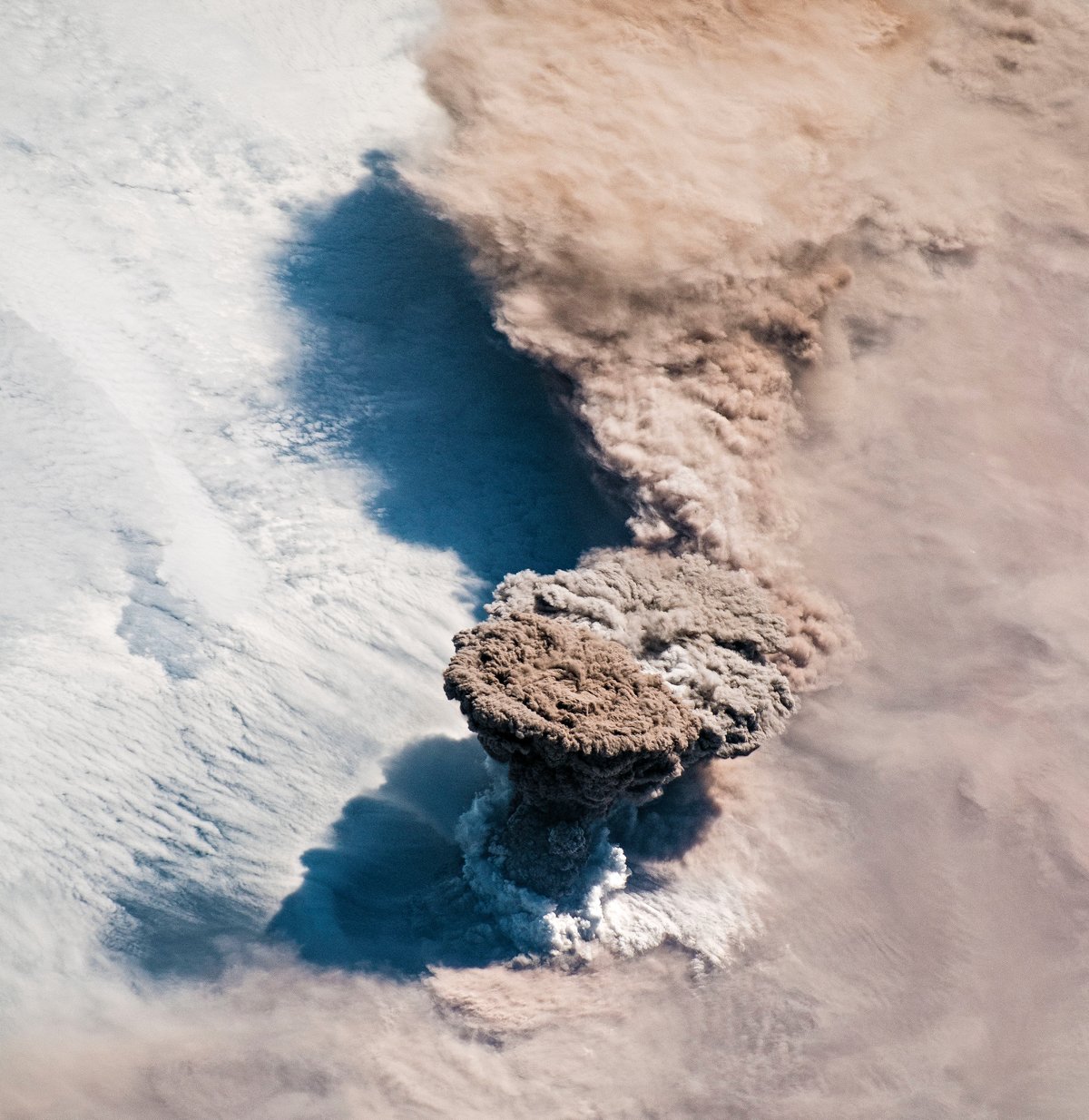
On a cloudy, windy April day at Llanbedr Airfield, on the Welsh coast beneath the peaks of Snowdonia, Matthew Watson and a team of eight researchers completed their first successful test flights of a high-altitude drone. The drone is built to fly into a volcanic plume—eventually, they hope, the plume of an eruption large enough to cool the planet. Nobody can tell them when, or where, that will be.Watson, a professor of volcanoes and climate at the University of Bristol in England, has nearly £4.3 million from the U.K. Advanced Research and Invention Agency, or ARIA, to design two distinct lightweight aircraft. The aircraft will be fitted with sensors to quantify how volcanic aerosols and cloud droplets form and evolve at altitudes from the lower troposphere to the lower stratosphere.Watson’s drones are meant to gather data relevant to an idea called solar geoengineering: cooling Earth by deliberately reflecting a small fraction of sunlight away from it. One of the most widely studied proposals, stratospheric aerosol injection, or SAI, calls for the release of sulfur dioxide or other aerosol precursors into the stratosphere, where they could form reflective particles. A large sulfur-rich volcanic eruption happens to do something similar. No deliberate atmospheric experiment has come near the scale needed to observe climatic effects directly, and even far smaller outdoor tests have encountered intense political and public resistance. What researchers have instead is a scattered record of past eruptions—and the prospect that the next big one could answer questions no controlled experiment can yet approach.On supporting science journalismIf you're enjoying this article, consider supporting our award-winning journalism by subscribing. By purchasing a subscription you are helping to ensure the future of impactful stories about the discoveries and ideas shaping our world today.When Mount Pinatubo in the Philippines erupted in 1991, superheated avalanches roared down the flanks of the volcano. Lahars, fast-moving flows of water, ash and rock, rumbled through the valleys of the country’s Zambales Mountains and buried villages. Of the more than 800 people who died in the eruption, many perished when their roofs collapsed under the weight of wet ash.Pinatubo also unleashed nearly 20 million tons of sulfur dioxide into the stratosphere. There the gas reacted with water vapor and other chemicals to form sulfate aerosols, which reflected solar radiation back into space. With less sunlight reaching Earth’s surface, global temperatures fell by about one degree Fahrenheit, and the cooling lingered for about two years. For researchers trying to understand the possibilities of sulfate cooling, Pinatubo presented a natural experiment on an enormous scale. It has not been repeated. Thirty-five years on, its impact persists in the imaginations of scientists considering whether that cooling effect could ever be deliberately engineered.Volcanoes are natural analogs, says atmospheric scientist James Haywood, who has long studied the climate impacts of eruptions at the University of Exeter in England. “You’re able to track plumes. You’re able to test your model. And you’re able to test the dispersion of the aerosol in the stratosphere—how that evolves and how long it lasts in the stratosphere.”Solar geoengineering has proved deeply controversial, with major uncertainties around unintended impacts to regional rainfall patterns. It’s possible that SAI could weaken Asian and African monsoons, because cooler surface temperatures would alter evaporation and atmospheric circulation. Some climate experts and politicians oppose studying it at all, arguing that it distracts from efforts to cut emissions and is ripe for capture by fossil-fuel interests.A pilot checks a prototype drone before a test flight at Llanbedr Airfield in Wales, part of a project to study volcanic plumes.The MACE TeamIn such a highly politicized environment, scientists and engineers have struggled to secure public support for field trials that could help them better assess these technologies.One high-profile experiment led by researchers at Harvard University illustrates the difficulty. The Stratospheric Controlled Perturbation Experiment, or SCoPEx, proposed releasing tiny particles composed primarily of calcium carbonate into the stratosphere from a high-altitude balloon. But a 2021 flight over Sweden that would have tested only the balloon platform, releasing nothing at all, was called off following strong opposition from environmental and Indigenous groups. The team ended SCoPEx in 2024 without ever having reached the sky. Florida, Louisiana and Tennessee have passed laws prohibiting intentional atmospheric releases meant to affect temperature, weather or sunlight.“The problem is, if we don’t get more data, it will hamper us from understanding [climate engineering] better,” says Ying Chen, an atmospheric scientist at the University of Birmingham in England. When field experiments fail to achieve social buy-in, “volcanoes give us an opportunity to do this.”If volcanic eruptions are the most socially acceptable way to study solar geoengineering in the atmosphere, then the job of a researcher like Watson is to wait—and prepare. “It’s quite difficult to get a drone into a volcanic plume or a cloud associated with that plume,” he says, adding that his team’s attempt would probably be the first with climate engineering as the scientific driver.The unmanned, electric drones need to be capable of soaring to extreme altitudes, where thin air provides little lift. Combustion exhaust from airplanes could contaminate the emissions Watson’s team hopes to measure, and sending pilots into a volcanic plume is inherently dangerous.In 2027, if all goes according to plan, the researchers will deploy the drones to volcanoes in Guatemala, Montserrat and Chile that experience either frequent eruptions or passive degassing, the gentle and continuous release of gases able to alter cloud microphysics. Chile’s Lascar volcano, towering over the Atacama Desert with a peak more than 18,000 feet above sea level, is considered one of the tallest persistent passive emitters in the world. Guatemala’s Fuego volcano emits small bursts of ash, gas and magma several times per hour.Montserrat’s Soufrière Hills volcano offers a different kind of natural experiment. Though it last erupted in 2013, it still sends a steady supply of sulfur dioxide out to sea from a couple of miles inland. That makes it relevant to marine cloud brightening, a second solar geoengineering approach that involves spraying microscopic sea-salt particles into low-lying clouds over the ocean. The salt would serve as cloud condensation nuclei, the specks on which water vapor condenses; clouds with tiny droplets reflect more sunlight than clouds with large drops. Watson hopes to “measure the amount of gas coming out, how quickly it forms these little particles that seed clouds and how the cloud-droplet size distribution is changing,” he says.Mount Pinatubo’s 1991 eruption in the Philippines cooled the planet by about one degree Fahrenheit.Arlan Naeg/AFP via Getty ImagesThe goal, he adds, is to figure out precisely how much sunlight is passing through the clouds—brightened by the volcanic gases—and how much solar radiation is coming out at the bottom. “You’re going to be able to work out how effective those emissions, or that brightened meteorological cloud, are at performing the cooling that you want.”Studying degassing and small eruptions is useful for refining models, but Watson is after a bigger fish. His end goal is a rapid drone-response system of nine aircraft that could be swiftly deployed the next time a large eruption occurred anywhere in the world. “A lot of thinking has been done about the fact that the next significant volcanic eruption will tell us an awful lot about climate engineering,” he says. “And it’s an opportunity we don’t want to miss.”Watson is not alone. In 2015 the Volcano Response initiative (VolRes) was created under the World Climate Research Program, bringing together more than 250 scientists to prepare for the rapid collection of atmospheric data from the next large eruption. They aim to get initial estimates of sulfur dioxide and ash emissions, as well as of how high they are launched into the sky. So far they’ve mobilized and collected those estimates for the 2019 eruption of Russia’s Raikoke volcano and the 2022 underwater eruption of Hunga Tonga-Hunga Ha‘apai in the South Pacific.That the world has gone nearly four decades without a Pinatubo equivalent is a source of frustration among scientists and engineers in the field, who have been unable to answer their most pressing questions or test some of their theories against another eruption of similar scale. Long lulls in volcanic activity aren’t unheard of; during the 20th century there was a 50-year gap, between 1912 and 1963, with no large eruption. “We’re sort of overdue for a large volcanic eruption that would put stuff into the stratosphere,” Haywood says. “And we’d all be scrambling to model that.”There is no telling how long the wait could be. Scientists can often detect the unrest immediately before an eruption, but they cannot reliably forecast exactly when a volcano will erupt or how explosive it will be. “Statistically, we have a good idea of the return frequency of eruptions of different sizes, but it doesn’t make them predictable,” explains Thomas Aubry, a geophysicist at the University of Oxford who is also a member of VolRes.So researchers plumb the archive. Chen is working on a multiyear research project, also funded by the U.K. government, to quantify the efficacy of solar-radiation modification and its risks by examining two eruptions: Pinatubo in 1991 and Russia’s Raikoke in 2019, which sent more than 1.5 million tons of sulfur dioxide into the stratosphere, ranking among the largest injections since Pinatubo—though its global cooling effect turned out to be negligible. Analyzing eruptions in different parts of the world is critical, Chen says, because a volcano’s location, including how close it sits to the ocean, affects both how much an eruption cools the planet and what side effects follow. Latitude and plume height shape how volcanic material spreads through the stratosphere, giving researchers different tests of their models.Scientists will keep preparing for the next big eruption, hoping it will once again turn the sky into a natural experiment.Eruptions don’t necessarily need to be explosive to provide useful data for solar geoengineering research. The effusive eruption of the Holuhraun volcanic system in Iceland during a six-month period from 2014 to 2015 provided one of the few real-world research opportunities in the past 30 years for those interested in marine cloud brightening. Churning out about 40,000 tons of sulfur dioxide per day, as lava gently poured out of a sprawling fissure system, Holuhraun increased regional cloud cover by about 10 percent. Chen and his colleagues found that the fraction of cloud cover could be even more important for cooling than cloud brightening itself.Though there have been other notable eruptions in the past decade, not all eruptions are conducive to solar geoengineering studies. Their size, chemistry and plume height can produce very different experiments. The 2022 underwater eruption of Hunga Tonga, near Fiji, was comparable in explosive power to the 1980 eruption of Mount St. Helens in Washington State. But its plume contained primarily water vapor rather than the sulfur dioxide load researchers would want for a Pinatubo-like natural experiment. “We could have gotten a lot more [information] if it had been a big bang and had put a lot of stratospheric aerosols up there,” Haywood says.Studies of past eruptions suggest that volcanic cooling can exact a human toll far from the volcano itself. According to a 2025 study in Communications Earth & Environment, the eruption of a likely tropical volcano around 1345 spurred cold and wet summers in Europe, leading to a Mediterranean famine that forced Italian maritime republics to import grain from the Black Sea. The trade helped to stave off starvation, the researchers say, but it also brought the plague bacterium to Mediterranean ports, helping to launch the Black Death in Europe.The 1783–1784 eruption of Laki, a volcanic fissure system in Iceland, weakened African and Indian monsoons, contributing to low Nile flow and famine in Egypt. And the 1815 eruption of Indonesia’s Tambora volcano caused global temperatures to plunge and helped to trigger harvest failures the following year across Europe in what became known as “the year without a summer.”Anyone proposing to mimic the effects of volcanic cooling on purpose inherits that history. Lorena Sabino, an environmental scientist at the University of the Philippines Los Baños, had been looking into solar geoengineering when she mentioned the Pinatubo parallel to a friend. Her friend’s response was that it sounded “scary.”Sabino was inspired by this reaction to look deeper into the social dimensions of climate engineering in the Philippines, where many people are vulnerable to the impacts of both climate change and volcanic eruptions. Throughout 2026 she and a research team surveyed nearly 1,000 people living in the danger zones of five of the country’s deadliest volcanoes, including survivors of the 1991 Pinatubo eruption, about their perceptions of geoengineering. Many had never heard of the field, much less the relevance of the volcano in their backyard.Sabino wonders whether residents would prefer to live with the impacts of climate change or accept the risks of “mimicking climate cooling through volcanic eruption,” especially for those who depend so heavily on agriculture. Ultimately, she hopes her work will one day inform the ethics and governance of any intervention modeled after volcanic eruptions.That is, if atmospheric scientists and engineers can show that their Pinatubo-inspired ideas might actually work. For now, they’ll keep preparing for the next big eruption, hoping it will once again turn the sky into a natural experiment.
What a cataclysmic volcanic eruption could teach us about solar geoengineering
Full Article
Original Source
Read the full article at Scientificamerican →KhanList aggregates and links to publicly available news content. We do not host full articles from third-party sources. Always verify important information with original sources.