
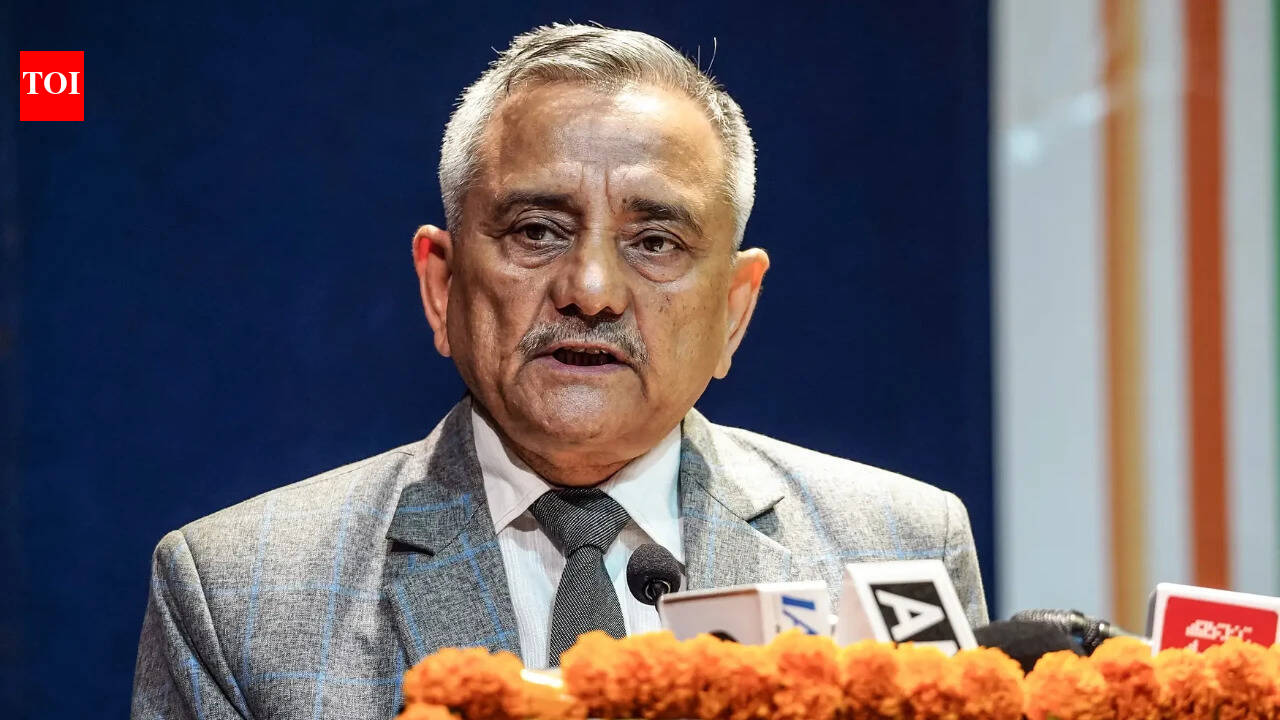
File photo: Former Chief of Defence Staff (CDS) General Anil ChauhanFormer chief of defence staff Gen Anil Chauhan has cautioned that the recent defence agreement between Pakistan, Saudi Arabia and Turkiye could induce “overconfidence” in Islamabad and lead it to make another “miscalculation”.Speaking at an event at the Teen Murti Bhawan complex in New Delhi on Saturday, Chauhan said Pakistan would remain a major security concern for India.“But, we've also seen some kind of agreements and accords with they have recently signed. This sometimes, I feel, may induce some kind of an overconfidence into Pakistan, and they may make some kind of a miscalculation again. We've got to be careful about that,” he said.His remarks came nearly a month after Pakistan, Saudi Arabia and Turkiye signed the Makkah Joint Defence Agreement on August 7. Under the pact, an attack against any one of the three countries will be treated as an attack against all three.Chauhan calls Pakistan a continuing security concernDelivering the 22nd Bharat Ratna Pt Govind Ballabh Pant Memorial Lecture on ‘Threats and Challenges to India's Security’, Chauhan said India’s security environment was shaped by several factors, including unresolved borders, cross-border terrorism, non-state actors and competition in areas such as space, cyber and the maritime domain.“Let me talk about our western neighbour. So Pakistan will remain, I think, a major security concern and a threat for times to come,” he said.He said Operation Sindoor, India’s decision to hold the Indus Water Treaty in abeyance and other practical measures could “hopefully change or induce behavioural change in our neighbour”.Chauhan was serving as CDS when Operation Sindoor was conducted in May last year. The operation followed the April 22 Pahalgam attack.Even after retiring in May 2026, Chauhan has said Operation Sindoor is “not over” but on pause, and has called for continued operational readiness by the armed forces.Terrorism, proxy war and nuclear deterrenceChauhan described terrorism and proxy war as central to Pakistan’s approach towards India, arguing that nuclear weapons had reduced the scope for conventional operations while creating space for sub-conventional activities.“The existing of nuclear weapons has created a degree of static stability at the apex level. And this is what has induced instability at the lowest level. So it's classically known as a stability-instability paradox,” he said.He said Pakistan’s strategy had been to reduce the scope for conventional operations while expanding “sub-conventional operations”, including terrorism and cross-border activities.According to Chauhan, non-state actors can provide deniability and lower the apparent cost of such operations, while terrorist networks can be rebuilt through ideology, recruitment, financing, training, propaganda and state support.He said terrorism and proxy war would remain a “major challenge” for India and argued that the response should involve credible deterrence.“And the only way you can defeat is to create credible deterrence. And that's what we demonstrated in three cross-border operations -- Uri, then Balakot, and then Operation Sindoor,” he said.He added that India needed to raise the cost of proxy war and terrorism for Pakistan so that Islamabad stopped using them “as an instrument of state policy”.Future warfare will require faster adaptationChauhan also spoke about how technology was changing the nature of warfare and the requirements for India’s armed forces.“The future will favour the forces that learn, adapt faster than their adversaries,” he said, adding that the military would need capabilities across traditional and emerging domains, including land, sea, airspace, cyber, the electromagnetic spectrum and cognitive and synthetic domains.He stressed the importance of jointness and integration among the armed forces.“Jointness and integration are essential because technology erases organisational boundaries faster than bureaucracies do. Sensors, decision-makers, and shooters must be connected across all domains,” Chauhan said.He attributed part of India’s performance during Operation Sindoor to what he described as better battlefield transparency and situational awareness, which enabled faster decision-making.He said services and domains supported by a common operational picture and a resilient network would be important for future military operations.
‘We’ve got to be careful’: Ex-CDS flags Pak's 'overconfidence' after Mecca Pact
Full Article
Original Source
Read the full article at Timesofindia →KhanList aggregates and links to publicly available news content. We do not host full articles from third-party sources. Always verify important information with original sources.