
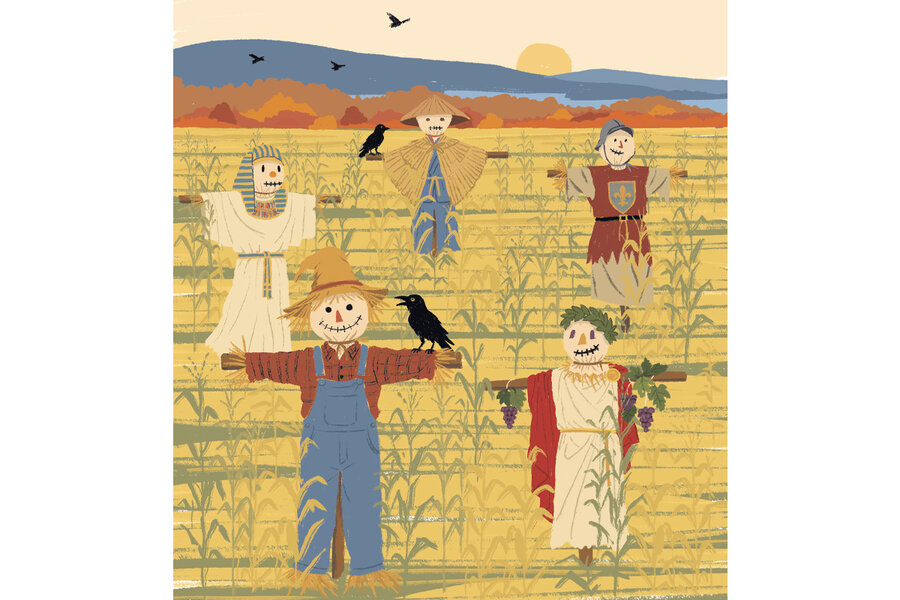
Crop cops. Film stars. Quaint centerpieces of fall decor.Over the years, scarecrows have undergone a remarkable transition that spans centuries and continents. To get a full picture of scarecrows’ role as harvest guardians and beyond, the Monitor turned to folkloric authorities and other researchers in the field. (You could say we took, ahem, a straw poll.)Here’s a guide to scarecrows past and present, including expert tips on how to construct an autumnal bogeyman of your own that is sure to stand out.How long have scarecrows been around?Because of the lack of extensive historical records, folklore historians say true scarecrow scholars are scarce. But they agree that some of the first-known scarecrows protected agriculture thousands of years ago along the Nile River. Michael Ferguson, an associate curator and public historian at the Pioneer Florida Museum and Village, which annually hosts a popular scarecrow festival in central Florida, says ancient Egyptians had to constantly defend crops from flocks of hungry birds. To frighten away the feathered foes, farmers built wooden frames and draped them in linen tunics. In the same spirit, Greek and Roman farmers created wooden effigies, often painted red, to spook unwanted visitors from their orchards and vineyards.In his 2006 book, “Scarecrows,” Gregory Holyoake writes that, as part of the kakashi tradition, Japanese farmers hung rotting meat and rags from bamboo poles, believing the bad smell would deter birds. The Kojiki, an eighth-century record of Japanese history, refers to Kuebiko, a scarecrowlike deity that is fixed in place yet knows everything in the world. “But the classic straw man that we know of today really took off in medieval Europe after the black death,” Mr. Ferguson says. “Landowners suddenly kind of lost a massive portion of their rural workforce.” Before the plague, he adds, “young boys known as bird-shoos ran through the fields all day clattering noisemakers and throwing rocks.” Faced with a worker shortage, farmers filled old clothing with straw to make a humanlike figure that could stand guard over their fields. It wasn’t until the 16th century in England that the term “scarecrow” was coined. Yet different cultures have varying names and versions for the figures. In Scotland, for example, a scarecrow is known as a tattie bogle, or “potato ghost,” nodding to their role on potato farms. Scarecrows found their way to the United States once immigrant farmers crossed the Atlantic. But “by the mid-20th century, scarecrows [had] really kind of fallen out of favor” on farms, says Mr. Ferguson. “Modern agriculture moved on to things like propane cannons, reflective tape, and netting.”And that might have been, well, the last straw for scarecrows in their traditional role. How did scarecrows become film and festival icons? Nowadays, scarecrows are a global symbol of the harvest season. They can be found every autumn as decorations on porches and in leaf-strewn yards. They also have emerged as a focal point for festivals around the world. “In the past, it was just: Create a shape that looks human enough to scare the birds away,” says Ceri Houlbrook, a lecturer on folklore at the University of Hertfordshire in the United Kingdom. “Over the years, as it’s become less about being an agricultural tool ... it’s more aesthetic.”Ryan Lintelman, curator of entertainment at the Smithsonian National Museum of American History, notes that at the turn of the 20th century, when many Americans were moving to cities, the scarecrow “became kind of this quaint reminder of an earlier time in history. ... The associations with that sort of agricultural, pastoral past were then useful for advertising, for entertainment.” Mr. Lintelman suggests that L. Frank Baum’s 1900 novel, “The Wonderful Wizard of Oz,” and, specifically, its 1939 film adaptation, shaped the image of scarecrows today. In the movie, young protagonist Dorothy befriends unlikely companions on her journey to the Emerald City, including a straw figure brought to life on the screen by limber-legged, vaudeville-trained actor Ray Bolger. “I think a lot of people really remember that performance for the combination of dancing and humor, and also a real emotional weight” of the friendship between Dorothy and Scarecrow, says Mr. Lintelman. Ms. Houlbrook notes that a new generation has been introduced to scarecrows through the “Wicked” franchise. In the second film of the two-part blockbuster, Elphaba’s spell to save Prince Fiyero’s life unwittingly transforms him into a scarecrow. But scarecrows might not have made their last stand.“Who knows what festivals we’ll be having in 100 years, and who knows whether scarecrows will still be a thing?” Ms. Houlbrook says. “I do wonder whether our next thing will be, like, an AI scarecrow or something like that. You know, what will the next evolution be?”What’s the best way to make a scarecrow?The website for the Made in Iowa Fall Market and Scarecrow Festival includes tips that autumn aficionados can follow to “think outside the cornfield” and create unique scarecrows. Event organizer Cynthia Freese also shared tips with the Monitor via email, stressing one thing: “There is no ‘right’ way to make a scarecrow.” “It doesn’t have to be a traditional straw-filled person standing in a field,” she explained. “A scarecrow can sit in a lawn chair, hang from a tree, perch on a flowerpot or even be a tiny little scarecrow sitting on a windowsill or in a car seat.”To start, gather worn-looking materials. Seek out old pairs of jeans, shirts (flannel is classic!), hats, and other seasonal accessories. Collect what you’ll use for the soft stuffing; it can be straw or even plastic grocery bags. For joints, use zip ties or wire. If your scarecrow will be upright, consider creating a T-shaped wood frame. “They really help the scarecrow kind of stand up,” says Mr. Ferguson, from the Pioneer Florida Museum and Village. “That’s one thing that a lot of people get wrong. ... And then also making sure that you stuff it pretty tight.” The really fun part? “Giving your scarecrow a personality,” Ms. Freese said. Deepen your worldviewwith Monitor Highlights.Politics with respectGet political stories with respectful analysis.There‘s a world of new ideas in everyBooks newsletter.There‘s more to life, enrich yours withCulture & Learning weekly.Follow humanity‘s discoveries withScience & Nature stories in your inbox.Gain a spiritual perspectivefrom the stories in your inbox.Want to understand the deeper impact of critical events? Learn the Monitor‘s insight.Already a subscriber? Log in to hide ads. Consider topping it off with a distinctive head, such as a pillowcase, a burlap sack, or even an upturned pail. Maybe add a funny sign or other prop for the scarecrow to hold.When you’re done, you can wave to your new fall friend and say, “Hay there!” Whether they’re stuffed with straw or not, there’s a lot of history propping them up. ALREADY A SUBSCRIBER? LoginReal news can be honest, hopeful, credible, constructive.The Christian Science Monitor was founded in 1908 to lift the standard of journalism and uplift humanity. We aim to “speak the truth in love.” Our goal is not to tell you what to think, but to give you the essential knowledge and understanding to come to your own intelligent conclusions. Join us in this mission by subscribing.
We’re not in Kansas anymore: A (sometimes corny) history of scarecrows
Full Article
Original Source
Read the full article at Csmonitor →KhanList aggregates and links to publicly available news content. We do not host full articles from third-party sources. Always verify important information with original sources.