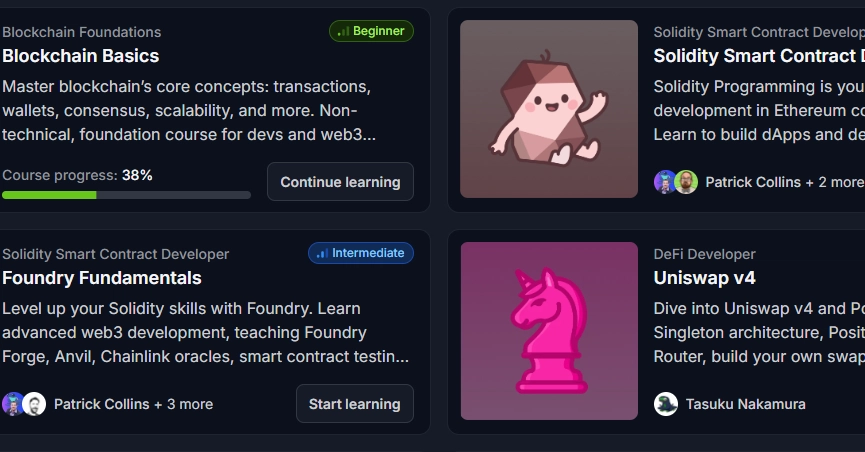
My Zero to Blockchain Engineer journey — Week 2 update Last week I announced I was teaching myself blockchain engineering from zero. This week I went deep into Cyfrin Updraft — and I have to be honest, it changed how I think about learning Web3. Here's everything I covered, what surprised me, and why I think this platform is the best free resource for anyone serious about becoming a blockchain developer. What I covered this week I'm currently 45% through the Blockchain Basics course on Cyfrin Updraft. Here's exactly what the lessons covered: Section 1 — What Is A Blockchain? This section answered the question properly — not in a surface-level way, but by starting with the problem blockchain solves. The lesson on centralized control hit differently. Think about it in a Nigerian context — banks freezing accounts, payment processors blocking transactions, elections where results can't be independently verified. These aren't hypothetical problems. They're things we live with. Blockchain's answer: a shared ledger where truth is verified by math, not by a middleman. That framing made everything click for me. Key lessons I completed: What Is A Blockchain — centralized problems vs decentralized solutions History Of Blockchain — from the double-spend problem to Bitcoin to Ethereum Benefits Of Blockchain — permissionless, immutable, credibly neutral Use Cases — DeFi, cross-border payments, DAOs, digital ownership Many Many Chains — L1s, L2s, Mainnets vs Testnets The Oracle Problem — why smart contracts can't access real-world data alone The Purpose Of Smart Contracts — math-based promises vs trust-based agreements What Is The EVM — Ethereum's computation engine explained simply Benefits Of Smart Contracts — decentralization, immutability, transparency Section 2 — Sending Transactions This is where things got hands-on — and where Cyfrin pulled ahead of every other platform I've tried. Key lessons: What Is A Wallet — your public address as a digital mailbox Setting Up A Wallet — MetaMask from scratch, self-custody explained MetaMask Wallet Walkthrough — multiple accounts, custom networks, testnets Sending Your First Transaction — on a Tenderly virtual testnet A Note On Testnets — public vs virtual testnets Sending First Transaction On A Public Testnet — using Etherscan to track it Introduction To Gas — why transactions cost ETH and how gas is calculated What Are Smart Contracts — from Solidity code to deployed bytecode The thing that genuinely surprised me: the faucet If you've tried to learn blockchain development before, you know the pain of testnet faucets. A faucet is a website that gives you free test ETH so you can practice sending transactions without spending real money. On most platforms — including LearnWeb3.io — you have to hunt for a working faucet, deal with rate limits, wait hours, sometimes get nothing. Cyfrin Updraft uses Tenderly virtual testnets instead. You spin up your own private blockchain in seconds. Infinite test ETH. No waiting. No faucet hunting. No frustration. That one decision by the Cyfrin team removes one of the biggest friction points for blockchain beginners. I sent my first transaction in under 10 minutes. On other platforms that process took me an hour of troubleshooting. Cyfrin Updraft vs LearnWeb3.io — my honest comparison I've now used both platforms seriously. Here's my take: Cyfrin Updraft is better for: Depth of explanation — Patrick Collins doesn't skip anything Hands-on practice — Tenderly integration is seamless Career path — the course order takes you from zero to security auditor Up to date content — courses updated as recently as late 2025 LearnWeb3.io is better for: Gamification — XP, levels, and NFT certificates keep you motivated Community feel — the platform has a social layer built in Hackathon and bounty awareness — they actively point you toward earning opportunities My verdict: Use Cyfrin Updraft as your primary learning platform. Use LearnWeb3.io for motivation, community, and to discover hackathons and bounties. They complement each other well. You don't have to choose. The concept that changed how I see blockchain Before this week, I understood blockchain as a technology. After this week, I understand it as a philosophy. The oracle problem lesson explained something I hadn't thought about — smart contracts are powerful but they're isolated. They live on the blockchain and can only see what's on the blockchain. They can't check the weather, the price of oil, or the result of a football match by themselves. That's why Chainlink exists — decentralized oracle networks that feed real-world data into smart contracts securely. This matters because almost every DeFi protocol I'll eventually build will need external data. Knowing why oracles exist makes the whole DeFi ecosystem make more sense. Where I am on the roadmap Phase Status JavaScript fundamentals 🔄In progress daily Blockchain Basics (Cyfrin) 🔄45% complete Solidity Smart Contract Development ⏳Starts after JS done Foundry Fundamentals ⏳Month 4 Smart Contract Security ⏳Month 6 First hackathon / bounty ⏳Month 7+ My honest reflection on Week 2 The learning is going well. But I want to be transparent about something. I made a mistake early on — I rushed through LearnWeb3.io lessons by reading instead of coding. Got to the Solidity introduction without actually being ready for it. Had to go back to JavaScript basics. That's a lesson in itself: passive learning feels like progress but isn't. The rule I've set for myself now: if I can't close the lesson and explain it in my own words, I haven't learned it. I go back and re-read until I can. Week 2 done. JavaScript and Blockchain Basics side by side every day. See you next week with Week 3. 🚀 Follow the full journey: Twitter GitHub LinkedIn Previous article: I'm Teaching Myself Blockchain Engineering from Zero
Week 2: I Found the Best Free Blockchain Course on the Internet — Here's My Honest Review
Full Article
Original Source
Read the full article at Dev →KhanList aggregates and links to publicly available news content. We do not host full articles from third-party sources. Always verify important information with original sources.