
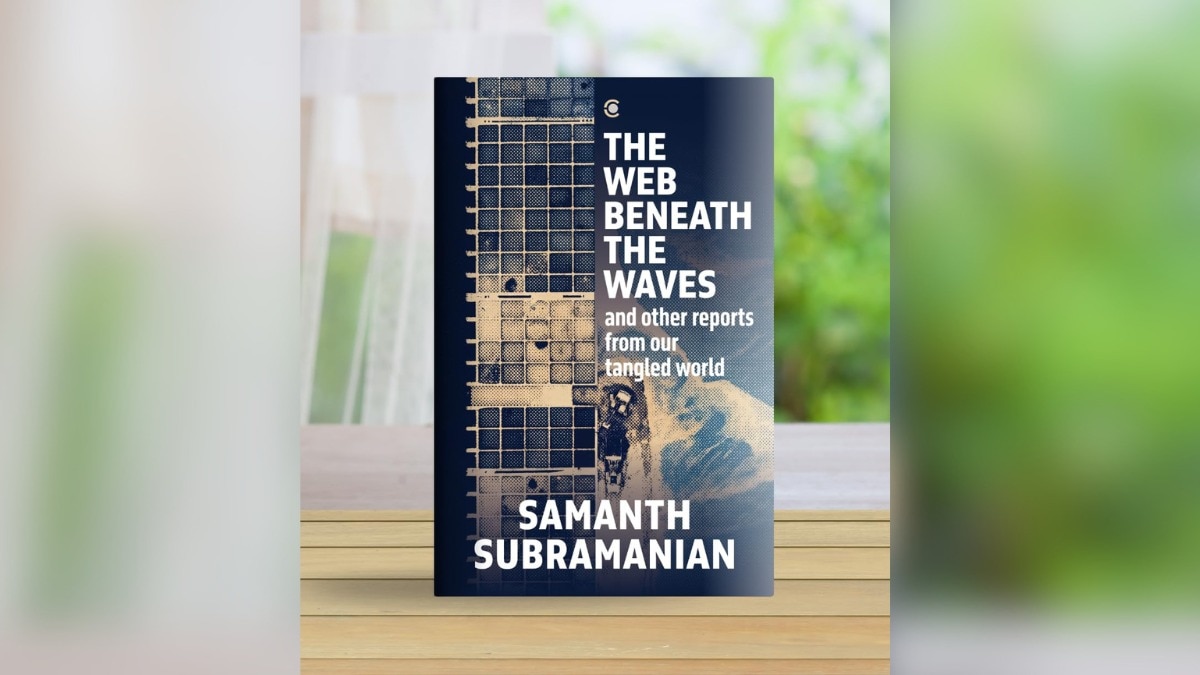
Samanth Subramanian combines rigorous research and reportage to answer an eclectic range of questions—many of which we would not even think of askingWriting on quizzing, journalist Samanth Subramanian explains what makes a fact interesting: “It has to have the ring of novelty or the tilt of oddity or the gloss of some human achievement; it has to sit at an angle to all the rest of the information that continually laps at our feet.”That philosophy applies equally to The Web Beneath the Waves: And Other Reports From Our Tangled World, his collection of essays from publications as varied as The New Yorker, Granta, Caravan, The Guardian, Financial Times and The New York Times. It might be difficult to find a common theme among stories of disappearing vultures in India, cricketer Jimmy Anderson, India’s languages, the lost Jews of Nigeria, terrorism in Sri Lanka, the exclusive club culture, our dependence on undersea cables for the Internet, and others (“tangled world”). What is common to them is the approach to the writing, the rigour, the research, the organisation of facts. Long-form journalism demands patience, doggedness and the ruthlessness to shape art from a mountain of facts. Subramanian’s research is extensive and passions diverse. His wit ensures the research sits lightly. The reader with little or no interest in real-estate spam (that all of us receive on our phones), for example, is taken along on a unique ride. There are answers to questions none of us thinks of asking. There is a lyrical quality to the writing; the use of the inevitable word rather than the convenient one makes this volume a standard guide to the genre. Subramanian, whose biography of scientist J.B.S. Haldane is a modern classic, doesn’t beat you over the head with his discoveries nor does he point excitedly to the larger picture that emerges in the essays. He allows the social commentary, the politics, the human drama to evolve gradually and naturally. What happens when a cable connecting Tonga to the world snaps? “A country offline may as well not exist at all,” writes Subramanian. To use a range of subjects to delineate the modern condition is a rare challenge and requires a rare talent. Subramanian has taken on the former cheerfully because he has oodles of the latter. Subscribe to India Today Magazine- Ends
'Web Beneath the Waves': The world in the details
Full Article
Original Source
Read the full article at Indiatoday →KhanList aggregates and links to publicly available news content. We do not host full articles from third-party sources. Always verify important information with original sources.