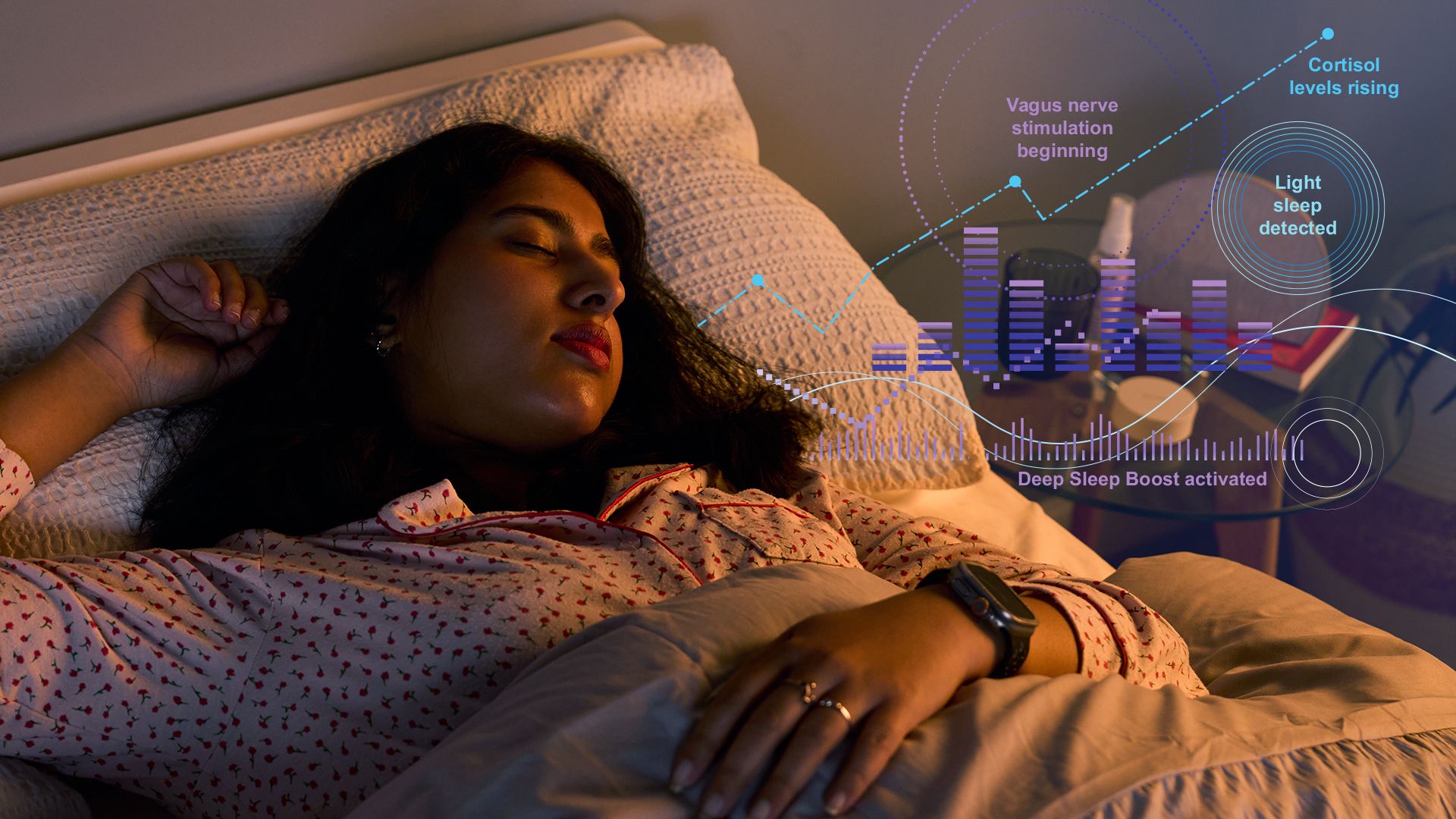
(Image credit: Future/Getty) Wearables that passively track your sleep will soon be obsolete. We have a massive sleep problem — and sleep trackers aren't doing enough. But the next frontier in sleep tech is taking the data exposed by the best sleep trackers and doing something about it.If tracking can uncover how bad we're sleeping, isn't it time it starts offering some solutions? Thankfully, the new generation of sleep tech is all about actively helping you sleep better. These devices monitor your sleep, identify problems, and intervene for better rest. All you have to do is lie back and start dreaming.While it sounds futuristic, it's already happening, with brands like Elemind, NextSense and Muse offering consumers an easier way to sleep better. I asked the experts why sleep tracking is dead... long live sleep intervention.Key takeaways:Sleep tracking is becoming smarter and better, as well as more comfortable. Sleep tracking lamps and mats allow us to monitor our sleep without wearables.However, sleep tracking has hit a wall — we know we're sleeping bad, so what can we do about it?Sleep intervention devices such as the Elemind, Muse S Athena, and NextSense offer active sleep improvement, monitoring your brainwaves and responding to changes in your sleep.Devices like the Kimba, Sleepal, Orion and Eight Sleep alter your environment in response to tracking data, helping you stay asleep.Sleep enhancement tech offers a non-medical way to improve your sleep. And by improving your sleep, you might see benefits to your overall health and wellbeing.Sleep tracking is moving off your wristResearch suggests over 48% of the population use sleep trackers. But if you're the half yet to succumb to wearing a watch to bed, there's good news. The latest gen of sleep trackers are a little more... sleep-comfort friendly.Think the screen-free FitBit Air, the slimmer-than-ever Oura Ring 5, and the non-intrusive monitoring of the Withings Sleep Mat. (Image credit: Future)“Good sleep products and technology have to do two things, in my opinion,” says Ben Fuxbruner, founder of Kimba, a personalized sleep scent system. “One, they have to be effective, but two, they have to be very comfortable and unintrusive. I feel like some companies work really hard on showing effectiveness, but if it's not comfortable, nobody will use it.”In some cases, that means moving off the body entirely. Expect a cluttered nightstand as companies such as Kimba and Hatch aim to break the tight grip wearables have on health tracking. Products such as the Sleepal lamp already offer sleep tracking from your bedside.Get instant access to breaking news, the hottest reviews, great deals and helpful tips.Sleep tracking is getting stronger and smarter“The old adage that what's measured improves is generally true,” says Meredith Perry, co-founder and CEO of Elemind.And if improved measuring leads to better rest, we’re all about to see our sleep scores go through the roof.Wearable sleep trackers often use movement and heart rate to estimate your sleep stages. The latest devices want to remove the guesswork, employing brainwave monitoring to accurately measure sleep.The next step isn't collecting more data. It's what the technology does with itJonathan Berent, CEO of NextSenseThat's the kind of data you used to have to go to a sleep lab to learn. Now you can have it in your own home. The Elemind measures "Alpha" brainwaves, NextSense Earbuds capture "brain data" the DUSQ patch senses electrical signatures, while the Bia collects oxygen levels in the brain. All without the tubes and wires of traditional of polysomnography.For some innovators, that’s just the start.Adaptyx is the first wearable patch that tracks cortisol in real time. “Cortisol is a one of the the most important hormones in sleep architecture and in that sleep wake cycle,” says Dr. Vijit Sabnis, CEO. “[The cortisol awakening response] is an entire system and rhythm that we can begin to modulate.”But for Jonathan Berent, CEO at NextSense, focusing on quality tracking is missing the wood for the trees.“The next step isn't collecting more data,” says Berent. “It's what the technology does with it.”But sleep tracking isn’t enough any moreWe’re in a sleep crisis. Fewer than one-third of us sleep well every night and 6 out of 10 American adults report not getting enough sleep. Despite sleep quality being linked to over 130 medical conditions, it’s often overlooked by the healthcare system, with Dr. Carlos Nunez of Resmed describing sleep as "too important to ignore." (Image credit: Future)But even if you know you're sleeping badly, it's hard to bridge the gap between knowledge and action. As Perry notes, “[sleep is] literally eight hours of the night where you're unconscious and unable to control it yourself.”“You know how bad you slept, but there's no real solution for you to improve it," says Andrew Jolie of Bia. "And if there is, you have to do it. The device doesn't do it for you.”That's about to change. With the latest round of technology, the device does do it for you.Next step, sleep intervention“There are lots and lots of devices that just read, that just track, that give you information to the user, and the user is supposed to go do something about that,” says Perry of Elemind. “We take that considerably further. We can actively guide and change your sleep over the course of the night. Not just tell you what happened — influencing what happened.”She describes it as a “read and write” approach: read the data and start writing the solution.We can actively guide and change your sleep over the course of the nightMeredith Perry, CEO of ElemindFor Berent, it’s a closed loop: “a continuous conversation between your brain and the technology around you, where the system understands what's happening in real time and responds that same night, gently guiding your brain into deeper more restorative sleep, and lulling you back to sleep.”Whatever the term, it’s good sleep made easy. (Or, at least, easier.) All with no extra effort on your part. Imagine if your oven turned cake into health food, or your step counter racked up 5 miles for you.Perry compares it to the sudden boom in GLP-1s. Suddenly weight loss went from hard work to simple injections. Is sleep in for the same overhaul?Sounds great! But what's it going to do for my sleep?From 3 a.m. wake ups to groggy mornings, the sleep tech industry is tackling every minute of your bad night’s rest.Can’t fall asleep? The Elemind cancels out the brainwaves keeping you up. Waking in the night? The Muse S Athena and NextSense detect brief disruptions and soothe you back into restfulness. Too hot? The Eight Sleep or Orion will cool you down. Waking up tired? The Bia and Sleepal AI make mornings easier. Restless, stressed, anxious? Soon, there’ll be tech for that. I tested the Muse S Athena and noticed a real difference in the quality of my sleep (Image credit: Future)It’s not just for the insomniacs, either. Even those consistently earning high sleep scores might see the benefits of intervention-based sleep tech.“We have an athlete,” explains Fuxbruner of Kimba, “that doesn't have problems sleeping at all but wants to optimize his sleep… so the [intervention] each person gets is different, and the personalization, the targeting is different.”“With Orion, you give it the limited amount of hours you have to spend in bed, and it helps squeeze the juice out of every minute you have,” explains Harry Gestetner, Founder and CEO of Orion.So is the next big leap for sleep tech to replace your doctor?Well, no, and in cases of severe sleep deprivation we recommend speaking to a healthcare professional. Cognitive behavioral therapy for insomnia (or CBT-I) remains the gold standard in treatment, while conditions such as sleep apnea require medical intervention.But there are many of us struggling to sleep who can benefit from an at-home approach.“I was really interested in creating electronic medicine,” explains Perry. “Ways where you could, instead of using a drug to influence the body, use technology instead. Then you could have tighter control over the outcomes because you could actually see in real time whether or not it was working.”Deep sleep is one of the most powerful, underused levers we have on long-term healthJonathan Berent, CEO of NextSense“We believe in a future not to replace medication” she adds. “But we want to improve the state of wellness and healthcare in such a way we effectively have a secondary autonomic nervous system. Something that's continuously monitoring the biology, can see when something goes awry and then address it in real time with something that uniquely works for you.”The future of sleep tech is personalized, non-invasive and, in most cases, comes with minimal side effects.That takes us to the next big leap in sleep tech: what comes after sleep?What's next? Moving beyond sleep to health and wellness“Deep sleep is one of the most powerful, underused levers we have on long-term health — tied to memory, mood, metabolism, heart health, even the brain's overnight clearing of the proteins linked to Alzheimers," explains Berent."If we can measure it at clinical fidelity and improve it, from something as ordinary as a pair of earbuds, we're not building a better sleep tracker. We're turning sleep into an intervention for long term chronic diseases.” (Image credit: Future)He’s not the only sleep tech founder that plans for wider healthcare applications. Fuxbruner of Kimba notes his scent-forward system has been linked to improved memory, while cortisol-tracking Adaptyx hopes to link up with smart mattresses for a bed that responds to your stress levels.As for your sleep tracker. Well, it’s about to look passé.“I think that devices that just track will probably go by the wayside over the next 10 years,” predicts Perry, “and that people will start adapting more helpful tools.”In the meantime, expect your sleep tracker to become smaller, more powerful and less expensive.Bottom lineWhile sleep tracking has helped people recognize their own sleep problems — as well as exposed the bigger issues with sleep in society — simple tracking isn’t enough anymore. The future of sleep tech lies in intervention and improvement.“Sleep stops being something you passively track and becomes something you can actively restore,” explains Berent.The bigger picture, however, is about more than sleeping well.“Sleep is just the beginning,” says Perry.Our favorite sleep intervention tech Withings Sleep Tracking Pad Muse S Athena Sleep Headband Orion Sleep System (queen) Follow Tom's Guide on Google News and add us as a preferred source to get our up-to-date news, analysis, and reviews in your feeds. Ruth is an experienced Senior Staff writer at Tom’s Guide, covering all things sleep and mattresses. She writes to help people sleep better, from how-tos to the latest deals to mattress reviews, and has interviewed an array of experts who share her passion. She is also our specialist on memory foam — she’s flown around the world to see memory foam being made — and leads our hotel mattress content. She has a deep interest in the link between sleep and health, and has tried enough mattresses, from Helix to Nectar to Simba, to know the right bed really can make a difference to your wellbeing. Before joining the team at Tom’s Guide, Ruth worked as a sleep and mattress writer for our sister website, TechRadar.
Wearables that just track your sleep are so 2025 — meet the new school of sleep tech that intervenes, in real-time, to help you skip 3 a.m. wake-ups and other major sleep issues
Full Article
Original Source
Read the full article at Tomsguide →KhanList aggregates and links to publicly available news content. We do not host full articles from third-party sources. Always verify important information with original sources.