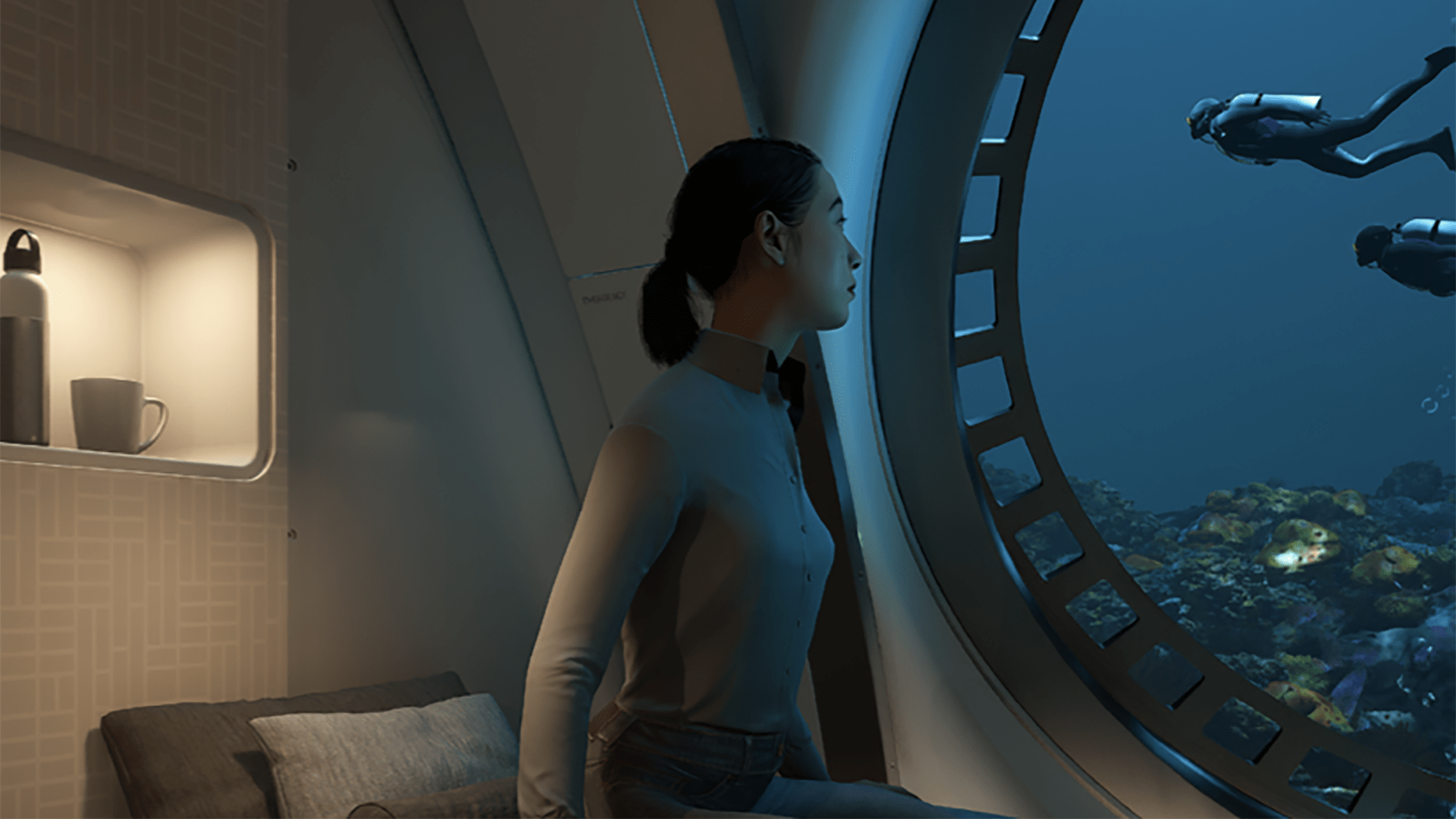
WHAT if your next holiday wasn’t to Spain (or even to space if you’re a billionaire) but to the bottom of the ocean? It might sound like mad science fiction, but a company called DEEP has dreams of creating an underwater city laid out like aquatic hamster tunnels. They’ve even got one habitat off the cost of Florida up and running. DEEP wants to put modular habitats on the ocean floor Credit: DEEP I spoke to DEEP’s Phil Short on the latest episode of The Sun’s Future Tech Feed with Sean Keach (Watch the full episode on YouTube), and he revealed what life is like below the sea – including why you might sound like Minnie Mouse underwater. Phil works as the Research Diving & Training Lead at UK-headquartered DEEP, whose mission statement is to “make humans aquatic”. Sign up for the Tech newsletter Thank you! The company has already deployed its Vanguard habitat in Florida’s Tennessee Reef, and dreams of aquatic living in its subsea Sentinel home. OUTTA SPACE Earth’s billionaires are obsessed with colonising Mars, but DEEP reckons we’d be better off looking below – at the vast underwater realm we so often ignore. Read more on futuristic homes In fact, DEEP already has a habitat operational off Marathon in the Florida Keys: Vanguard. “It sits in approximately 20 metres water depth on its foundation, and the depth of water at the moon pool is approximately 14 metres,” said Phil, speaking to The Sun. It’s not quite an underwater hotel, but it does operate as a fully functional underwater living platform for four crew. And it’s complete with fold-down bunks, a galley, show, toilet, and a research area. Most read in Tech Better still, meals are delivered directly down to the seabed by support divers like a kind of oceanic Uber Eats service. That’s important, as divers can spend as long as seven days down on Vanguard. Phil Short is the Research Diving & Training Lead at DEEP, and spoke to The Sun on Future Tech Feed with Sean Keach Credit: DEEP DEEP already has a Vanguard habitat on the Tennessee Reef in the Florida Keys But for a bit of spectacle, there’s also a moon pool, which is literally a pool inside the habitat that divers can hop into to access the open ocean. Water doesn’t flood the habitat because the air pressure inside is equal to the water pressure outside. And you can test this bizarre phenomenon in your bath at home. “When you finish your tea, just turn the mug upside down and push it down under the water in the bath,” Phil explained. “And if you put a bit of kitchen paper in the top of it before you do this experiment, you pull it out and find that the paper’s dry.” Vanguard is primarily built for people doing work – whether that’s science or commercial sea activities. But eventually, DEEP’s habitats will be able to offer much more comfortable living. “Looking forward into our vision for the future, our concept habitats beyond Vanguard, they will become larger, which will enable bigger spaces, more privacy, more luxuries if you like,” Phil said. Vanguard allows divers to get easy access to the ocean floor, rather than constantly going up and down to and from the surface In the future, DEEP hopes to offer more comfortable living on board its concept Sentinel habitat Credit: DEEP “So I suppose if you compare it to the hotel chains, we’re kind of right smack at the Premier Inn at the moment.” HAMSTER TUNNELS Vanguard is how it all starts, but it’s not where it ends. The future for DEEP is what the company calls Sentinel, which is a sprawling underwater habitat far bigger than Vanguard. It’s modular, which means individual units can be clicked together to form a sprawling base on the ocean floor. “When I was a kid, I used to have pet hamsters and used to buy these incredible hamster cages that were balls and tubes and boxes that all interconnected,” Phil told Future Tech Feed. “So the hamsters could travel from the round ball to the square box, through a tunnel. “If you take multiple habitat components and interlink them, you end up with a subsea village, subsea town, eventually a subsea city.” Each of these modules could have a distinct purpose. You might have living quarters and research labs, or pressurised dive locks. There could even be surface-pressure viewing galleries for visitors who can’t undergo decompression. And Phil reckons these bases could eventually line the continental shelves across the globe, opening up our ocean’s “twilight zone” for long-term human habitation and exploration. LIFE UNDERWATER But what is living underwater actually like? Well, one of the most bizarre side effects is that you’d sound like Minnie Mouse. It’s all linked to the immense pressure of the ocean that grows rapidly as you descend. For every 10 metres you go down, the pressure increases by the equivalent of one entire Earth atmosphere. The air we’re breathing down at those depths is compressed and much denser, which makes breathing feel very heavy. Sentinel would be more like apartment or hotel living, with luxurious quarters and stunning ocean views Credit: DEEP These are renders of DEEP’s futuristic Sentinel habitat, which will use modular pods to connect containers together to create underwater villages and even cities. Credit: DEEP “When we breathe compressed air, even at 10 metres, it’s much denser,” Phil explained. He said it’s like trying to gulp down a milkshake versus a glass of tap water. To make breathing as easy as possible, the air is rebalanced – with helium used to replace nitrogen. This makes breathing much easier on the body, preventing the “rapture of the deep” effect that makes you feel drunk. But it also makes your voice very squeaky: “You’re like Minnie Mouse,” Phil joked. In fact, surface supervisors often have to use electronic “unscramblers” to decode the squeaky chatter coming down from the deep. PLANET WATER Many people will wonder why we even need to live underwater at all. But Phil points out that we’ve barely scratched the surface of our own planet. DEEP hopes that one day, even people with very little experience could make trips to the ocean floor Credit: DEEP DEEP’s mission statement is “making humans aquatic” through oceanic engineering Credit: DEEP “Seven tenths of the Earth, as we call our planet, is water,” Phil explained. “That is true, but that’s surface area only. If you look at it volumetrically, because the ocean is so deep, then the amount of the Earth that is covered with water compared to our land masses is immense. “So we really maybe should be called Planet Water, not Planet Earth.” As well as that, it could get humanity to better connect with the sea. “We as a species have made an awful mess of our planet,” Phil said. “Especially we’ve made an awful mess of our oceans because out of sight is out of mind.” Plant life in the oceans generates an enormous share of Earth’s oxygen. And scientists working in the twilight zone and discovering hundreds of new marine species every year, which Phil says may even hold cures for human diseases. NO GILLS NEEDED Future-gazers often think that humans may eventually undergo genetic engineering or take on synthetic gills to survive the sea. A bit like Kevin Costner in Waterworld. And there are ideas around liquid breathing – where we breathe a fluid instead of air – as seen in James Cameron’s The Abyss. Sentinel is a modular design that connects different containers in a kind of hamster-tunnel system Credit: DEEP Sentinel could be extended into an entire village or even a subsea city Credit: DEEP But Phil and DEEP reckon the answer is far simpler: just build safe homes down below. “We’re not looking at modifying the human,” Phil said. “No strange physiological adaptions, no miracle drugs, no weird adaptations of the human body.” Just like astronauts use space stations and spacesuits to survive, aquanauts will rely on subsea habitats and diving systems. And for the sea-fearing out there, DEEP isn’t go too deep at all. Vanguard is down at 17 metres, and the plan is to provide habitats up to 200 metres of depth. That’s in contrast to the maximum known depth of the ocean at 10,935 metres in the Mariana Trench. So building habitats at those depths isn’t too tall an order. EVERYONE’S AQUATIC The ultimate aim for DEEP isn’t just making sea living accessible to top divers, elite scientists or adrenaline-seeking billionaires. Sentinel modules can perform a variety of functions, including habitation or science Credit: DEEP Future Tech Feed with Sean Keach sees expert guests answering big questions about what’s next Credit: FTF DEEP wants the ocean to be open to everyone – even without extensive diving experience – all around the world. But for now, Phil reckons we’re at a kind of Volkswagen stage. “Volkswagen make great family cars, but their break-off company Bugatti also made the Veyron,” Phil said. “It’s a concept car that broke all the rules, broke all the speed records. “So we’re working on real habitats that exist, are in the water, as our starting point. “But our vision – the vision of our founder off into the future – is habitats that enable longer stays at deeper depths. “And that will require concept car habitats – but we’re not trying to run before we can walk. “So once Vanguard has proven all those systems work, we’ll expand on it with depth, with size, with autonomy. “And each step will get further and further to that future vision of the capability for all humans that want to be aquatic – to be able to live, work, study or just be in the ocean.” Comment now
Inside quest to make humans AQUATIC by living in underwater ‘hamster-style’ homes & there’s already one on the sea floor
Full Article
Original Source
Read the full article at Thesun →KhanList aggregates and links to publicly available news content. We do not host full articles from third-party sources. Always verify important information with original sources.