
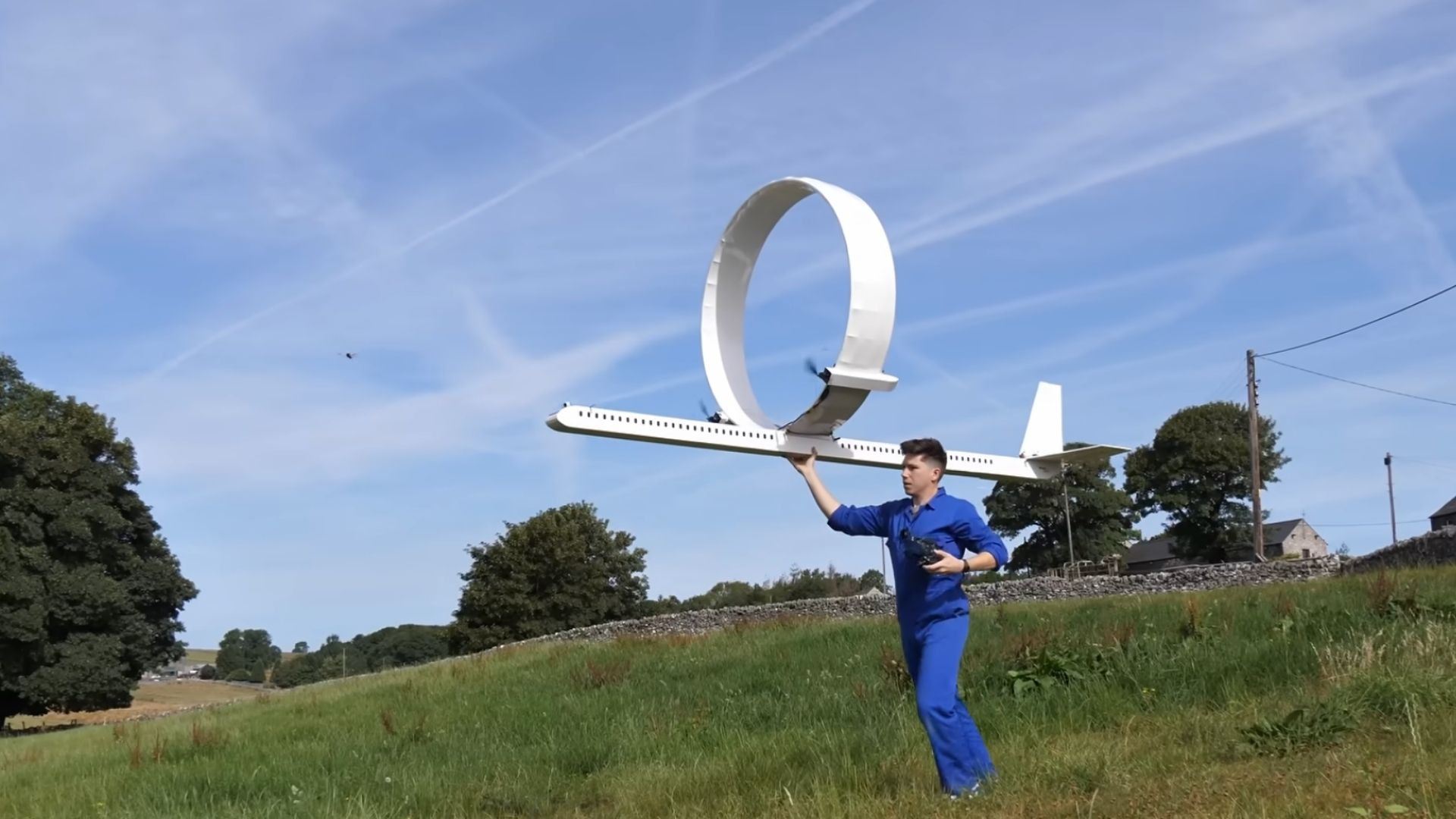
British YouTuber James Whomsley has built and flown a giant radio-controlled aircraft fitted with circular wings, testing whether the unconventional configuration could perform better than traditional straight wings. Whomsley, better known through his ProjectAir channel, spent a month developing the aircraft after recalling a ring-shaped paper plane he flew as a child. A paper plane is a tool that gives a lot of joy to children, and the same idea encouraged him to try out something bigger. The project progressed from 12-gram rubber-band-powered models to a large RC aircraft that survived several crashes before finally completing a controlled flight. Small circular plane beats straight-wing model Circular wings produce lift using the same broad principle as conventional airfoils. When the ring moves through the air at an angle of attack, pressure differences between its upper and lower surfaces generate lift. Whomsley began by constructing a lightweight balsa prototype with two circular wings. Testing different configurations showed that the most successful arrangement featured a large lifting ring near the front and a smaller stabilizing ring at the rear. He then built a conventional model with an equivalent wing area to compare the two designs. Each aircraft weighed approximately 12 grams and received 150 winds of its rubber-band motor. In breezy conditions, the straight-wing aircraft remained airborne for seven seconds and was heavily affected by the wind. The circular-wing version flew for just over 10 seconds, travelled farther and repeatedly corrected itself after being pushed off balance. “The stability of this thing is insane,” Whomsley said during the test. Giant balsa aircraft suffers two crashes Encouraged by the results, Whomsley designed a much larger version in computer-aided design software. Its balsa components were individually laser-cut and assembled like a construction kit. The two unfinished wing frames weighed 4.6 pounds (2.13 kg). Whomsley also built a long, box-shaped fuselage with reinforced bulkheads beneath the wings and covered the completed structure with heat-shrinkable film. Unpowered glide tests confirmed that the wings generated lift, although the aircraft required additional nose weight and a high angle of attack. The first powered attempt ended with the main wing hitting the ground and both balsa spars snapping. Whomsley reused the smaller surviving ring, lowered the motors and added a conventional tail. Nevertheless, the aircraft pitched downward again during its second launch, destroying the remaining balsa wing. Redesigned circular plane finally flies For the third version, Whomsley replaced balsa with foam and aluminum tubing. The more flexible wing survived its first flight but stretched and distorted while airborne. A central strut was therefore added to prevent the ring from expanding, while the motors were transferred to rigid mounts on the fuselage. The final aircraft launched successfully and cruised around the field for several minutes. Whomsley said it responded like a conventional RC plane but demonstrated greater stability along its roll axis, helping it handle the windy conditions. After its batteries began running low, he brought the aircraft down safely with its structure intact. “I think that proves that a circular wing works,” Whomsley said following the initial successful flight. The experiment does not establish that circular wings are universally superior. However, it demonstrates that a properly reinforced ring-wing aircraft can generate lift, remain controllable and cope surprisingly well with wind.Get the latest in engineering, tech, space & science - delivered daily to your inbox.Atharva is a full-time content writer with a post-graduate degree in media & amp; entertainment and a graduate degree in electronics & telecommunications. He has written in the sports and technology domains respectively. In his leisure time, Atharva loves learning about digital marketing and watching soccer matches. His main goal behind joining Interesting Engineering is to learn more about how the recent technological advancements are helping human beings on both societal and individual levels in their daily lives.
Watch: YouTuber turns childhood idea into a giant aircraft with ring-shaped wings
Full Article
Original Source
Read the full article at Interestingengineering →KhanList aggregates and links to publicly available news content. We do not host full articles from third-party sources. Always verify important information with original sources.