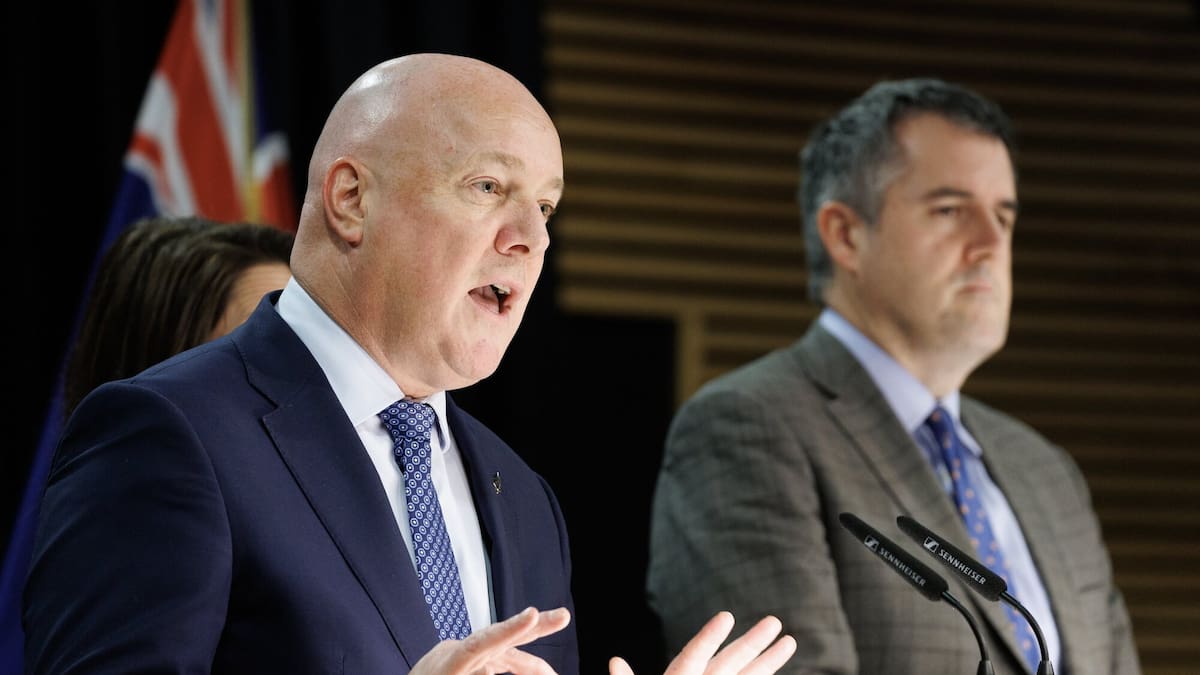
The Government has decided that existing agreements between councils and local iwi will be scrapped under its new resource management reforms.The deals, called Mana Whakahono ā Rohe, are between an iwi and a council and set out how iwi will feed into local decision-making. The Government’s resource management reforms would have originally grandfathered these deals into the new system.Instead, as a result of a flurry of new deals being inked or negotiated and a fierce campaign by the Taxpayers’ Union against the deals, the Government has decided that Mana Whakahono ā Rohe agreements will not transfer into the new system.Prime Minister Christopher Luxon and Minister Responsible for RMA Reform Chris Bishop will take questions on the changes at a press conference at 3.30pm, which will be livestreamed at the top of this story.Bishop said councils will “have the option of entering into new narrowly scoped iwi participation agreements to record how iwi authorities will participate in statutory planning processes and processes required to give effect to Treaty settlement redress”.“Clear guardrails will be included in the legislation to prevent scope creep,” he said. Bishop said that since the Resource Management Act (RMA) replacement laws were introduced, the Government had become “concerned about the rapid increase in new agreements and initiated processes between councils and iwi”.He said just eight agreements existed when his RMA replacement bills were introduced at the end of last year.“Since then, several dozen more have been agreed or initiated,” Bishop said.The Ministry for the Environment lists 14 such deals in negotiation since the start of this year. More than twenty are in negotiation in total.Bishop announced Cabinet had agreed to the changes as he and Luxon announced the next steps in the Government’s RMA reform programme, which involves getting the bills passed through their final stages.National campaigned on overhauling Labour’s resource management regime, which involved scrapping the RMA and replacing it with two new laws. Bishop alighted on a regime that is both very similar and very different to Labour’s reforms.It also involves scrapping the RMA and replacing it with two new laws, the Planning Bill and the Natural Environment Bill.The bills both returned from the select committee process and the Government announced on Monday how it would respond to concerns raised by the select committee.Bishop said the benefits of the new planning system would “boost GDP [gross domestic product] by an additional 0.56% every year by 2050, worth up to $3.1 billion annually”.“A cost benefit analysis estimates $13.3 billion in savings over 30 years through reduced administrative and compliance costs,” he said.“Officials also estimate that around 45% of consent and permit applications required under the RMA could be removed under the new system. Based on 2023/24 volumes, that represents between 15,000 and 22,000 consents no longer needed,” Bishop said.Implementation delayed Bishop said there were a range of “practical improvements” recommended by the committee, which have been agreed to.The transition to the new system will take place over 39 months, rather than 30.“This will provide more time to prepare the first tranche of national instruments and support a smoother transition from the Resource Management Act to the new system,” Bishop said.Parliamentary Under-Secretary Simon Court, who is supporting Bishop with the reforms, said the committee had recommended the restoration of controlled activity classes to give farmers and other primary producers more certainty, and “simplify wildlife approvals to cut unnecessary bureaucracy so projects can get underway sooner”.“They have also made it clearer that environmental limits need to balance environmental, social and economic outcomes and that those limits should be workable in practice,” Court said.The changes made under the last Government to ensure resource management law had an eye to emissions reduction when making planning decisions.The Government has axed these from the new regime, arguing the Climate Change Response Act and the Emissions Trading Scheme were the appropriate levers for emissions reduction.Bishop said the next step of the reforms will be the illustrative draft of the new National Policy Direction, a set of national-level directions that guide the use of the new system.“These reforms will replace one of New Zealand’s most complicated and litigious pieces of legislation with a planning system that is more predictable, more consistent and far better at enabling New Zealand to grow,” he said.‘Race to the bottom’ with $2b price tag – GreensThe Green Party said the bills ushered in a “race to the bottom” for environmental protection.Green Party environment spokeswoman Lan Pham said “the Luxon Government is stripping away environmental protections while New Zealanders are left paying for the costs of environmental damage and the Government’s regulatory relief framework”.Meanwhile, citing a report commissioned by the Government, Pham said the regulatory relief measures would cost ratepayers $2b. “The Government has not listened to local councils or submitters at all. Almost all submitters opposed the regulatory relief framework, which would force councils to pay private landowners not to destroy biodiversity. “It has been estimated to cost ratepayers $2 billion, while the report writers themselves cautioned there is a high degree of uncertainty around those estimated.”
Watch live: Government scraps existing iwi agreements as RMA reform enters final stages
Full Article
Original Source
Read the full article at Nzherald →KhanList aggregates and links to publicly available news content. We do not host full articles from third-party sources. Always verify important information with original sources.