
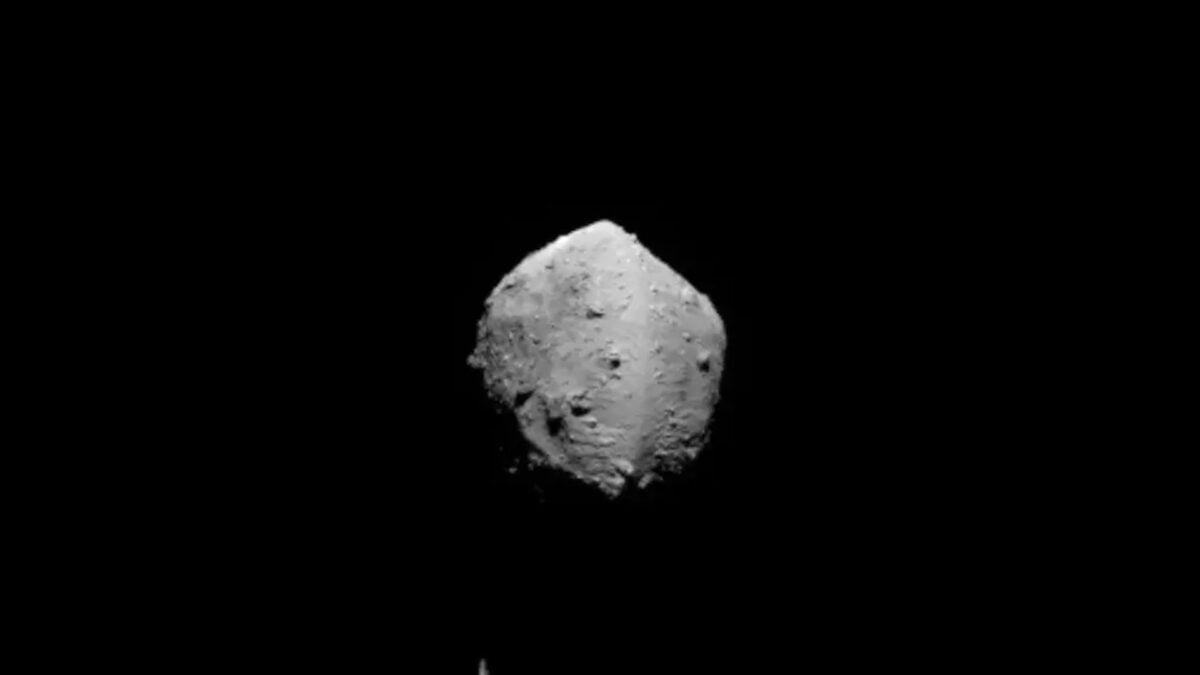
Four years ago, NASA made history by deliberately crashing a spacecraft into an asteroid. The experiment was a first-of-its-kind test of planetary defense, designed to see whether humanity could alter the trajectory of a space rock before it ever threatened Earth. But the entire story of what happened has yet to be told. Now, the European Space Agency’s (ESA) Hera spacecraft has arrived at the scene. Its mission is to investigate the aftermath of NASA’s DART collision, getting up close to the asteroid and documenting the changes left behind. ESA is revealing the first close-up images captured by Hera on Wednesday at 1:45 p.m. ET, allowing us to see just what a spacecraft-sized punch can do to a space rock. The event will be live-streamed on ESA’s WebTV, as well as the space agency’s YouTube channel. You can also tune in through the feed below. Hera’s journey NASA’s Double Asteroid Redirection Test (DART) was designed to test whether a spacecraft could deflect an asteroid by deliberately crashing into it. Its target was Dimorphos, a 558-foot-wide (170-meter) space rock that orbits its larger 2,625-foot-wide (800-meter) companion, Didymos. Together, the pair form a binary asteroid system. On September 26, 2022, DART slammed into the asteroid at approximately 14,000 miles per hour (22,500 kilometers per hour). The impact sent a massive plume of rocky debris streaming into space and changed the asteroid’s orbit around its larger companion, Didymos, shortening its orbital period by 33 minutes. The mission was deemed a success, but scientists needed a closer look at the crash site to better understand the aftermath of DART’s kinetic impact and possibly turn this into a reliable planetary defense technique. As such, a follow-up mission was required. ESA launched its Hera spacecraft on October 7, 2024, to investigate the full consequences of the impact. After a two-year journey through space, the car-sized spacecraft has finally arrived at its destination. “This is a very exciting time for us,” Patrick Michel, Hera’s principal investigator, said in a statement. “First NASA’s DART spacecraft flew to the Didymos system to impact the Dimorphos moonlet, successfully shifting its orbit. Now ESA’s Hera mission has arrived to learn the answers we need to know. How did the impact change Dimorphos? What is the mass of the asteroid and which of its properties explain its response to DART impact? Hera is carrying out [the most] thorough investigation ever of a deflected asteroid, packed with scientific firsts, to give us a complete and unbiased picture of humankind’s first planetary defence test.” Let the investigation begin Earlier this month, we got a little peek at Hera’s target. The spacecraft snapped an image of the binary asteroid system from about 37 miles (60 kilometers) away, revealing the side of Didymos that NASA’s DART never got to see before it crashed into its smaller companion, Dimorphos. The team of scientists behind the mission believes some of the features on Didymos may have been created in the aftermath of the impact, whereby debris was thrown across the 0.6-mile (1-kilometer) gap between the two space rocks. The black-and-white photo only revealed a tiny sliver of Dimorphos below its parent asteroid. Hera is expected to get much closer to the asteroid pair, examining both bodies in detail over the course of six months. Hera is also set to deploy a pair of shoebox-sized cubesats, named Milani and Juventas, in January 2027. Milani is tasked with identifying the composition of materials on and around Dimorphos while Juventas will use a radar to peer inside the interior of the asteroid. “In the next few months we will be flying closer to the asteroids, and early in the new year will deploy a pair of shoebox-sized CubeSats to take extra risks and venture even nearer than the main spacecraft!” Michael Kueppers, ESA’s Hera mission scientist, said in a statement. The unveiling of the new close-up images is just the beginning.
Watch Live as We Get the First Close-Ups of the Asteroid NASA Punched in 2022
Full Article
Original Source
Read the full article at Gizmodo →KhanList aggregates and links to publicly available news content. We do not host full articles from third-party sources. Always verify important information with original sources.