
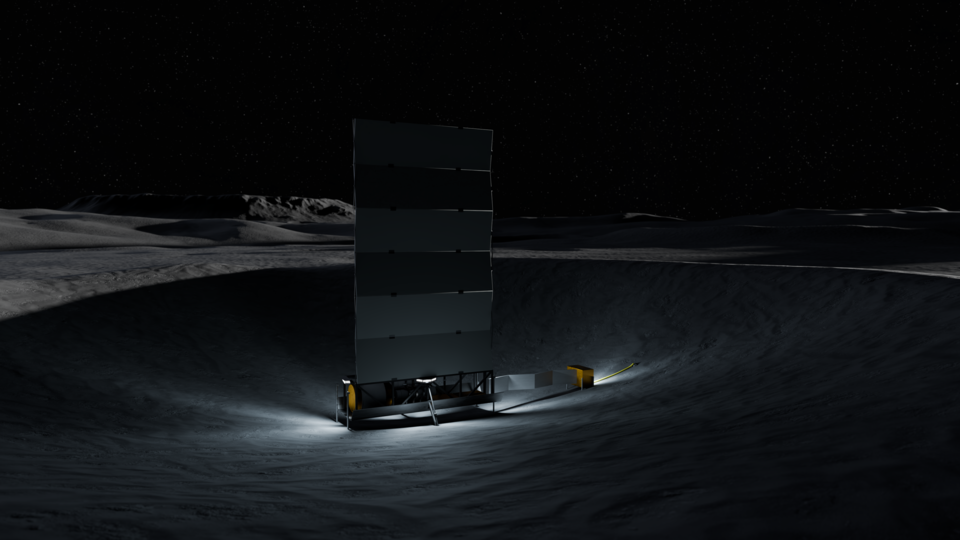
Powering any future lunar base is a massive engineering challenge. The two-week lunar night can drain batteries charged by solar panels during the two-week day, if the batteries themselves can even withstand the freezing temperatures that go along with it. So, for decades at this point, engineers have planned to use a nuclear reactor to at least partially power any future human settlement on the Moon. A new paper from researchers at Los Alamos, NASA Glenn, Oak Ridge, Idaho National Lab, and Lockheed Martin, and presented at the American Nuclear Society’s Nuclear and Emerging Technologies for Space (NETS) conference back in April, offers a simple solution to one major problem for any such future nuclear reactor - shielding. Currently, space-based nuclear power is advancing under a NASA program known as the Space Power and Reactor Capabilities (SPARC) program. One crucial constraint in this plan to build a 40-kilowatt nuclear reactor on the Moon is its weight limit. Any system has to be under 6,000 kg in order to fit on a mobile rover on the lunar surface. That’s not a lot of weight to work with for a nuclear reactor, especially one of that size. And in addition to being one of the most important health and safety parts of a reactor, shielding is also one of the heaviest. To lower the weight of their systems, space reactor designers have historically relied on directional “shadow shields.” Instead of encompassing an entire reactor with an absorbent material like lead or concrete, they use lightweight hydrogen-rich materials like lithium hydride combined with dense metal positioned in a specific direction to protect highly sensitive parts of the reactor itself, such as the control electronics. Fraser talks in detail about the Kilopower reactor. Directional shields mean the rest of the area around the reactor is left unprotected, which isn’t great if part of that area is zoned for human habitation. Even 1 km away from the reactor site, the amount of radiation if left unprotected would be deadly. But bringing up even more shielding from Earth to protect any such habitation zone is extraordinarily expensive. To solve this problem, the research team, led by Los Alamos researcher Alex Levinsky, turned to a simple solution – use natural lunar terrain—like a crater depression or a dirt hill—to block the direct line of sight, and thereby most of the radiation from reaching the habitation area. Since building a mockup lunar nuclear reactor and procuring hundreds of tons of lunar regolith presumably wasn’t in the budget for this research, the team turned to computer simulations instead. They used a software called Monte Carlo N-Particle to simulate millions of subatomic particles emanating from the nuclear reactor core. Placing it 1.5 m off the ground allowed them to simulate its positioning on the back of a wheeled rover. They then started modeling what different kinds of barricades would look like between the reactor and the habitation space. Fraser talks about lunar base site selection and why it needs a fission reactor. First, their simulations focused on arbitrary landscapes, such as a three-meter-deep crater or a gently sloping three-meter-high dirt hill. Both effectively blocked almost all of the radiation coming from the reactor, knocking it down to roughly one-tenth of a rem per year—about fifty times lower than the five-rem-per-year limit set for reactor radiation above the Moon's natural background. With that success in mind, the next task was to model an actual environment. The research team chose Connecting Ridge, a mountain ridge near Shackleton Crater at the Lunar South Pole. This is an ideal site for future crewed missions, as it combines two of the most sought-after features of the lunar landscape. Some of the ridges are in almost permanent sunlight, being lit 80-90% of the time, while also being right next to Permanently Shadowed Regions that never see the Sun at all and are home to deposits of water ice that is crucial to life support and rocketry in any future permanent colony. When placing the reactor in this environment, the research team made sure to respect the limitations of the rover (no slopes more than 18 degrees), but managed to find a natural depression that could be separated from a simulated base camp by a 120-m-high crater wall. With that barrier in place, the radiation hitting the habitat from the reactor dropped to near zero—only about four-hundredths of a rem per year—allowing the reactor's onboard shadow shield to focus solely on protecting nearby electronics. Fraser talks about finding water ice in the Moon's Permanently Shadowed Craters. One nice feature about the airless Moon in this context is the engineers don’t have to deal with “skyshine” – a phenomenon where radiation shot into the sky bounces off air particles there and bounces back down onto the habitat. Since the Moon has no atmosphere, there is nothing for the radiation to bounce off of, solving one of the problems with reactors on Earth. However, there is one major catch. While placing regolith between the reactor and the habitat protects the habitat itself, inside the crater or operational space of the reactor is a death zone. Astronauts would immediately develop radiation poisoning if entering the area while the reactor is in operation. And since regolith actually reflects neutrons pretty well, many of those neutrons are reflected directly into space, meaning no spacecraft or landers could fly directly over it. So while we might be able to save thousands of kilograms of launch cost by building our own radiation shields on the Moon, we might also create a no-fly exclusion zone on one particular part of the Moon, just to ensure that astronauts have light and heat during the long, cold lunar nights. That is likely a tradeoff many space enthusiasts will be willing to make. And this study will bring the dream of reliable, continuous nuclear power on our nearest celestial neighbor one step closer to reality. Learn More: A. Levinsky et al - Impact of Terrain on Doses for Fission Surface Power UT - A 1,000°C Lunar Microreactor Could Power the Next Era of Moon Bases UT - NASA is One Step Closer to Deploying Fission Reactors on the Moon UT - NASA Funds the Development of a Nuclear Reactor on the Moon That Would Last for 10 Years
Using Lunar Craters as Free Radiation Shields for Moon Base Nuclear Reactors
Full Article
Original Source
Read the full article at Universetoday →KhanList aggregates and links to publicly available news content. We do not host full articles from third-party sources. Always verify important information with original sources.