
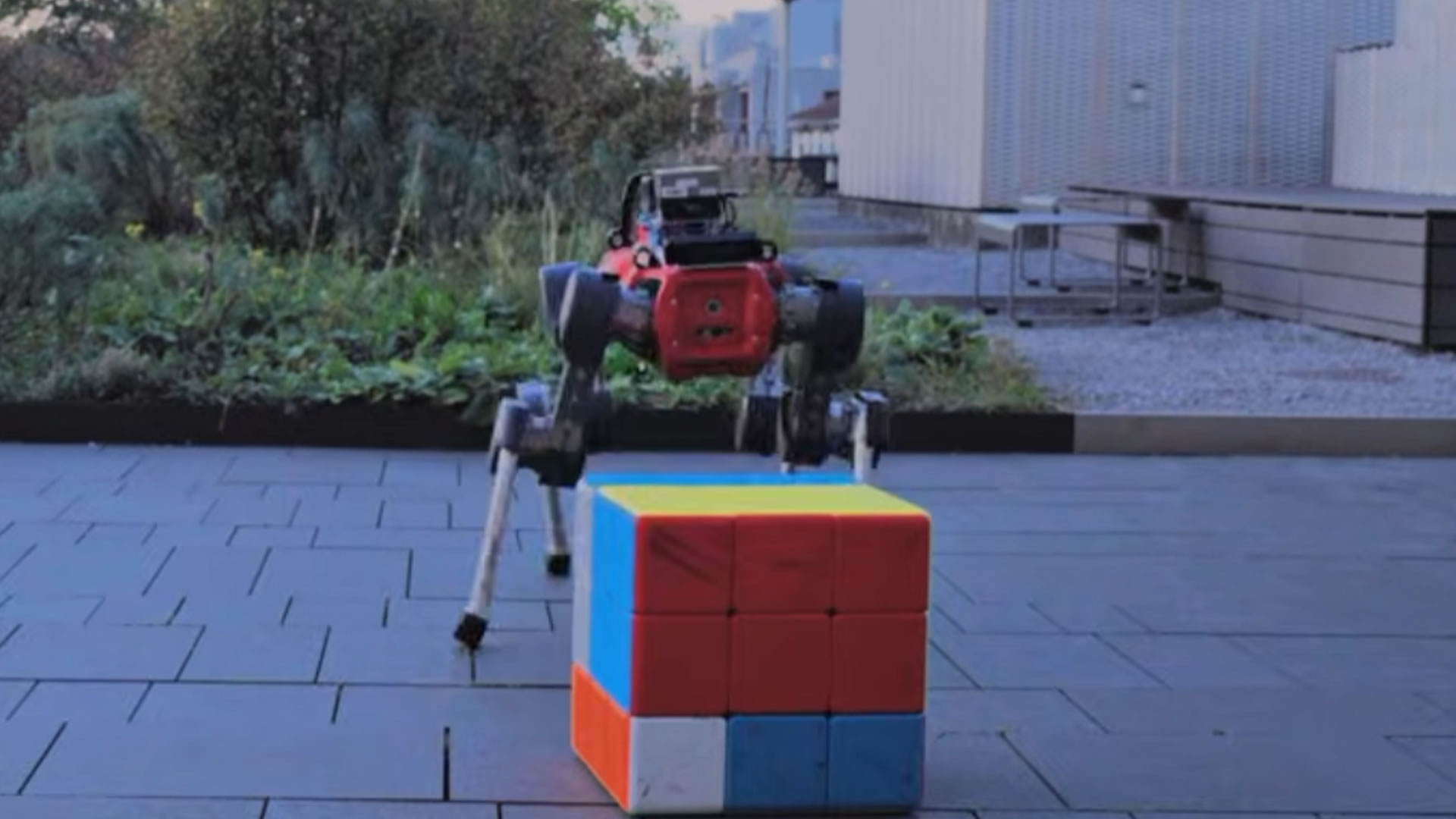
ETH Zurich’s Robotic Systems Lab has showcased its ANYmal-D solving a giant Rubik’s Cube entirely on its own. While not unprecedented for a robot, what makes this feat interesting is that the robot achieved this using its legs while maintaining balance. Technically called pedipulation (manipulating objects with feet), the team managed this using a combination of classical algorithms, computer vision, and reinforcement learning. Solving a Rubik’s Cube requires several separate tasks. The first is to understand the starting state of the cube by examining all six faces to see which colors are where. The next is to plan how to solve it mathematically or, in other words, you need to figure out the sequence of rotations needed. Depending on your knowledge level, this can include executing basic “algorithms” to run through the classic “white cross,” “white corners”, “middle layer,” “yellow cross,” etc or faster methods. But all stages require physical manipulation of the cube to complete each move. Especially in a way that doesn’t accidentally move the wrong pieces. Solving a Rubik’s Cube with legs For humans, this is usually the easiest part of the process, but for something like a four-legged robot it can be extremely challenging. Since it lacks hands, it needs to move layers and flip the entire cube, all using its legs while maintaining its balance. To achieve this, ANYmal had to balance on its remaining legs, precisely position its feet, apply the correct forces, and continuously adjust for what happens when it touches the cube. For this particular enterprise, the cube itself weighed in at around 10 pounds (4.6 kg). To successfully complete just one move, the robot needs to ensure the bottom layer doesn’t move, while also applying enough torque to move the desired layer. And, critically, it must do this repeatedly and not fall over. One accidental move could ruin the attempt, requiring a correction at best, and a possible restart at worst. According to the team, this was achieved through a combination of reinforcement learning, simulation, and “teacher–student training.” So, instead of hard-coding instructions for its limbs, the robot was able to learn “muscle memory” through trial and error. But that is only part of the challenge; just moving the cube around won’t necessarily solve it. For this part, the team gave the robot something called Kociemba’s solver to figure out what moves are needed. A combination of computer vision, color classification, and the algorithm is then used to work out the sequence. Potential industrial applications This was then used to tell the robot’s limbs what moves to make, all the while monitoring the cube’s state to check and correct for errors. And the result? According to the team, the robot was able to solve 3 out of 3 attempted solves. Each solve took between 8 and 9 minutes to complete, requiring about 30 separate robotic actions. Not bad, especially for a robot that has no hands. But what, if any, are the wider implications for this research? Well, it shows that robots can be taught to use tools they already have in more unconventional ways to solve problems. It could, for example, enable a robot to open doors, manipulate valves, move obstructions, etc., using its legs instead of requiring specialist tools to be installed. That could translate into simpler, lighter, and potentially cheaper robots in the future. That could eventually be valuable in industrial inspection, maintenance, search and rescue, and other environments where a robot needs to do more than move around. Get the latest in engineering, tech, space & science - delivered daily to your inbox.Christopher graduated from Cardiff University in 2004 with a Masters Degree in Geology. Since then, he has worked exclusively within the Built Environment, Occupational Health and Safety and Environmental Consultancy industries. He is a qualified and accredited Energy Consultant, Green Deal Assessor and Practitioner member of IEMA. Chris’s main interests range from Science and Engineering, Military and Ancient History to Politics and Philosophy.
Watch: Four-legged robot solves giant Rubik’s Cube without using hands
Full Article
Original Source
Read the full article at Interestingengineering →KhanList aggregates and links to publicly available news content. We do not host full articles from third-party sources. Always verify important information with original sources.