
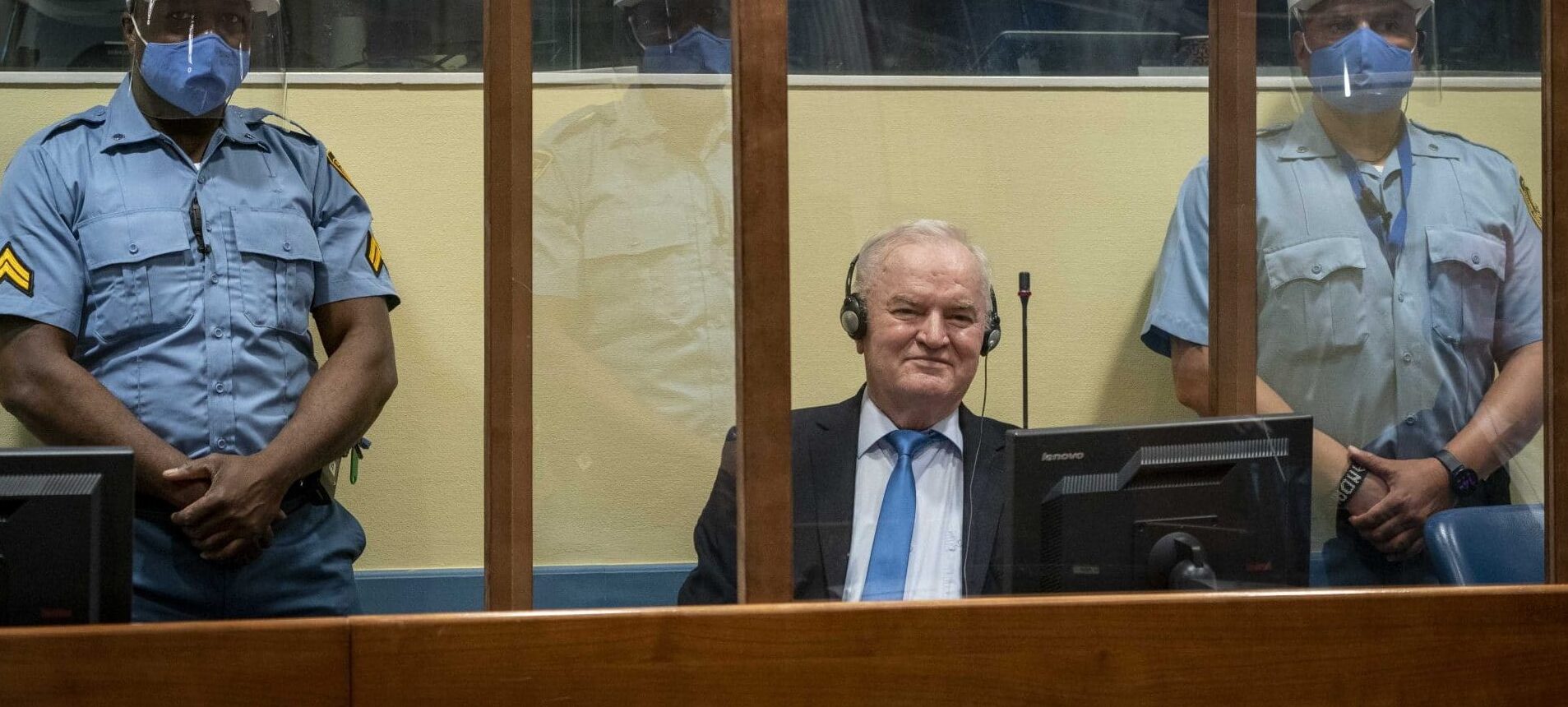
Bosniak survivors of the crimes committed by the Bosnian Serb genocide convict said he died where he belonged, in prison – but Serbian nationalists and pro-government media in Belgrade mourned his death and blamed the Hague court. After news broke on Thursday that Ratko Mladic had died at the UN Detention Unit in The Hague, reactions in media and social networks highlighted continuing divisions across the region – some condemning the wartime Bosnian Serb general’s crimes, others praising his legacy. The reactions differed sharply in media coverage from Serbia, where Mladic is portrayed by some as a Serb military hero, and Bosnia and Herzegovina, where he is seen by Bosniaks and others as a war criminal and the mastermind of the Srebrenica genocide. In Serbia, this divide was further reinforced by the stance of pro-government media outlets, which glorified Mladic’s wartime role while emphasising efforts by the Serbian authorities to secure his release and bring him to Belgrade when he was seriously ill and about to die. In contrast, some opposition politicians have spoken of his death as the passing of a convicted war criminal. When he died, 84-year-old Mladic was serving a life sentence for committing genocide, crimes against humanity and war crimes during the 1992-95 war in Bosnia and Herzegovina. He has suffered severe health problems for several years and was being treated by medics at the UN Detention Unit. Serbian pro-government media amplified claims by nationalist politicians that Mladic was “killed” by the UN court in The Hague because he was not brought to Belgrade for medical care, as his lawyers had repeatedly requested. “From Gavrilo Princip to Ratko Mladic, the best Serbs are killed while bound,” declared Aleksandar Vulin, former Serbian Interior Minister and ex-head of the Security Intelligence Agency. Vulin argued that “the Serbian state owes convicted war criminal Ratko Mladic a state and military funeral, as well as a day of mourning”, Bosnian news agency SRNA reported. Vojislav Seselj, leader of the far-right Serbian Radical Party, also convicted of wartime crimes by the UN court, said that Mladic had long been battling a serious illness and the Hague “villains” had not provided him with proper medical treatment for several years. Serbia’s public broadcaster RTS and pro-government media outlets highlighted how Serbian President Aleksandar Vucic had appealed to the court the previous week to release Mladic and allow him to come to Serbia. “I do not understand why they would not allow someone to spend their final days outside a prison cell. But am I particularly surprised? No,” Vucic said at the time, as reported by Informer, one of Serbia’s main pro-government tabloids. Informer’s high-profile editor-in-chief, Dragan Vucicevic, said that “the real news today should not be that Ratko Mladic has died, but that he was killed in The Hague Tribunal”. “That is a terrorist organisation whose aim is to convict Serbs of genocide, and now it has killed a general,” Vucicevic said. Milorad Dodik, leader of the Alliance of Independent Social Democrats, SNSD and former president of Bosnia’s Serb-dominated Republika Srpska entity, also described Mladic’s death as murder. “This really is a killing, because everything pointed to his poor state of health, and this was an organised approach that was intended to lead to a fatal outcome,” Dodik said, according to Republika Srpska’s public broadcaster RTRS. No mourning from survivors Graves prepared for burials at the Srebrenica Memorial Centre before the July 11 mass funeral. Photo: BIRN. From Bosniaks and from survivors of Mladic’s bloody campaigns, calls came for an end to the denial of his crimes, a phenomenon that remains widespread in Serbia and Republika Srpska and was again highlighted by the media coverage of his death. Camil Durakovic, the former mayor of Srebrenica and current vice-president of Republika Srpska, who managed to flee the Srebrenica genocide on foot in 1995, noted that Mladic outlived his victims by decades. “More than anything, we feel the bitterness that he lived to such an advanced age while thousands of others, unfortunately, did not,” Durakovic said. Munira Subasic of the Mothers of Srebrenica association, another survivor of wartime atrocity, said that mothers of genocide victims are “still carrying the pain in our souls … we are still listening to denials, we are still listening to how Ratko Mladic was a hero for the Serbs”, The Guardian reported. The Bosnia-based Association of Genocide Victims and Witnesses insisted that Mladic “cannot be discussed outside the context of the crimes for which he was finally convicted. “Behind his name remain thousands of people who were killed, expelled, detained, and tortured; destroyed cities and villages; the siege of Sarajevo; the systematic persecution of the non-Serb population; and, above all, the genocide in Srebrenica, in which more than 8,000 Bosniak men and boys were killed,” the association said. Its words were echoed by Ramo Isak, Interior Minister of Bosnia and Herzegovina’s Federation entity, who said that war crimes deniers will not be able to erase the Hague Tribunal’s judgment on Mladic. “Neither propaganda from Belgrade, nor the glorification of criminals in the Republika Srpska entity, nor murals, songs, rallies and falsification of the past can overcome the final verdicts of international courts and the facts established before the entire world,” Isak said. Serbian leftists contest nationalist narrative A flag depicting Ratko Mladic is raised by his supporters during a vigil to mark the 28th anniversary of the Srebrenica genocide in Belgrade, July 2023. Photo: EPA/ANDREJ CUKIC In the Serbian parliament when the news broke of Mladic’s death, Marina Ragus, an MP from the ruling Serbian Progressive Party who was chairing the parliamentary session at the time, said the Belgrade authorities tried hard to aid the convicted war criminal. “Citizens of Serbia should know that the Serbian state made every possible effort, particularly through the Ministry of Justice, to ensure that Mladic could spend his final days, given that he was in the terminal stage of his illness, receiving palliative care here,” Ragus said. But representatives of the left-wing opposition, a small minority in parliament, highlighted the crimes that Mladic committed. “Convicted war criminal Ratko Mladiv has died,” Aleksandar Radovanovic, general secretary of the opposition Movement of Free Citizens, wrote on X. “He was sentenced to life imprisonment for crimes against humanity, including genocide in Srebrenica. This is the only correct way to write the lead of today’s news,” Radovanovic added. The opposition Green-Left Front said in a statement that “the death of Ratko Mladic does not bring an end to the question of responsibility for the crimes committed; rather, there remains a lasting obligation to ensure that the truth about the genocide in Srebrenica and other war crimes is never forgotten or relativised”. “Instead of paying tribute, the Green-Left Front calls on state institutions to prevent any attempt to glorify a convicted war criminal in the public sphere and expresses full solidarity with the families of the victims, who, unlike Mladic, have been denied justice and dignity for decades.”
War Criminal or ‘Serb Hero’: Reactions to Ratko Mladic’s Death Reflect Balkan Divisions
Full Article
Original Source
Read the full article at Balkaninsight →KhanList aggregates and links to publicly available news content. We do not host full articles from third-party sources. Always verify important information with original sources.