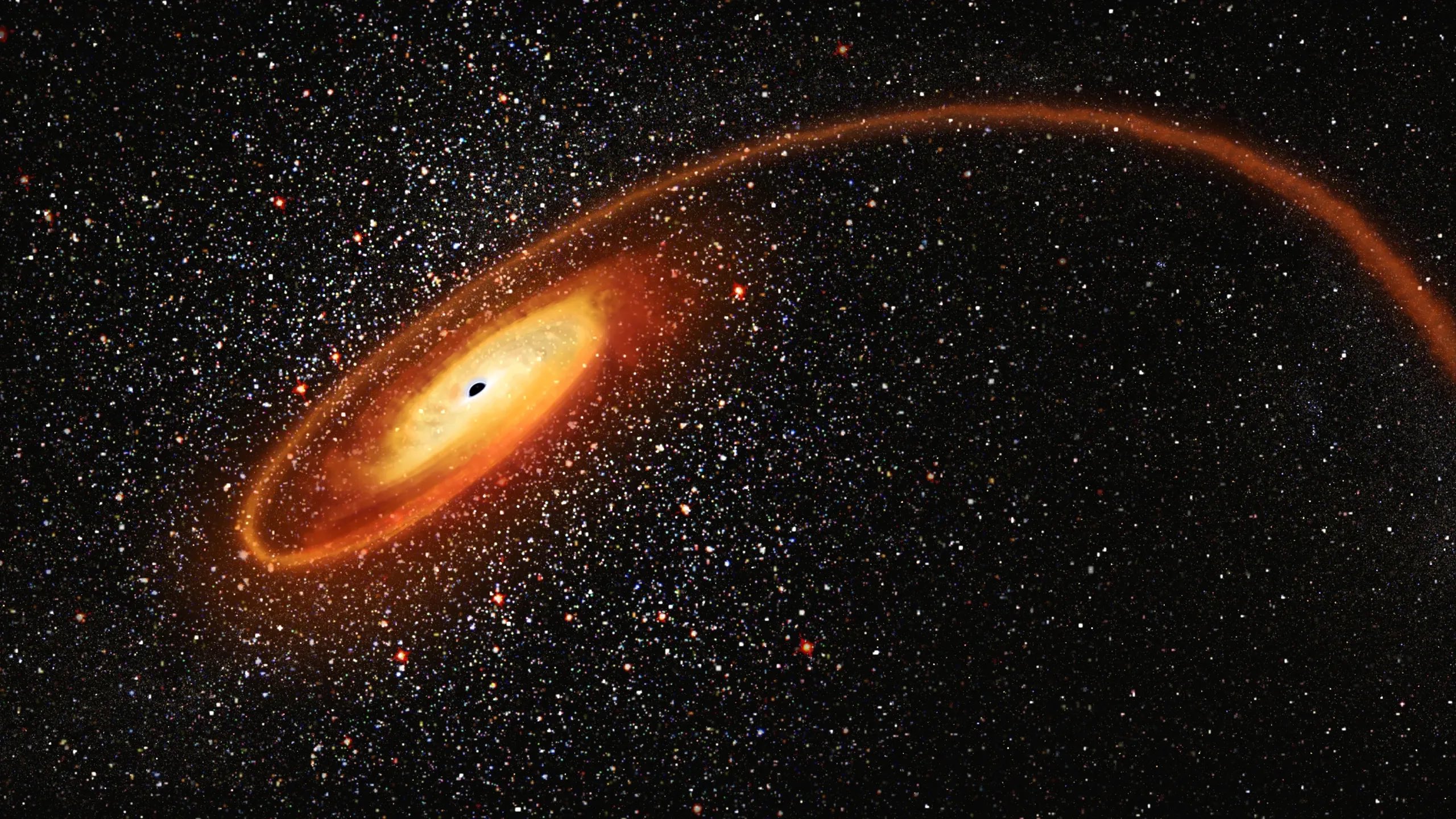
Astronomers have long thought supermassive black holes can escape their home galaxies — now they’ve found one roaming its host’s galactic outskirts. This illustration depicts a tidal disruption event. A similar event might have lit up an otherwise unassuming supermassive black hole lurking in a distant galaxy's outskirts.NASA / ESA / D. Player (STScI) Supermassive black holes, millions or billions of times heavier than our Sun, normally rest firmly at the centers of galaxies. Bound by the gravitational potential of their surroundings, these monsters remain invisible unless they swallow a gas cloud or a star. But not all seem to have settled down: Some wander solo, while others seem to run away from their galactic homes at incredibly velocities. In a paper to appear in Astrophysical Journal Letters, Robert Stein (University of Maryland) and his colleagues report an unusual tidal disruption event (TDE). TDEs are outbursts of energy following a black hole’s destruction of a passing star or gas cloud. They’re picked up regularly by the Zwicky Transient Facility (ZTF) at Palomar Observatory in California, whose two telescopes scan the northern sky every two days for such transient events. Although at first glance TDEs appear to resemble supernovae or flickering active galactic nuclei, the way their light changes over time and over different wavelengths reveals their true nature, enabling astronomers to derive the masses of the black holes that caused them. This particular event, TDEabcr, was different, because it did not light up at the center of its galaxy, as most TDEs do, but about 30,000 light-years away from it. That’s roughly the distance between our Sun and the center of the Milky Way. Further analysis showed that the black hole that launched TDEabcr has 4 million solar masses — making it as massive as Sgr A*, the black hole in our galactic center. While the black hole was undetected in an archival image (above), the black hole's recent meal appears as a blue dot in a newer image taken by the ZTF (below).Stein et al. / arXiv: 2602.10180 Before the detection in November 2025, the black hole seems to have been completely quiet. Archival images don’t reveal any emission at its position or evidence of a second galaxy around it. “You would not have suspected a black hole was hiding there,” Stein says. Apparently, such sizable black holes can roam around unseen in galactic outskirts. “This is a novel result,” stresses team member Suvi Gezari (also University of Maryland). Astronomers have detected a few similar off-center TDEs in recent years, but these occurred either much closer to the cores of their galaxies, or inside much smaller satellite galaxies. Doubts remained whether they were caused by true solo black holes. Stein, Gezari, and their team thus developed a machine-learning algorithm to look for farther-out TDEs, applying it to ZTF data in August 2025. “We weren't really sure we would be successful so quickly, it's amazing that we found one so fast,” Stein says. There are several ways supermassive black holes can end up alone. Most of them are connected to the fact that galaxies grow by merging with other galaxies. These mergers may tear smaller galaxies into tidal streams of stars hundreds of thousands of light-years long, leaving their black hole by itself. The researchers think that’s what happened here: Stripped of its former host, the black hole ended up orbiting its new, larger host galaxy. Some stars remain close enough to be swallowed though, one of which caused the TDE. Another, even more massive black hole probably rests at the galaxy’s core. Usually, when larger galaxies merge, their black holes do, too, at least theoretically speaking. Studies as early as the 1970s showed that the resulting, larger black hole can experience significant recoil — especially when the masses, rotational speeds, and axes of rotation of the involved partners differ greatly. The recoil can fling the merged supermassive black hole out of the galaxy altogether. This was most probably not the case with TDEabcr: The black hole is still relatively close to its galaxy and seems not to move significantly different than its host. This Hubble Space Telescope image shows a galaxy (blob at top right) and an emerging streak of light (which extends toward lower left). The researchers speculate that a runaway black hole at the head of this streak created shock waves that prompted new stars to form in its wake. Pieter van Dokkum et al. / Astrophysical Journal Letters 2023 But in 2023, another team, led by Pieter van Dokkum (Yale University), found a candidate for such a runaway (which they called “runaway black hole 1”, or RBH-1 for short). RBH-1 did not reveal itself by a TDE. The team instead found it in images taken by the Hubble Space Telescope, hiding at the tip of a 200,000-light-years long cloud of star-forming gas. That elongated cloud of gas and stars emerges from the center of a dwarf galaxy and itself has the mass of at least 10 million Suns. According van Dokkum’s group, the black hole is sweeping up and compressing gas, forming the star-lined cloud, as it races away from its former home at about 1,000 kilometers per second (2.2 million miles per hour). This spectacular interpretation wasn’t universally shared, though. Another group argued that what appears to be an elongated cloud of gas and stars might actually be a spiral galaxy seen edge-on. Now, with James Webb Space Telescope (JWST) data in hand, van Dokkum’s team says they’ve ruled out that possibility. “With the JWST, we discovered the huge displacement of the gas at the tip of the wake, where the black hole is pushing against it,” van Dokkum says. “The shock signatures are crystal clear, and there is just no doubt about what is happening here.” The James Webb Space Telescope captured emission from both energized hydrogen and ionized oxygen atoms at the head of the line of gas and stars. Van Dokkum and team argue that the appearance is that of a bow shock (outlined in black), like the wake around the front of a boat. If this is a rogue black hole, it's speeding through space, compressing gas in front of it to form the shock.van Dokkum et al. / Astrophysical Journal Letters 2026 “The relation between the two black holes is that in both cases we are left with a massive black hole in ‘empty space’ — which is very cool,” van Dokkum adds. Such wandering and runaway supermassive black holes may ultimately teach us about galaxies and their mergers. That’s why both teams plan to find more of them, applying their respective techniques: Stein’s group wants to pick up more and further-off-center TDEs with the Vera C. Rubin Observatory, which just began its 10-year “movie” of the sky. Meanwhile, Van Dokkum’s team is counting on the Nancy Grace Roman Space Telescope, scheduled for launch later this year, to discover other high-speed runaways and the extensive clouds of gas they sweep up.
Wandering Supermassive Black Hole Found at the Edge of its Galaxy
Full Article
Original Source
Read the full article at Skyandtelescope →KhanList aggregates and links to publicly available news content. We do not host full articles from third-party sources. Always verify important information with original sources.