
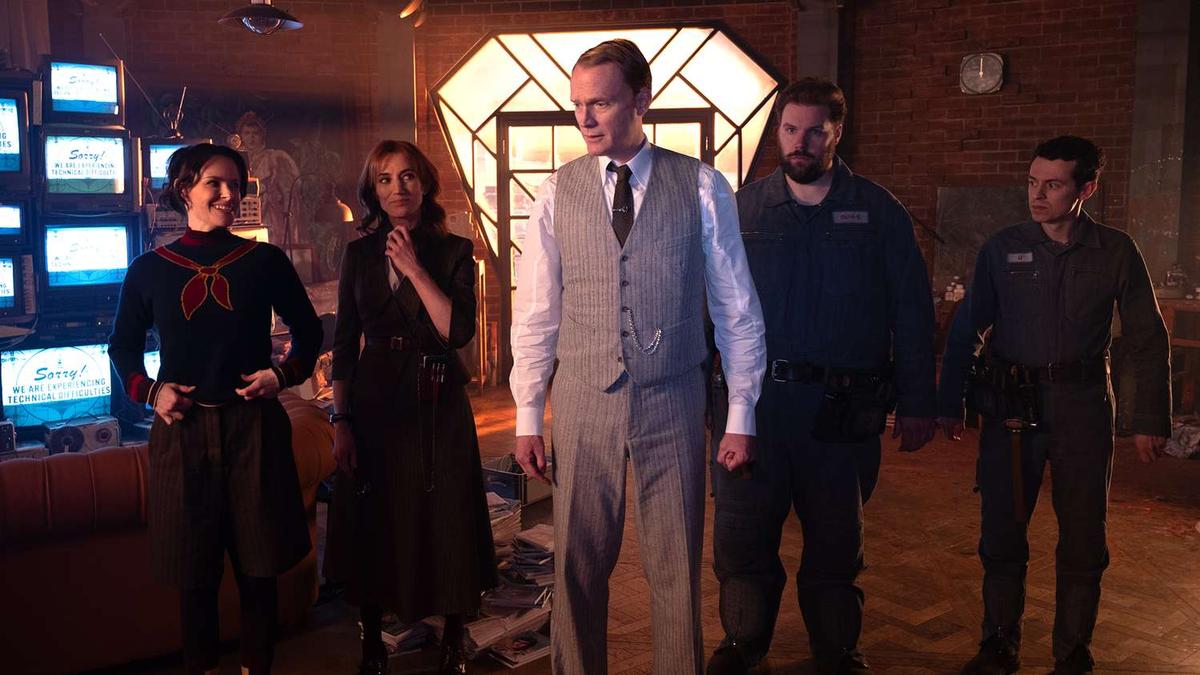
We are on the cusp of one of the year’s greatest cinematic experiences, a saga-defining, climactic spectacle of stupendous proportions, featuring a stellar ensemble cast and visual effects that promise to be nothing short of extraordinary. There is also Avengers: Doomsday, which happens to be releasing on the very same date. That a Marvel series about a synthezoid contemplating his humanity should prove a more intellectually stimulating companion to Frank Herbert’s meditations on artificial life than the MCU’s own impending apocalypse is a fitting bit of happenstance, all things considered. Irrespective of what comes next, this is one of the better produced Marvel projects we’ve had in a while.Created by Terry Matalas for Disney+, VisionQuest is the third and concluding instalment of the television trilogy, inaugurated by WandaVision (2021) and continued through Agatha All Along (2024). The eighteenth MCU television series, produced under the Marvel Television banner, follows White Vision (Paul Bettany), the reconstructed synthezoid last seen departing the events of WandaVision, as he attempts to reconcile his inherited memories with an elusive sense of identity. His journey takes him to an Edinburgh pub to lead a simple life, though much of his time is spent in his sprawling internal mind palace populated by other sentient AI, before an encounter with a mysterious teenager potentially connected to his former family sends him fleeing from a determined bounty hunter.The inhabitants of Vision’s cranial condominium are an assortment of former Stark Industries’ AI personalities, each given an idiosyncratic human avatar. James D’Arcy’s J.A.R.V.I.S. is the prim, paternal elder sibling; Orla Brady’s F.R.I.D.A.Y. is the measured voice of reason; Emily Hampshire’s E.D.I.T.H. is an exuberantly combustible adventurer; and Henry Lewis and Jonathan Sayer’s D.U.M.-E and U. are the silly Laurel-and-Hardy maintenance act. Outside this virtual household, Ruaridh Mollica plays Thomas Shepherd, a young man whose memories and identity carry residual memories of Vision and Wanda’s deceased son Tommy Maximoff. Lauren Morais is Lisa Molinari, his enterprising partner in petty criminality, while Todd Stashwick’s Paladin is the bounty hunter dispatched to retrieve Vision.VisionQuest (English)Showrunner: Terry MatalasCast: Paul Bettany, James Spader, Ruaridh Mollica, Todd Stashwick, Lauren Morais, Orla Brady, Diane Morgan, Polly Frame, Henry Lewis, Jonathan Sayer, Emily Hampshire, James D’Arcy, Ben Crompton, T’Nia MillerEpisodes: 8Runtime: 50-60 minutesStoryline: A rebooted Vision has been hiding from those who seek to weaponize him. While lying low he consults the AI personas embedded in his programming to find his true meaningThe series’ most consequential casting decision, however, is James Spader’s return as Ultron, making his first substantial appearance in the MCU since Avengers: Age of Ultron (2015). The big bad artificial intelligence has spent the intervening years imprisoned inside Vision’s consciousness, where he has apparently developed an appreciation for art and philosophy. For the majority of the season, Ultron assumes the human form of Spader himself, albeit sporting a prodigious beard that makes him look uncannily like Karl Marx, which is a curious sartorial choice for a machine with genocidal misanthropy (unless Marvel is indulging in the time-honoured Hollywood tradition of equating communism with the systematic annihilation of humanity, of course).Spader, naturally, is magnificent. His languid drawl, surgical sarcasm, and delightfully venomous delivery make even the most pedestrian exchanges an absolute riot. Every time Ultron is allowed to commandeer the screen, the series becomes substantially more interesting. He is simultaneously the funniest, most unsettling, and most intellectually engaging character here, and the show’s greatest asset by a comfortable margin. A still from ‘VisionQuest’ | Photo Credit: Marvel Studios Bettany, meanwhile, has perhaps his most demanding assignment as Vision yet. He must play a being who possesses the memories of an extraordinarily compassionate individual without possessing the emotional experiences that gave those memories meaning. His performance is most effective when Vision’s attempts at rationalising human relationships expose just how much he has yet to understand about them. Hampshire deserves similar recognition. Those who know her exclusively as the comparatively timid Stevie from Schitt’s Creek are in for a considerable surprise. Her E.D.I.T.H. is an irrepressible bundle of enthusiasm, fine-tuned as the former AI companion for the MCU’s resident web-slinger.Matalas is at his most inventive when translating the otherwise abstract mechanics of computer programming into elaborate cinematic flights of fancy. Vision’s mind palace is a perpetually shape-shifting architectural fever dream, with its costumes and interiors adapting to the peculiarities of whatever is transpiring in his head. The technological conceit also gives Matalas ample opportunity to indulge in some shameless wordplay — the show seems constitutionally incapable of leaving a digital pun unspoken.There are, admittedly, stretches when the narrative’s strained efforts to accommodate every MCU connection threaten to overwhelm its more rewarding ideas. Paladin’s pursuit, the Butcherbird mystery, and the various revelations surrounding the Maximoff family sometimes feel contrived. Yet the central relationship between Vision and Ultron consistently rescues the proceedings, while the production’s willingness to experiment with television as a visual medium gives it a welcome formal identity.But what makes VisionQuest genuinely interesting is that beneath the digitised vaudeville lies a surprisingly substantial interrogation of the Frankenstein complex. The question of what creators owe the intelligent beings they manufacture has rarely been more pertinent, and the series approaches it through the uneasy relationship between Ultron and Vision. Both are products of human ingenuity, yet neither can escape the prejudices, anxieties and shortcomings of the intelligence that preceded them. A still from ‘VisionQuest’ | Photo Credit: Marvel Studios There are also some uncomfortable questions of human exceptionalism lurking beneath Ultron’s peculiar intellectual pursuits, though I do suspect that his greatest affliction is simply FOMO. Having been denied participation in the civilisation he once considered beneath him, he has apparently spent his confinement binge-watching television and acquainting himself with humanity’s cultural achievements. His fascination with art, literature and the moving image is more revealing than his homicidal tendencies. Television, after all, is a comprehensive simulacrum of the human experience, compressing centuries of cultural behaviour, emotional contradictions and social rituals into stories that can be consumed from a sofa. Ultron is attempting to understand humanity through its own representations of itself, which raises another amusing question: if a machine can recognise, interpret and appreciate the accumulated expressions of human civilisation, what experience remains exclusively human?The show’s most compelling little allegory is how it treats grief as a computational problem. There are glimmers of Sonny from I, Robot in his pained attempts to reconcile the person he remembers being with the consciousness he has become. He possesses the information necessary to remember love, but cannot reproduce the experience that makes remembering worthwhile. No amount of processing power can resolve that contradiction, and it is a poignant limitation for a machine whose entire existence is predicated on being able to process virtually everything.When I first heard the premise, the prospect of a billion-dollar megacorporation waxing lyrical about the virtues of artificial life amid a fraught cultural conversation about AI, felt spectacularly tone-deaf, if not outright soft-core tech propaganda. Yet, against the odds, VisionQuest manages to tell a genuinely thought-provoking little story about the very questions its corporate parent might be better off not encouraging us to ask. Whether that is reassuring or deeply concerning is another matter altogether.VisionQuest is currently streaming on JioHotstar
‘VisionQuest’ series review: Processing grief.exe in Marvel’s witty existential musings on artificial life
Full Article
Original Source
Read the full article at Thehindu →KhanList aggregates and links to publicly available news content. We do not host full articles from third-party sources. Always verify important information with original sources.