
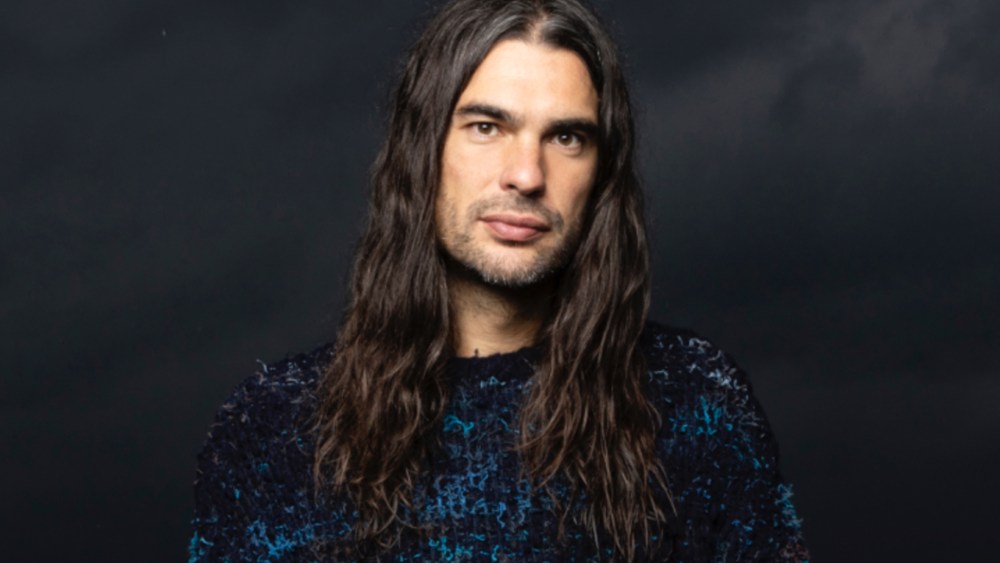
Oscar-nominated Spanish director Oliver Laxe opened up about the fear, vulnerability and self-doubt that undergird his work as a filmmaker, confessing in a deeply personal appearance at the Thessaloniki Film Festival that his career was born in part out of a “need to protect” himself. “Many times I am afraid to express what I truly have inside of me. Sometimes, I end up thinking: ‘You make a film that maybe no one will watch, but you can count on becoming a better person through this process.’ And I take the leap,” he said. “I am a particularly fragile person, and my decision to become a director is to a great extent related with my need to protect myself. The crises we have suffered enable us to comprehend more deeply our inner world. ‘Sirat’ aspired to bring people faced up against death.” Laxe was invited to this year’s Thessaloniki festival to curate a special programming sidebar, “Welcome to the Desert,” selecting 17 films — from the 1930s until the present day — set in the desert, including David Lean’s seven-time Oscar winner “Lawrence of Arabia,” Dennis Hopper’s seminal 1969 road movie “Easy Rider” and a pair of the director’s own films: the 2016 Cannes Critics’ Week prizewinner “Mimosas” and his 2025 dual-Oscar-nominated “Sirat.” Laxe, who won the Thessaloniki Film Festival’s Golden Alexander in 2019 with his Un Certain Regard prize-winning “Fire Will Come,” appeared in conversation with programming head Yorgos Krassakopoulos to talk about his artistic process and the spiritual element running through the tribute program. “The desert is like a mirror. There, you cannot escape yourself, you cannot hide. You are called to confront what you are really made of,” he said. “In our everyday lives, we find ourselves in a state of constant distraction. In the desert you need to be alert, to be present, and that is one of its most enchanting elements in my view.” Reflecting on how the theme of this year’s tribute resonated within his own films, he went on to describe such desert encounters as a kind of journey, drawing on his own deeper need for connection. “I am searching for love. I, too, seek a way to cross the desert. I have wounds,” he said. The director’s fourth feature, “Sirat,” which competed for the Palme d’Or at last year’s Cannes Film Festival, was partly filmed on location in Morocco’s Saraha Desert. Praised by Variety’s Jessica Kiang as “a brilliantly bizarre, cult-ready vision of human psychology tested to its limits,” it follows a father and his son searching for his daughter, who vanished after attending a rave in the desert. That dusty, scorched landscape serves as more than just a backdrop for the film, taking center stage in Laxe’s probing investigation into the human psyche. Speaking in Thessaloniki, the director explained that the belief that nature “possesses a transcendental quality” is essential to his cinematic worldview. “When surrounded by nature, you sense how meaningless you are in contrast with its infinitude. As a film director, I too succumb to arrogance,” he said. “We believe we have the power to change the world, and every once in a while we could use a reminder that we are not in control of everything. “Very often, while shooting, we get frustrated because things do not go as expected,” he continued. “Months later, we rewatch the material and we come to understand that it is beautiful exactly because it is gifted with a touch of the unexpected. Life has its own way to create images, and sometimes you just need to accept it.” A French-born filmmaker, who moved to his parents’ native Galicia as a young boy, Laxe spent a formative period of his life in Morocco, where he also filmed “Mimosas” and the 2010 docufiction “You All Are Captains.” It was an experience that shaped his views on both filmmaking and the world, with Laxe explaining how his encounters with Islamic culture highlighted the need for empathy, and a reexamination of how we observe and represent “the Other” in film. “We, as Western people, suffer from a great deal of guilt, often choosing to handle it by pointing the finger and blaming ‘the Others,’” he said. “We are still amidst a de-colonization process. The best way to observe other people is by placing yourself in their position. You have to be willing to meet them, to forge a bond and accept how this encounter can transform you.” Such transformation, he later added, pointed to the deeply spiritual nature of so much of his work. “To me, film directing is like a prayer,” he said. “It is my way to celebrate life’s complexity, express my gratitude for being alive and feel connected with anything occurring around me.” The Thessaloniki Film Festival runs Nov. 5 – 15.
Oliver Laxe on Overcoming His Fears, Making Films as an Act of ‘Prayer’ and Allowing His ‘Wounds’ to Drive Him to ‘Take the Leap’
Full Article
Original Source
Read the full article at Variety →KhanList aggregates and links to publicly available news content. We do not host full articles from third-party sources. Always verify important information with original sources.