
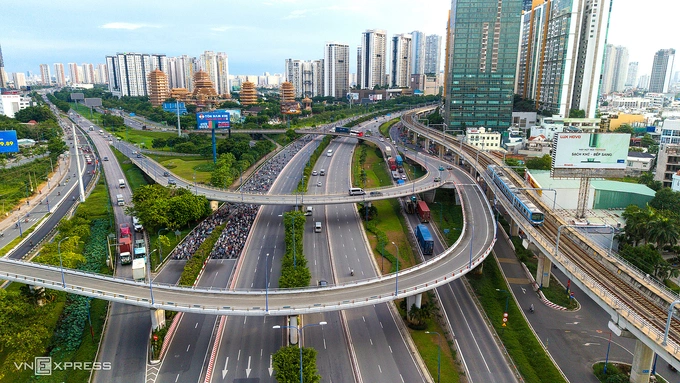
Key interchanges in Ho Chi Minh City, built three to four levels high and paired with underpasses, keep traffic streams from crossing directly, easing congestion on arterial roads linking the city's ports and airport. The Cat Lai T-junction interchange sits on Hanoi Highway in Binh Trung Ward, connecting to Mai Chi Tho Boulevard. The Ben Thanh-Suoi Tien metro line crosses overhead, creating a three-level interchange. It is one of the busiest and most important routes at the city's eastern gateway, linking Ho Chi Minh City with the southeastern provinces and the north. Following the merger with Vung Tau and Binh Duong last year, Ho Chi Minh City now has nearly 12.7 million vehicles, including more than 1.4 million cars and 11.3 million motorbikes, the largest fleet of any locality in the country. Several arterial roads in the center and near the airport and ports carry heavy volumes and require multi-level interchanges to separate traffic streams and reduce congestion. The Cat Lai interchange opened in 2010 with two overpasses carrying left-turning traffic from Cat Lai Port, the country's largest, toward the city center along Nguyen Thi Dinh Street and Mai Chi Tho Boulevard, one overpass carrying left-turning traffic from the former Thu Duc City toward the port, and seven surface branches below. The bridge branches, surface roads and metro line interweave to form a modern traffic network at the city's eastern gateway. About 10 km away, the Tram 2 overpass is another key junction at the eastern gateway. Completed in 2004 at a cost of roughly VND120 billion (US$4.6 million), it connects Hanoi Highway with National Highway 1A for access to the city center or out to Dong Nai City. It was Vietnam's first cloverleaf overpass design, with four loops 420 m in diameter and connecting branches spread across 27 hectares. Two open-top underpasses, an overpass and the metro line stack up to make it a four-level interchange. Also on Hanoi Highway is the Vietnam National University Ho Chi Minh City interchange, completed in 2019. The project runs nearly 2 km and includes one open-top tunnel and three overpasses, stretching from the entrance of Suoi Tien theme park to near the new Mien Dong bus station. The open-top tunnel is more than 1 km long, with eight lanes and an 80 kph speed limit. Above it sit overpasses 17 m wide and 38 m long that allow vehicles to turn around. The metro line crosses overhead, forming a three-level interchange in the university district. The VND3.64 trillion ($138 million) project is part of the wider expansion of Hanoi Highway at the city's eastern gateway. After four years of construction, several components are already in use, including the overpass branch for right-turning traffic from the Long Thanh-Dau Giay Expressway down to Mai Chi Tho Boulevard, two bridge branches linking Mai Chi Tho with Dong Van Cong Street in both directions, and two underpasses on Mai Chi Tho that have helped ease local congestion. Contractors are now concentrating on the section connecting Mai Chi Tho with the expressway and Luong Dinh Cua Street. The full project is scheduled for completion in the third quarter of 2027. About 5 km away, the My Thuy interchange in Cat Lai Ward broke ground in 2016 with total investment of VND3.449 trillion ($131 million) across three phases and remains unfinished. It joins three major corridors, Nguyen Thi Dinh-Dong Van Cong-Vo Chi Cong, part of Ring Road 2, in an area packed with containers moving in and out of Cat Lai Port and prone to frequent jams. The design combines overpasses, underpasses and collector roads to separate container traffic from urban traffic. So far the project has delivered only a handful of components, including the Ky Ha 3 bridge, the left branch of My Thuy 3, an overpass and an underpass built between 2019 and 2021, which have eased congestion on the approach to Cat Lai Port. Phase three broke ground in 2025 and covers the right branch of the Ring Road 2 overpass and the right branch of the Ky Ha 3 bridge, each with four lanes. Both are taking shape but have slipped behind schedule and are now pushed to 2027. Once finished, the interchange will stand four levels high, cutting congestion and accidents in the area and helping meet freight demand at the Cat Lai port cluster. In central Ho Chi Minh City, the Nguyen Huu Canh Street interchange combines a tunnel with a Y-shaped viaduct carrying two branches. The project cost VND1.473 trillion ($56 million) and was completed in 2009. The overpass runs more than 600 m and is about 13 m wide, opening in 2002. The underpass below is roughly 430 m long and 26 m wide with four lanes, opening in 2009. Together they link the city center and the Thu Thiem urban area with the eastern gateway, reducing conflict points and congestion. The overpass runs more than 600 m and is about 13 m wide, opening in 2002. The underpass below is roughly 430 m long and 26 m wide with four lanes, opening in 2009. Together they link the city center and the Thu Thiem urban area with the eastern gateway, reducing conflict points and congestion. The overpass runs more than 600 m and is about 13 m wide, opening in 2002. The underpass below is roughly 430 m long and 26 m wide with four lanes, opening in 2009. Together they link the city center and the Thu Thiem urban area with the eastern gateway, reducing conflict points and congestion. The Tan Van interchange in Di An Ward, costing more than VND1.8 trillion ($68 million), is the largest and most complex structure on Ho Chi Minh City's Ring Road 3, with a three-level design and five overpass branches. Combined with the Tan Van overpass, it will form a three-level junction once complete. The project connects six arterial corridors and is intended to unlock economic movement between Ho Chi Minh City and Dong Nai. As of late August it was about 65% complete, with girders for the main overpass branch already spanning Hanoi Highway and My Phuoc-Tan Van Road. Contractors are accelerating work on the deck and secondary branches to finish by the end of this year.
Vietnam megacity with 11.3 million motorbikes is stacking its roads four levels high
Full Article
Original Source
Read the full article at E →KhanList aggregates and links to publicly available news content. We do not host full articles from third-party sources. Always verify important information with original sources.